Special offers: free digital logo mock-up and free samples against a confirmed LPO. View offers


Inclusive and Diverse Fit: A Uniform Sizing Guide for UAE Workforces

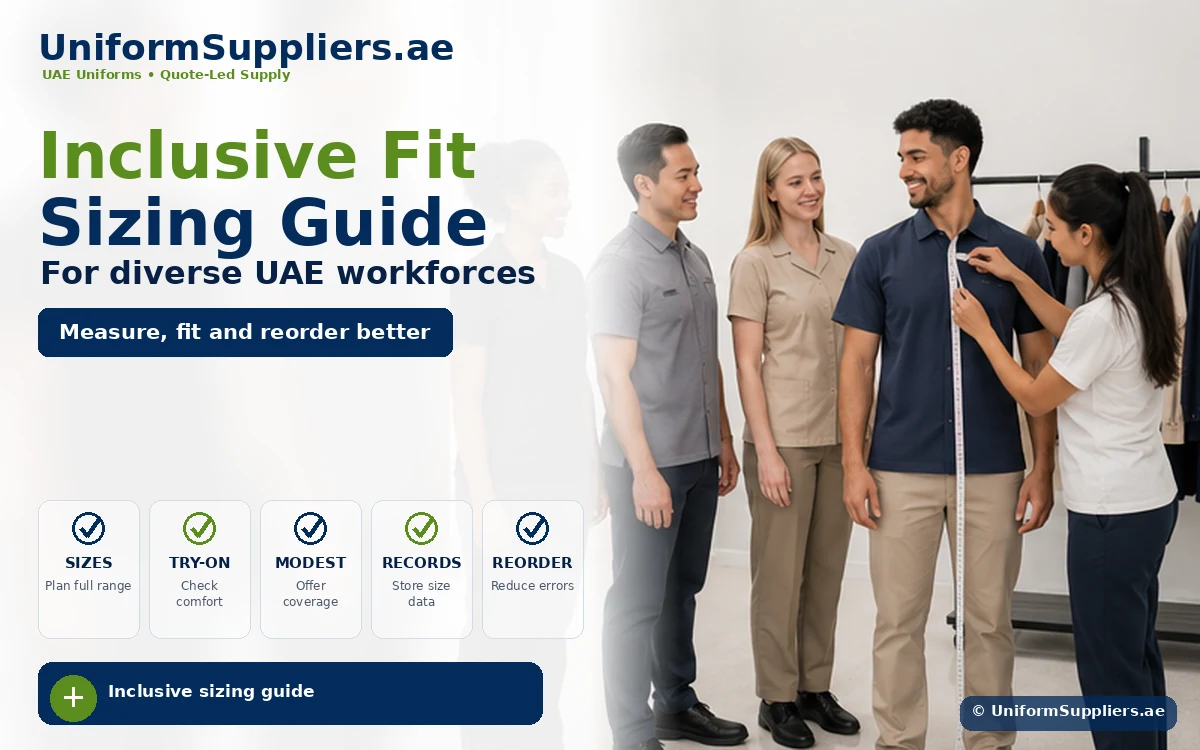
A uniform sizing chart tells you how to measure a person. It doesn’t tell you whether your size range actually fits the people you’re measuring. This guide looks specifically at building an inclusive size range for a diverse UAE workforce — the specification-stage decisions that determine whether your uniform programme fits everyone comfortably, distinct from the measurement technique covered in our uniform sizing chart guide, which this article assumes as a starting point rather than repeats.
Table of Contents
- Why Size Range Is a Specification Decision, Not an Afterthought
- The Reality of a Diverse UAE Workforce
- Gender-Inclusive Cuts and Options
- Extended and Plus-Size Ranges
- Petite and Below-Standard-Range Fit
- Fabric Choice as a Fit Tool
- Comparison: Sizing Approaches
- Checklist: Specifying an Inclusive Size Range
- FAQs
Why Size Range Is a Specification Decision, Not an Afterthought
Most uniform programmes start with a design and a standard size run — commonly XS through XXL in a single, unisex or gender-split cut — and only discover the gaps once garments are issued and some staff are visibly uncomfortable, or worse, unable to find a size that fits at all. Retrofitting a size range after rollout is slower and more expensive than specifying an inclusive range from the outset, and it sends an unintended signal to the staff left waiting for a workable size while their colleagues are already kitted.
Specifying size range is a decision that belongs at the same stage as fabric and colour choice — part of the initial brief to your supplier — rather than something addressed reactively once a standard range proves insufficient.
The Reality of a Diverse UAE Workforce
UAE workplaces are unusually internationally diverse, often drawing staff from dozens of nationalities with genuinely different average body proportions, height ranges and build. A size range calibrated to a single population’s typical proportions will systematically underperform for a workforce this varied. This is one of the most practical, business-relevant reasons to think carefully about size range — it isn’t an abstract inclusivity exercise, it’s a direct response to who’s actually on your team.
This diversity also shows up in less obvious ways than height and chest measurement — proportional differences in torso-to-leg ratio, shoulder width relative to height, and sleeve and trouser length preferences all vary meaningfully across a genuinely international workforce. A supplier used to producing for a single, narrower market may not have graded their patterns to account for this range of proportions, which is worth asking about directly when briefing a new uniform range rather than assuming any supplier’s standard chart will automatically suit your team.
Gender-Inclusive Cuts and Options
A single unisex cut, sized only by chest or waist measurement, often fits no one particularly well — it tends to be cut generously through the shoulders for a traditionally male frame while running long or loose through the torso for others. Offering distinct, well-fitted cuts — rather than one compromise cut in multiple sizes — generally produces a better-fitting uniform for a broader range of body types. Where roles don’t have a strict gender-specific dress requirement, offering staff a choice between cuts, rather than assigning one based on assumption, is worth building into your uniform policy; see our guide on writing a uniform policy for how to document this kind of choice clearly.
Extended and Plus-Size Ranges
Standard supplier size charts frequently stop at a size that excludes a meaningful portion of any real workforce. Confirming an extended size range — both in terms of the numeric range and, importantly, in terms of proportional cut rather than simply scaling up a smaller pattern — should be part of your initial specification conversation with your supplier, not a follow-up request after the first order arrives and doesn’t fit everyone. A pattern that’s simply scaled up from a smaller size often fits poorly at larger sizes, since proportions don’t scale linearly; a properly graded pattern accounts for this.
Petite and Below-Standard-Range Fit
The opposite problem — staff at the smaller end of a size range — is less commonly discussed but equally real, particularly relevant for some roles and nationalities represented in UAE workplaces. Garments that are simply the smallest standard size, rather than genuinely petite-proportioned, can still be oversized through the shoulders, sleeve length or torso. Where this is a recurring issue for your team, raising it explicitly with your supplier, and considering onsite measurement for affected staff, tends to resolve it more reliably than ordering progressively smaller standard sizes and hoping for a better fit.
Fabric Choice as a Fit Tool
Fabric with a small amount of mechanical or added stretch can meaningfully expand how well a limited size range accommodates a diverse team, without requiring an impractically large number of distinct sizes to be held in stock. This isn’t a substitute for a genuinely inclusive size range, but it is a practical lever worth discussing with your supplier, particularly for roles requiring freedom of movement, where a rigid, non-stretch fabric makes an imperfect size fit more noticeable and less comfortable.
Communicating a Size Range Change to Staff
If you’re expanding or revising an existing size range rather than starting fresh, how the change is communicated matters almost as much as the range itself. Framing it as a general uniform update, rather than singling out the specific staff whose fit issues prompted the review, avoids putting anyone in an uncomfortable spotlight. A simple internal note explaining that new sizing and cut options are now available to all staff, with a straightforward process for anyone to request a resize or exchange, tends to work better than a targeted rollout aimed only at previously affected individuals.
Where a resizing exercise follows specific feedback, it’s worth confirming privately with the individuals concerned that their new uniform fits well, rather than assuming the broader range change has automatically resolved their specific issue — a genuinely inclusive range still needs individual confirmation for staff at the edges of it.
Handling Sizing Information Sensitively
Collecting sizing information, particularly for extended or petite ranges, occasionally intersects with topics some staff may feel sensitive about discussing openly. Keeping sizing data collection straightforward, professional and handled by a small number of designated people — rather than something discussed informally in front of colleagues — helps keep the process comfortable for everyone. Our onsite measurement service is typically conducted privately, one team member at a time, for exactly this reason, and the same principle is worth applying to any internal size-collection process you run yourself between supplier measurement sessions.
Comparison: Sizing Approaches
| Approach | Strength | Limitation |
|---|---|---|
| Single unisex cut, standard range | Simple to manage and reorder | Fits fewer people well |
| Gender-split cuts, standard range | Better average fit | May still exclude size extremes |
| Gender-split cuts, extended range | Fits the widest range of staff | More sizes to manage in stock/reorder |
| Standard range + onsite measurement for outliers | Balances practicality and fit | Requires an identified measurement process |
Checklist: Specifying an Inclusive Size Range
- Confirm your actual staff size distribution before finalising a size range, rather than assuming a standard chart will cover it
- Offer distinct, well-fitted cuts rather than one compromise unisex cut where practical
- Confirm extended sizing is properly graded, not simply scaled up from a smaller pattern
- Address petite and below-standard-range fit explicitly if it’s a recurring issue for your team
- Consider fabric with light stretch to improve fit tolerance across a limited size range
- Use onsite measurement for staff who fall outside standard sizing
FAQs
How do we find out if our current uniform range is excluding staff?
A simple internal check — asking supervisors or HR whether any staff have raised fit or comfort issues, or are wearing a visibly ill-fitting size — often surfaces gaps quickly and cheaply, well before a formal review. Our onsite measurement service can also help identify sizing gaps across your team directly.
Does an extended size range cost significantly more?
This varies by garment, fabric and supplier, and depends on how many additional sizes are added and how they’re graded. Final pricing will be confirmed during quotation based on your specific size range and order volume.
Should we offer staff a choice of cut, or assign one based on role?
Where there’s no strict role-based dress requirement, offering a genuine choice tends to produce better fit outcomes and staff comfort than assigning a cut by assumption. This is worth documenting clearly in your uniform policy so the choice is consistently available to every new starter, not just those who happen to ask.
Can stretch fabric fully replace the need for an extended size range?
No — stretch fabric can improve fit tolerance within a range, but it doesn’t substitute for genuinely offering the sizes your workforce needs. We’d recommend treating it as a complement to, not a replacement for, an inclusive size range.
How do we handle sizing sensitively for staff who may be uncomfortable discussing it?
Keep the process private and handled by a small, designated group rather than discussed informally in front of colleagues. Onsite, one-on-one measurement sessions and a straightforward, low-friction resize or exchange process both help keep this comfortable for staff.
Should new hires be measured individually, or fitted from a standard chart?
Where practical, individual measurement at onboarding tends to produce a better first-time fit than issuing a uniform based on a self-reported standard size, particularly for a genuinely diverse team. Our onsite measurement service can be scheduled as part of your onboarding process, ideally before a new hire’s confirmed start date.
Want to review your current size range against your actual workforce? Request a quote and our team will help you specify a uniform range that fits your whole team comfortably, from initial sizing through to reorders.