Special offers: free digital logo mock-up and free samples against a confirmed LPO. View offers


PPE Checklist for UAE Construction Sites

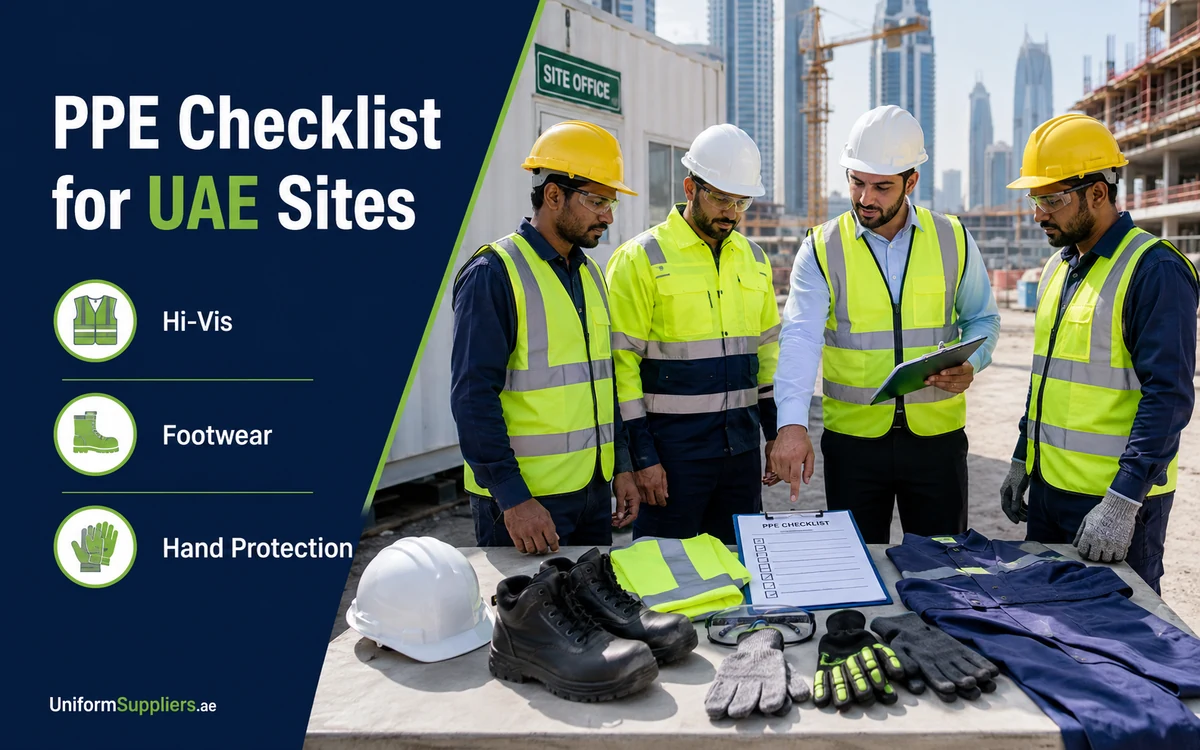
Mobilising a UAE construction site is a logistics problem before it is a safety problem. Crews arrive in waves, often at short notice, in mixed sizes and with mixed language backgrounds, and every one of them must be through the gate in correct kit on day one.
Generic issue lists cause most of the trouble. A single “PPE pack” for everybody leaves the steel fixers short of grip gloves, the scaffolders without a harness plan, and the site team holding boxes of items nobody uses. A per-trade list fixes that, and it also gives the storekeeper something to check against.
This is a kit list and mobilisation checklist, not a hazard-assessment guide. It is general guidance only: PPE selection must be based on the employer’s own risk assessment and on the manufacturer’s certification for the items actually supplied.
What this guide covers
- Why the list should be built by trade
- PPE kit list by trade
- UAE site conditions that change the kit
- Site mobilisation checklist
- Storage, reissue and damaged-item swaps
- Setting up your site kit
- Frequently asked questions
Why the list should be built by trade
Every worker on a live construction site needs a base kit: head, eye, foot, hand and high-visibility protection appropriate to the area they are entering. What sits on top of that base depends entirely on the task, and it is the task-specific layer that gets missed at mobilisation.
Building the list by trade also makes issue and audit far easier. The storekeeper issues against a role, the supervisor inspects against the same role, and the client auditor can see that what was handed out matches what the risk assessment required. Hazard-to-garment selection itself is covered in our complete industrial workwear safety guide, and the employer duty and records framework in what UAE employers must know about PPE.
PPE kit list by trade
Use this as a starting template and adjust it against your own risk assessment and the client HSE plan. Every protective item listed is something you specify and the supplier evidences with a datasheet and certificate for the model supplied.
| Trade or role | Base kit | Task-specific additions | Inspection point before each shift | Typical replacement trigger |
|---|---|---|---|---|
| General labourer | Helmet with chinstrap, safety glasses, hi-vis, safety boots, handling gloves, coverall or two-piece | Dust mask for sweeping and cutting areas, ear protection near plant | Helmet shell and harness, boot soles, tape brightness, glove wear | Torn hi-vis, dulled tape, worn glove palms, cracked boot soles |
| Steel fixer | Helmet, glasses, hi-vis, safety boots, cut-resistant gloves, long-sleeve workwear | Knee protection for tying, arm protection where specified, rebar caps as site rule | Glove cut level intact, no exposed forearms, boot toe condition | Cut or punctured gloves, frayed sleeves, sole penetration damage |
| Scaffolder | Helmet with chinstrap, glasses, hi-vis, safety boots, grip gloves | Full-body harness with correct lanyard, tool tethers, harness-compatible clothing | Harness webbing, stitching, buckles and label date; lanyard energy absorber | Any harness defect, deployed absorber, cut webbing, missing inspection tag |
| Concrete and formwork | Helmet, glasses, hi-vis, safety boots, chemical-resistant gloves | Rubber boots for pours, face shield during pumping, waterproof apron or trousers | Glove integrity, boot condition, eye protection clarity | Cement burn damage, degraded gloves, boots holding water |
| Electrician | Helmet, glasses, hi-vis, safety boots, general gloves | Insulating gloves within test period, arc-rated clothing where the assessment requires it, face shield for live work | Insulating glove test date and air test, no metal accessories, tool insulation | Expired glove test period, any pinhole, damaged insulated tools |
| Welder and hot works | Helmet, glasses, hi-vis, safety boots | Welding helmet with correct shade, flame-resistant workwear, leather gauntlets, spats, fume extraction or respirator | Lens shade and condition, no oil on clothing, glove and sleeve condition | Charred or holed clothing, hardened leather, scratched lens |
| Plant operator | Helmet, glasses, hi-vis, safety boots | Hearing protection, seat-belt discipline, gloves for maintenance tasks | Hearing protector seal and cleanliness, hi-vis visible when out of cab | Perished ear-cup seals, faded hi-vis, damaged boots |
| Banksman or flagman | Helmet, glasses, safety boots, gloves | Highest-visibility garment on site, lamps or batons for night works, radio and pouch | Tape and fluorescent panel condition, lamp charge, garment cleanliness | Dust-greyed fluorescent fabric, lifting tape, failed lamp |
| Surveyor or engineer | Helmet, glasses, hi-vis, safety boots | Sun protection, gloves when handling equipment, dust mask in cutting zones | Boot fit for uneven ground, hi-vis visibility from all sides | Fading, damaged toe protection, broken helmet harness |
| Site visitor | Loan helmet, glasses, hi-vis in a visitor colour, safety boots or overshoes | Escort at all times, hearing protection where required | Cleanliness, correct size, return at gate | Damage, contamination, non-return recorded in the register |
Sizes, colours and technical properties are set by your specification. Final specification will be confirmed during quotation. Footwear deserves its own decision, and is covered in our guide to safety shoes and boots for UAE worksites.
UAE site conditions that change the kit
Summer heat. From May to September, temperatures in the mid-forties with high humidity dominate every kit decision. Breathable base layers, lighter-weight long-sleeve shirts and moisture-managing fabrics keep crews covered without pushing them into heat stress, and schedules built around the midday break need enough sets in circulation so nobody works in a garment that is still wet from the previous shift.
Dust and glare. Fine airborne dust is constant near excavation, cutting and backfill. Eye protection needs to be worn all day, which means it has to be comfortable, anti-fog and available in quantity, because scratched lenses get pushed onto the helmet rather than replaced. Tinted or photochromic options for outdoor roles reduce the temptation to work without them.
Night works and visibility. Where road-adjacent, tunnelling or cooler-hours work runs at night, the visibility class in the specification and the cleanliness of the garment both matter. Dust-greyed fluorescent fabric performs poorly under artificial light long before it looks worn out.
Multi-contractor congestion. On a busy UAE project several subcontractors share the same footprint. Distinct hi-vis colours or clear contractor identification let supervisors see who belongs to which crew, which helps with permit control, exclusion zones and headcount at muster. Agree the colour matrix with the main contractor before you order.
Site mobilisation checklist
Work through this before the first wave arrives, then repeat the relevant steps for each subsequent wave.
- Headcount and size capture. Collect names, trades and sizes before mobilisation, not at the gate. Where crews are already in the country, measuring in one organised session beats guessing; our guide to measuring a team and holding size records covers the method.
- Kit list sign-off. Have the per-trade list approved by the HSE manager and checked against the client HSE plan before purchase, including colours, visibility class and any client-mandated markings.
- Issue register. Record who received what, in which size, on what date, with a signature. This single document answers most audit questions and settles most disputes about replacements.
- Storage and issue point. Set up a lockable, dry, dust-controlled store with the stock organised by trade and size, and name the storekeeper responsible for it.
- Spare and visitor stock. Hold buffer stock in the fast-moving sizes plus a visitor set in a distinct colour, so nobody is sent to work in the wrong kit because the store was empty.
- Damaged-item swap process. Publish a like-for-like swap rule: the damaged item is surrendered, the replacement is recorded against the same worker, and the failed item is destroyed rather than returned to the shelf.
- Multilingual instruction. Provide fitting, wearing and care instruction in the languages your crews actually read, supported by pictograms. Cover it again in the toolbox talk rather than leaving it to induction.
- Documentation on file. Keep supplier datasheets and certificates for each item supplied, the approved kit list, the issue register, inspection records, replacement records and toolbox-talk attendance sheets in one place for client audits.
- Reorder trigger. Agree a minimum stock level per size that triggers a reorder, so resupply starts before the store runs dry.
Storage, reissue and damaged-item swaps
PPE stored badly fails early. In UAE conditions that means keeping stock out of direct sun, off the floor, away from fuel and chemical storage, and in sealed containers where fine dust is constant. Harnesses, insulating gloves and any item with an inspection date need their own controlled shelf with the dates visible.
Reissue is where most registers fall apart. Set the rule early: nothing leaves the store without being recorded, returned items are inspected before they go back on the shelf, and anything soiled, cut, cracked, faded or out of test period is withdrawn. Cleaning matters too, because a hi-vis garment that has lost its brightness is no longer doing its job even though it is intact.
Turnover on construction sites is high, so build demobilisation into the same process. Collect and inspect kit when a worker leaves, record what came back, and only return serviceable items to stock.
Setting up your site kit
Uniform Suppliers UAE, the uniform division of Mustang Advertising Trading LLC, has supplied UAE businesses since October 2007 from a Jebel Ali showroom with production and warehouse operations in Dubai. PPE and safetywear supply sits alongside industrial uniforms and safety workwear and support for construction and engineering projects, with embroidery, printing and badging for contractor identification.
Every protective property is something you specify and the supplier evidences with a certificate and datasheet for the model supplied. Send your per-trade kit list, headcount by size and the client HSE plan, and the requirement can be documented before anything is confirmed. Free digital logo mock-ups and free samples against a confirmed LPO are available, and free onsite individual measurement in the UAE applies to qualifying company orders. Final specification will be confirmed during quotation.
Request a quote with your kit list. If your scope includes hydrocarbon or hot-works exposure, read the companion guide to flame-resistant workwear for oil and gas teams.
Frequently asked questions
How much spare PPE should a site hold?
Enough to cover damage, loss and new starters between resupplies, weighted towards the fast-moving sizes and the items that fail most often, usually gloves, eye protection and hi-vis. Add a visitor set in a distinct colour. Agree a minimum stock level per size that triggers reorder, and review it after the first month of actual consumption.
Should hi-vis colours differ between subcontractors?
On congested multi-contractor sites it helps considerably. Distinct colours or clear contractor identification let supervisors identify crews at a glance, which supports permit control, exclusion zones and muster headcounts. The main contractor usually sets the matrix, so confirm it before ordering rather than after, because garments in the wrong colour cannot be used.
Who inspects PPE, and how often?
The wearer checks their own kit before each shift, the supervisor spot-checks during the shift, and items with an inspection regime such as harnesses and insulating gloves are checked by a competent person on the schedule set by the manufacturer and your procedures. Record the formal inspections; keep the daily checks as a toolbox-talk habit.
What records do client auditors usually ask for?
Typically the approved kit list, supplier datasheets and certificates for the items supplied, the issue register showing who received what and when, inspection and replacement records, and evidence that instruction was given in a language the workforce understands. Keeping all of it in one file makes an audit a short conversation rather than a search.
How should damaged PPE be handled on site?
Swap like for like against the register, surrender the damaged item, and destroy it so it cannot be reissued. Recording the swap against the same worker keeps the register accurate and shows a pattern if one item type is failing repeatedly, which is often a sign the specification needs revisiting rather than the worker being careless.