Special offers: free digital logo mock-up and free samples against a confirmed LPO. View offers


Mechanic and Automotive Workshop Uniforms: A UAE Guide

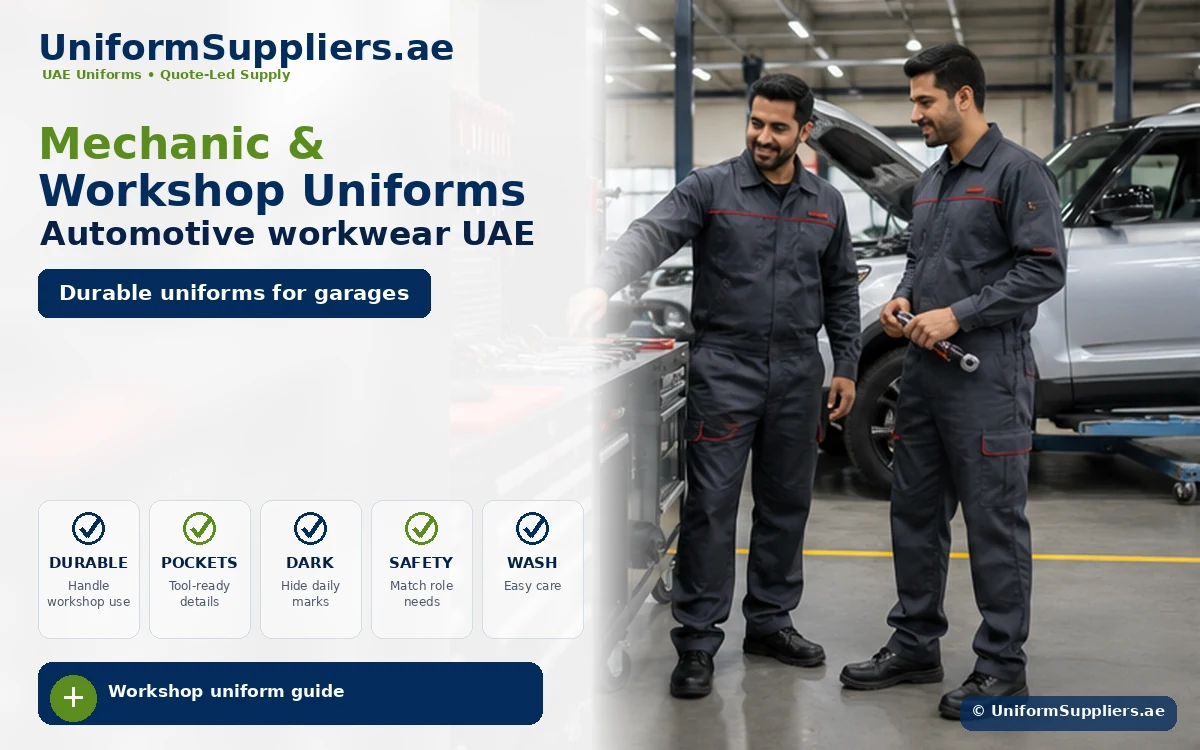
Automotive workshops, dealership service centres and independent garages across the UAE put uniforms through a harder daily test than almost any other sector: engine oil, brake fluid, grease, heat from workshop bays, and constant kneeling and reaching under vehicles. A uniform that looks presentable in a showroom but tears or stains permanently within weeks on the workshop floor is a false economy. This guide covers what actually matters when specifying mechanic and workshop uniforms – fabric durability, stain and oil resistance, practical design details, and how to keep a workshop team looking consistent from the service reception desk through to the bay.
Table of Contents
- Why Workshop Uniforms Are a Different Category
- Fabric and Construction for Oil, Grease and Heat
- Core Garments for a Workshop Team
- Practical Design Details That Matter
- Dressing the Service Reception Team Differently
- Comparing Coveralls, Two-Piece Sets and Polo-and-Trouser Kits
- Staining, Laundering and Replacement Cycles
- A Workshop Uniform Checklist
- FAQs
Why Workshop Uniforms Are a Different Category
General industrial workwear guidance covers hazard mapping and PPE selection at a broad level – see our industrial workwear safety guide – but automotive and mechanical workshops have specific, repeated exposure to petroleum-based fluids that most other industrial settings don’t face daily. A uniform specified for general warehouse or construction use will not necessarily hold up the same way against engine oil and brake fluid, and a fabric that resists one type of staining doesn’t automatically resist another. Workshop uniforms deserve their own specification rather than being treated as a generic coverall order.
Fabric and Construction for Oil, Grease and Heat
A handful of fabric properties consistently separate workshop uniforms that hold up from ones that don’t:
- Poly-cotton blends in the 240-280 GSM range strike the most practical balance for daily workshop wear – heavier than a corporate shirt fabric but not so dense that it traps heat in a warm bay.
- Reinforced stitching at stress points – knees, elbows and the seat – matters more here than in almost any other uniform category, since kneeling and reaching under vehicles puts repeated strain on exactly these areas.
- Darker base colours (navy, charcoal, black) genuinely help here, not as a style preference but because they visibly age better between washes than light grey or khaki, which show oil staining far more obviously even after a successful wash.
- Oil- and stain-resistant finishes can be requested on fabric at the sourcing stage, though it should be made clear to buyers that a resistant finish reduces staining and speeds up cleaning – it does not make a garment stain-proof, and this should never be represented to end customers as a guarantee.
Exact fabric weight, blend ratio and finish should be confirmed during quotation once sample garments are reviewed against the specific fluids and conditions of a given workshop.
Core Garments for a Workshop Team
Coveralls and boilersuits
The most protective option for technicians working directly under vehicles for extended periods, since a one-piece garment eliminates the gap between shirt and trousers that otherwise lets fluid and debris in. Our coveralls and boilersuits guide covers cut, closures and sizing in more depth.
Two-piece work shirt and trouser sets
A practical alternative for technicians who move between the bay and the counter, or for workshops where a full coverall feels excessive for lighter diagnostic and inspection work.
Heavy-duty work aprons
Useful as an additional layer over a base uniform for tasks with a higher splash risk, such as fluid changes, without requiring a full garment change between jobs.
Practical Design Details That Matter
- Reinforced knee panels, ideally with a pocket for a foam knee pad insert, reduce both garment wear and physical strain from kneeling on hard workshop floors.
- Multiple secure pockets sized for common tools (small ratchets, torque pens, phones) reduce loose items being set down and lost around a vehicle or lift.
- Action-back or gusseted shoulders give the reach and overhead movement technicians need without a garment riding up or restricting movement under a raised vehicle.
- Zip or snap closures over buttons on cuffs and pockets reduce the risk of a loose button being lost inside an engine bay or dropped into moving machinery.
Dressing the Service Reception Team Differently
Service advisors and reception staff who greet customers should generally wear a smarter, cleaner-looking uniform than bay technicians – typically a branded polo shirt or corporate shirt with trousers, in the same brand colours but a lighter, less workwear-oriented fabric. Keeping this visual distinction deliberate, rather than accidental, helps customers immediately identify who to approach with a question versus who is mid-task in the bay, and it keeps front-of-house staff comfortable in a role that doesn’t involve the same physical wear.
Comparing Coveralls, Two-Piece Sets and Polo-and-Trouser Kits
| Option | Best For | Protection Level | Comfort in Heat |
|---|---|---|---|
| Coveralls / boilersuit | Technicians under vehicles, heavy fluid work | Highest – full-body coverage | Moderate – can run warm in enclosed bays |
| Two-piece work set | Diagnostics, lighter bay work, mixed roles | Good – separate top/bottom flexibility | Better – easier to layer or shed a top layer |
| Polo shirt and trouser kit | Service reception, front-of-house advisors | Not intended for bay-level protection | Best – lightest standard option |
Staining, Laundering and Replacement Cycles
Workshop uniforms should be laundered on a genuinely different cycle to office uniforms. Pre-treating heavy oil and grease stains before a standard wash, rather than relying on the main wash cycle alone, makes a measurable difference to garment lifespan. Workshops running their own in-house laundering should budget for a shorter realistic garment life than a corporate uniform – heavy daily use and repeated hot washing both shorten fabric life faster than typical office wear – and plan a rolling top-up order rather than treating replacement as a one-off event. Companies wanting a broader view of care routines across all garment categories can also review our uniform care and laundering guide.
Integrating Safety Footwear and PPE
A workshop uniform programme rarely stands alone – it should be planned alongside safety footwear and hand protection rather than specified in isolation. Steel-toe or composite-toe safety shoes are standard for bay technicians given the risk of dropped tools and components, and our guide to choosing safety shoes and boots for UAE worksites covers the selection criteria in detail. Cut-resistant or oil-resistant gloves are similarly worth specifying as part of the same rollout, since hand protection needs vary by task – engine work, tyre changes and parts handling each carry different risks that a single generic glove doesn’t cover well. Treating footwear, gloves and the uniform itself as one coordinated specification, rather than three separate purchasing decisions, tends to produce a more consistent and better-value outcome.
Sizing a Workshop Team
Workshop uniforms are worn over a full shift of physical movement – reaching, crouching, climbing into and out of vehicles – so a size that looks correct standing still can still restrict movement in practice. Ordering true-to-body sizing rather than deliberately oversized “to be safe” is usually the better approach, since overly loose coveralls create their own snagging and entanglement risk around moving parts and tools. Where a workshop has a wide range of body types across its technician team, a short onsite fitting session before the first bulk order – see our onsite measurement service – reduces both reorder rates and on-the-job complaints far more effectively than sizing from a generic chart alone.
A Workshop Uniform Checklist
- Confirm fabric weight and finish against samples exposed to the workshop’s actual fluids, not a generic swatch.
- Specify reinforced knees, elbows and seat stitching as standard, not an optional upgrade.
- Decide coveralls versus two-piece sets by role, not as a single blanket choice for the whole team.
- Plan a visibly different, lighter uniform for service reception and front-of-house staff.
- Set a realistic replacement cycle based on actual wear rather than a standard corporate reorder schedule.
- Brief staff on basic stain pre-treatment to extend garment life between reorders.
Our team can review fabric samples against a workshop’s specific conditions as part of a quote request, or arrange an onsite measurement session for the full technician team.
FAQs
Can workshop uniforms be made genuinely oil-proof?
No fabric finish makes a garment fully oil-proof or stain-proof, and this should never be claimed to a customer. Resistant finishes reduce staining and ease cleaning, but heavy or repeated exposure will still mark a garment over time.
Should every technician wear a full coverall?
Not necessarily. Coveralls suit technicians doing sustained under-vehicle or heavy fluid work, while a two-piece set is often more practical and comfortable for lighter diagnostic or mixed-duty roles.
How often should workshop uniforms be replaced?
Replacement cycles vary by workload and laundering frequency; final recommendations depend on actual wear observed on site rather than a fixed universal figure, and are best confirmed during quotation and follow-up review.
Do service reception staff need the same fabric as bay technicians?
No. Reception and advisor uniforms are usually better specified in a lighter, smarter fabric suited to customer-facing wear, since they are not exposed to the same fluids and physical strain as bay work.
Can our workshop uniforms carry our dealership or brand logo?
Yes, branding can be embroidered or printed depending on the fabric – see our guide to matching branding method to fabric type for guidance on which works best on heavier workwear fabrics.
What colour works best for hiding oil stains between washes?
Darker navy, charcoal and black shades genuinely perform better here than light grey or khaki, since they visibly show residual staining far less even after a successful wash – this is a practical consideration rather than a stain-proof guarantee.
Should knee pads be built into the uniform or issued separately?
Many workshops prefer a reinforced knee panel with an internal pocket that accepts a removable foam pad, since this protects the garment fabric while letting technicians choose the pad thickness that suits them.