Special offers: free digital logo mock-up and free samples against a confirmed LPO. View offers


The Complete Guide to Onsite Uniform Measurement in the UAE

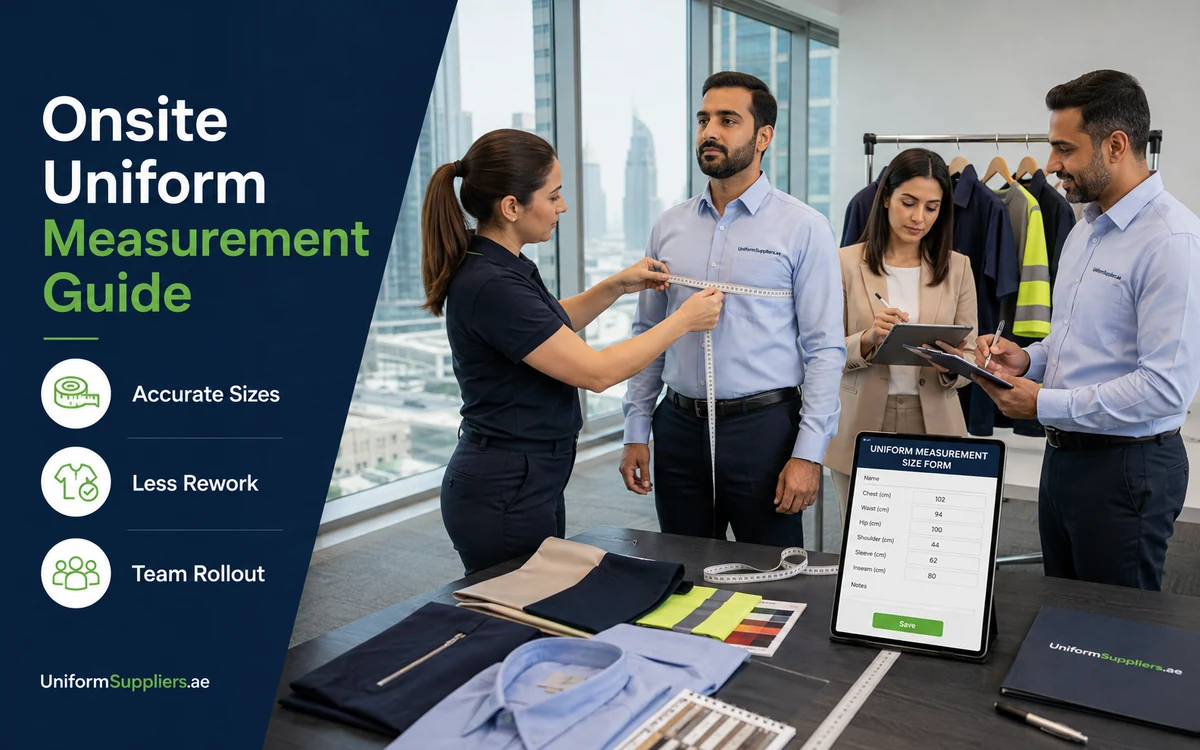
Most uniform programmes in the UAE do not fail on fabric or price. They fail on fit. A spreadsheet of self-declared sizes arrives from ten branch managers, garments are cut against it, and weeks later the HR inbox fills with exchange requests from people who were never measured.
Onsite measurement removes that guesswork by bringing a measurer to the workplace and recording every employee individually. The real question for an HR or operations manager is what the session costs in disruption, and whether the resulting data is worth anything at reorder time.
This guide covers the service and the session itself. For the tape-measure technique, use the companion article on how to measure a team and build a size chart.
What this guide covers
- What onsite uniform measurement actually is
- Is onsite measurement right for your organisation?
- Planning the session element by element
- Scheduling around shifts, Ramadan and absences
- Dignity and privacy in a multinational workforce
- What the day actually looks like
- The size file, sign-off and future reorders
- Booking your session
- Frequently asked questions
What onsite uniform measurement actually is
Onsite measurement is a scheduled visit to your premises during which each employee is measured against the garments they will be issued, with the results recorded in one controlled file under their name, employee number and role.
It is not the same as circulating a size chart and asking staff to pick a letter. Self-declared sizing works for a handful of office polos and badly for anything else, because people report the size they believe they wear rather than the size a particular cut delivers.
Most sessions combine two things: body measurements taken over light indoor clothing, and a physical fit set that employees try on so the recorded size reflects the actual pattern being produced. Mustang provides free onsite individual measurements in the UAE for qualifying company uniform orders, and garments measured by our team carry a fit-correction guarantee. The full service description sits on the onsite measurement service page.
Is onsite measurement right for your organisation?
Not every order needs a session. The more items below that apply, the stronger the case.
- Headcount. Below roughly 15 to 20 people, a size chart plus a small fit set sent to the office is usually enough. Above that, exchange handling costs more admin time than a visit would.
- Number of branches. Sites spread across Dubai, Sharjah and Abu Dhabi benefit most, because branch managers otherwise submit sizes to different standards.
- Shift patterns. Continuous operations such as hotels, facilities management, security and logistics rarely have a moment when everyone is present. That argues for a session planned around handovers.
- Turnover rate. High-churn departments need a repeatable joiner process more than a perfect first pass. Measure the stable core properly and agree how new starters are handled.
- Garment complexity. T-shirts and caps tolerate approximate sizing. Tailored jackets, waistcoats, chef whites, coveralls and layered PPE do not.
- Whether a size file already exists. A verified file from a previous programme using the same cuts may only need a top-up session for joiners and role changes.
If most of those point one way, treat the session as part of the ordering process rather than an extra. The uniform ordering checklist shows where it sits relative to LPO issue and sampling.
Planning the session element by element
The table below is the working plan most HR teams need. Share it with whoever owns the venue and the roster.
| Session element | What the company prepares | What the measurer does | Time consideration | Common problem |
|---|---|---|---|---|
| Venue and privacy screening | A closed room with a chair and a screened corner for try-ons | Sets up the fit set, forms and screen; measures one person at a time | Set-up and pack-down at each location | A corridor or reception is offered, so staff rush and decline try-ons |
| Scheduling across shifts | A roster of shift start, handover and break times per department | Works to the agreed slot order and pauses at handovers | Handovers create natural batches; breaks are the best windows | Everyone is called at once, the floor empties, the queue is abandoned |
| Employee list and role-to-garment mapping | Names, employee numbers, departments and the garments per role | Records against that list rather than creating names on the day | Mapping is settled before the visit, not during it | Roles listed without garments, so nobody knows if a supervisor gets the jacket |
| The fit set | Nothing beyond space to display it | Brings sample garments in the actual cuts for try-on before a size is fixed | Try-ons take longer than tape work and are worth the time | Sizes agreed from a chart alone, then the cut proves narrower than expected |
| Recording and verification | A coordinator who can confirm names and spellings | Reads the size back, notes special requirements, flags outliers for made-to-measure | Verification adds seconds per person and prevents weeks of exchanges | Transcription errors between a nickname and the payroll name |
| Sign-off | An authorised approver for the final file | Hands back the size file for written confirmation before cutting | Approval is scheduled, not left open-ended | The file sits unapproved and delays the order |
| Multi-branch sessions | A site contact and access arrangement per location | Applies the same recording standard and file format at every branch | Branches are sequenced and travel between them planned | One branch is measured, the rest self-declare, and the file becomes inconsistent |
Scheduling around shifts, Ramadan and absences
Shift handover is the most useful anchor in a UAE session. Outgoing and incoming staff overlap briefly, which raises the number of people available without pulling anyone off the floor. Hotels, warehouses, clinics and security contracts all have such a window; ask the duty manager, not the head office roster, for the real one. Avoid the operational peak the uniforms are being bought for, and measure well ahead of it.
During Ramadan, working hours are reduced and energy is lower in the afternoon. Morning slots work better, try-ons should be brief, and nobody should be left standing in a queue. Book earlier in the month rather than the final week, when pressure and leave requests both rise.
Plan for absences from the start. Annual leave, night shift and outstation duty always account for part of the list. Agree in advance how those employees are handled: a short second visit, a supervised measurement on the same form, or issue from ready stock followed by correction once the person is measured.
Dignity and privacy in a multinational workforce
A UAE workforce spans many nationalities, faiths and personal preferences, and measurement touches all of them. Handled carelessly, it becomes the part of the rollout staff remember and resent.
The safeguards are simple. Measure one person at a time behind a screen or in a closed room. Work over light indoor clothing, never over a jacket, abaya or heavy outerwear, and never in a way that requires anyone to undress. Keep recorded figures out of general view.
Same-gender measuring should be offered wherever employees prefer it, and agreed at booking rather than negotiated on the day. Where a department is predominantly female, arranging a female measurer removes the hesitation that otherwise causes people to skip the session and self-declare. Brief staff beforehand in the languages your team actually reads, and ask supervisors to attend early so the process looks unremarkable.
What the day actually looks like
The coordinator confirms the room and the running order, then calls the first department. Employees come in small batches rather than one queue, with the fit set laid out in view. Each person is measured, tries the relevant sample where the cut is unfamiliar, and the agreed size is read back and recorded against their employee number.
Special requirements are captured at the same time: maternity, longer sleeves, a garment worn over a base layer, or a body shape a standard grade will not serve and should be quoted as made to measure. Fabric matters too, since a cotton-rich shirt and a stable polyester blend do not relax the same way after laundering. If cloth is still open, settle it using the guide to fabrics for the UAE climate before measuring.
The size file, sign-off and future reorders
The output is a size file: one row per employee, with name, employee number, department, role, the confirmed size for each garment issued, and any made-to-measure notes. It is handed back for review and written approval before anything is cut.
Check three things before approving: that every name on your roster appears or is marked pending, that the garment columns match the roles you intended to issue, and that flagged outliers carry a recorded decision rather than a default size.
Once approved, the file becomes the reference specification for the programme. Mustang stores repeat-order specification records, so a reorder for the same garments quotes against the same sizes instead of restarting the exercise. Packing is done employee by employee, which makes distribution across branches manageable: each box maps to a person, not a size bundle. Revisit the file whenever a garment cut changes, because a size is only valid for the pattern it was recorded against. For the wider cycle, see the guide to building an employee uniform programme.
Booking your session
If your headcount, branches or garment mix point towards a session, the next step is a date rather than another spreadsheet. Send your employee list and role-to-garment mapping, and the visit is planned around your shifts.
Book onsite measurement for your team, or request a quote to price the specification first.
Frequently asked questions
How long does an onsite measurement session take?
It depends on headcount, the number of garments per role and how many people can be released at once. Rather than assuming a duration, plan around your operation: use handovers and breaks, call staff in small batches, and agree a running order by department. The plan is confirmed at booking.
Do employees need to remove clothing to be measured?
No. Measurements are taken over light indoor clothing, behind a screen or in a closed room, one person at a time. Jackets, abayas and heavy outerwear are removed only where the wearer is comfortable; where they are not, the measurer allows for it and confirms the size against a fit-set garment.
Can we request a female measurer for female staff?
Raise same-gender measuring at booking so it can be arranged for the departments that want it. It is a common request in the UAE and removes a real barrier to participation. Where it cannot be arranged, a supervised self-measurement on the same form plus a fit-set try-on is an acceptable alternative.
What happens to employees on leave or night shift?
Agree the fallback before the session: a short follow-up visit, a supervised measurement recorded by your coordinator, or issuing a ready-stock garment now and correcting the size once the person is measured. What matters is that they are marked pending on the file rather than filled in with a guess.
Is onsite measurement free?
Free onsite individual measurements are available in the UAE for qualifying company uniform orders. Whether an order qualifies depends on the garments and the scope of the programme, and is confirmed during quotation. Ask for it to be stated on the quotation so there is no ambiguity later.
Do we still need this if we already have a size list?
If the list was verified by physical measurement against the same garment cuts, it may only need a top-up for joiners and role changes. If it was self-declared, or built for different garments or another supplier, treat it as an indication only. Sizes are valid only for the pattern they were recorded against.