Special offers: free digital logo mock-up and free samples against a confirmed LPO. View offers
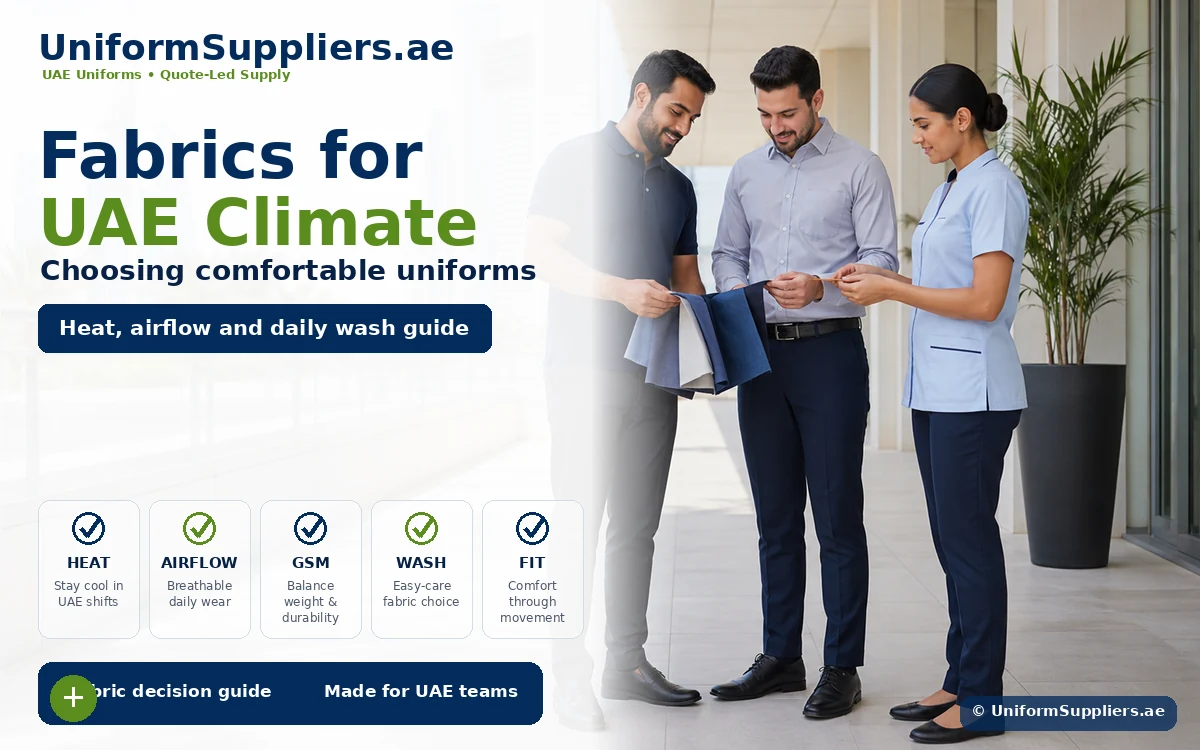
Fabrics for UAE Climate: Choosing Comfortable Uniforms

Uniform fabric decisions in the Gulf are usually made against the wrong problem. Buyers ask which cloth is coolest, when the harder question is which cloth behaves acceptably in two very different environments on one shift.
An employee in Dubai may walk from a 43°C loading yard into a lobby held at 21°C several times a shift. Add coastal humidity, fine dust on pale colours, strong UV on outdoor teams and near-daily laundering, and fabric choice becomes an operational decision rather than an aesthetic one.
This guide covers fibre, weave and finish: what each does, what to specify, and what to ask a supplier to confirm on the mill datasheet. Fabric weight is a separate variable, covered in the guide to fabric GSM for workwear in the UAE.
What this guide covers
- Why the Gulf problem is the swing, not just the heat
- Evaporative cooling versus absorbency
- Fibre and blend comparison
- Weaves: poplin, twill, oxford, ripstop and piqué
- Finishes and what survives repeated laundering
- Colour, dust and UV
- What to specify and confirm before you order
- Test it on your own team
- Frequently asked questions
Why the Gulf problem is the swing, not just the heat
From May to September, outdoor conditions in the UAE combine high temperatures with coastal humidity that stays high into the night. Interiors are held far cooler, and the transition between the two is constant for anyone doing deliveries, valet duty, facilities rounds or site inspections.
That swing punishes fabrics in specific ways. A heavily absorbent cloth that has taken up sweat outdoors becomes cold and clammy in air conditioning, and dries slowly because indoor air is chilled rather than dry. A sealed synthetic that never breathes traps heat outdoors even if it looks crisp indoors.
Humidity is why UAE performance differs from a dry desert climate. In coastal humidity, evaporation slows, so the fabric’s ability to move moisture away from skin matters far more than how much liquid it can hold.
Laundering frequency compounds everything. Uniforms in hospitality, healthcare and facilities work are washed after almost every shift, often at commercial temperatures, so a cloth that loses shape or colour after fifty cycles is a false economy.
Evaporative cooling versus absorbency
These two properties are routinely confused. Absorbency is how much moisture a fibre takes into itself. Evaporative cooling is how quickly moisture leaves the fabric surface, taking heat with it. Cotton is excellent at the first and mediocre at the second.
That is why the assumption that cotton is always cooler fails for high-sweat outdoor roles. A cotton T-shirt on a landscaping or logistics team absorbs sweat, becomes heavy, clings and stays wet for the rest of the shift. It feels pleasant for twenty minutes and unpleasant for the next eight hours.
Engineered polyester knits work the other way. The fibre absorbs very little, so moisture moves to the outer surface and evaporates, and the garment stays lighter. The trade-off is odour retention, managed through construction, laundering practice and enough sets for daily rotation.
Cotton therefore earns its place in low-exertion, air-conditioned roles where hand feel dominates, and synthetic or blended constructions earn theirs where people sweat. Most UAE organisations need both, specified role by role rather than standardised across the company.
Fibre and blend comparison
| Fibre or blend | Moisture behaviour | Durability | Wrinkle and shape retention | Best UAE use case | Watch-outs |
|---|---|---|---|---|---|
| 100% cotton | Highly absorbent, slow to dry, clammy in air conditioning | Good, but weakens with hot washing and abrasion | Creases readily; needs pressing | Air-conditioned front-of-house, chef whites, premium shirting | Shrinkage and loss of shape; poor for high-sweat outdoor work |
| 100% polyester | Absorbs almost nothing; moisture moves to the surface and evaporates | High abrasion and tear resistance; colour holds well | Excellent; recovers shape after washing | Outdoor teams, ready-stock items, sublimated garments | Odour retention; feels plasticky if the construction is dense |
| Poly-cotton blend (typically 65/35) | Moderate absorbency, dries faster than pure cotton | Very good; the standard for daily-wear uniforms | Good; light pressing usually enough | Corporate, hospitality, retail and light industrial wear | Pilling on cheap yarns; state the exact ratio in the specification |
| Cotton-rich blend with elastane | Similar to cotton, slower to dry, closer to the body | Good, though elastane degrades with heat and harsh chemicals | Good recovery when new; can bag if quality is low | Fitted shirts, blouses, tailored trousers, scrubs | Commercial laundry heat shortens elastane life; confirm care limits |
| Viscose or modal blend | Absorbent, with a cool fluid hand feel | Weaker when wet; not for hard wear | Drapes rather than holds a crisp line | Front-of-house blouses, spa and salon tailoring | Shrinkage and abrasion sensitivity; not for site or kitchen use |
| Technical moisture-management knit | Engineered to move sweat outward and dry quickly | Good where yarn quality is sound | Very good; resists creasing | Outdoor operations, security, logistics, event crews | Marketing language varies; ask for construction and finish on the datasheet |
Yarn quality changes the outcome as much as fibre type: two garments both described as 65/35 poly-cotton can behave very differently, which is why sampling matters more than a label. Final specification will be confirmed during quotation.
Weaves: poplin, twill, oxford, ripstop and piqué
Weave determines how a fabric drapes, breathes, resists abrasion and shows soil. The same fibre content in two weaves produces two different garments.
- Poplin. A plain, tightly woven cloth with a smooth flat surface. Light and crisp, which suits corporate shirts, but it shows creases and marks readily.
- Twill. Recognisable by its diagonal rib. More robust than poplin at similar weight, drapes softly and hides soil better, which is why it dominates trousers, chef wear and industrial shirting.
- Oxford. A basketweave with visible texture and a heavier hand. Durable, forgiving of creasing, and reads smart-casual rather than formal.
- Ripstop. A grid of reinforcing yarns woven at intervals so a tear cannot spread. Used for coveralls, cargo trousers and outdoor workwear where snagging is routine.
- Piqué. A textured knit rather than a woven cloth, standard for polo shirts. The raised surface holds structure, lifts fabric slightly off the skin and hides light creasing, which is why it survives a hot day better than a flat jersey. See the guide to polo shirts for business.
For outdoor roles, a textured or twill surface is more forgiving than a flat one: it hides dust, resists visible creasing and clings less when damp.
Finishes and what survives repeated laundering
Finishes are treatments applied to a fabric after weaving. They are useful, and none should be assumed permanent unless the supplier confirms otherwise on the datasheet.
Soil-release finishes alter the fibre surface so oily marks lift during washing instead of setting. They earn their place in kitchens and workshops, and most are durable for a stated number of wash cycles rather than indefinitely.
Wrinkle-resistant or easy-care finishes cross-link cotton fibres so the cloth recovers its shape. They cut pressing time, though they can stiffen hand feel and reduce tear strength. On blends, some of the effect comes from the polyester itself rather than the finish.
Moisture-wicking treatments applied to a fabric surface are the least durable of the three. Where wicking is genuinely important, prefer fabric engineered for it in the yarn and knit structure, not a topical treatment that fades over a laundry season.
Antimicrobial and odour-control finishes vary widely in mechanism and longevity, so treat any claim as something the mill should evidence. The request to a supplier is simple: state the finish, the standard it was tested to, and the number of wash cycles the effect is warranted for.
Colour, dust and UV
Fine dust is constant in the UAE and settles visibly on pale, flat fabrics. Mid-tones, textured weaves and marl yarns disguise it far better than plain white or light grey, which matters for outdoor and facilities teams who cannot change mid-shift.
Strong UV fades dyes, and darker shades show the loss sooner. Solution-dyed and well-executed reactive dyeing hold colour better than cheap surface dyeing. Where a brand colour must stay consistent across reorders, raise colour fastness at specification stage and ask for a light-fastness rating.
Sweat and sunscreen affect colour too, particularly on collars and cuffs. For outdoor teams, plan replacement on a colour-consistency cycle rather than only when garments wear out; the guide to signs it is time to upgrade company uniforms covers the timing.
What to specify and confirm before you order
Mustang recommendation: split the workforce by exertion and environment before choosing any cloth. Air-conditioned, guest-facing staff can take cotton-rich comfort. Mixed indoor and outdoor roles are best served by a quality poly-cotton in a twill or piqué. Sustained outdoor exertion, as in industrial and safety workwear, warrants an engineered moisture-management construction, with any protective requirement specified separately.
Ask your supplier to confirm in writing, on the quotation or the mill datasheet: exact fibre composition and blend ratio, weave or knit type, fabric weight, shrinkage after washing, colour fastness to light and washing, pilling resistance, and the durability of any finish in wash cycles.
Then test rather than trust. Wash a sample garment several times at your actual laundry temperature and inspect it for shrinkage, colour shift, pilling and shape loss. Free samples are available against a confirmed LPO through the uniform sampling service.
Settle the fabric before sizing. Cloths relax and shrink differently, so sizes should be confirmed against the final specification; if a measurement session is planned, schedule it after the cloth is approved and read the guide to onsite uniform measurement.
Test it on your own team
No datasheet replaces a garment worn through a UAE August. Shortlist two or three constructions per role group, put them on real staff for a fortnight, and let the wear trial decide.
Request a sample of the fabrics you are considering, or request a quote once the specification is settled.
Frequently asked questions
Is cotton or polyester better for the UAE summer?
It depends on the role. Cotton suits low-exertion, air-conditioned, guest-facing work where hand feel and appearance matter most. Polyester and engineered knits suit anyone sweating heavily outdoors, because they stay lighter and release moisture faster. Most organisations specify different fabrics for different role groups rather than one cloth throughout.
What poly-cotton ratio should we specify?
A 65/35 polyester-cotton is the common workhorse for daily uniform wear, balancing comfort, shape retention and durability. Cotton-rich ratios feel better next to skin but crease more and dry slower. State the exact ratio, because “poly-cotton” covers everything from 80/20 to 35/65 and the difference is significant.
Do moisture-wicking finishes last?
Topical wicking treatments generally lose effect over repeated commercial laundering. Where moisture management matters, choose a fabric engineered for it in the yarn and knit structure rather than one relying on a surface treatment. Ask the supplier whether the property is inherent or applied, and for how many wash cycles it is warranted.
How do we stop uniforms looking dusty by midday?
Avoid flat, pale, plain-woven fabrics for outdoor and facilities teams. Mid-tones, marl yarns and textured weaves such as twill or piqué disguise fine dust far better. Issuing enough sets for daily rotation also helps, since dust ground into fibres over consecutive shifts is harder to launder out.
Does fabric weight matter more than fibre?
They answer different questions. Fibre and construction determine how a garment handles moisture, heat and laundering; weight determines opacity, durability and how substantial it feels. Both belong in the specification, and weight is covered in the guide to fabric GSM for workwear.
Can we get fabric samples before committing?
Yes. Free samples are available against a confirmed LPO, and a wear trial is the most reliable test open to a buyer. Wash the sample several times at your own laundry temperature, then check shrinkage, colour, pilling and shape before signing off the specification.