Special offers: free digital logo mock-up and free samples against a confirmed LPO. View offers


School Sportswear and PE Kits: A Buyer’s Overview

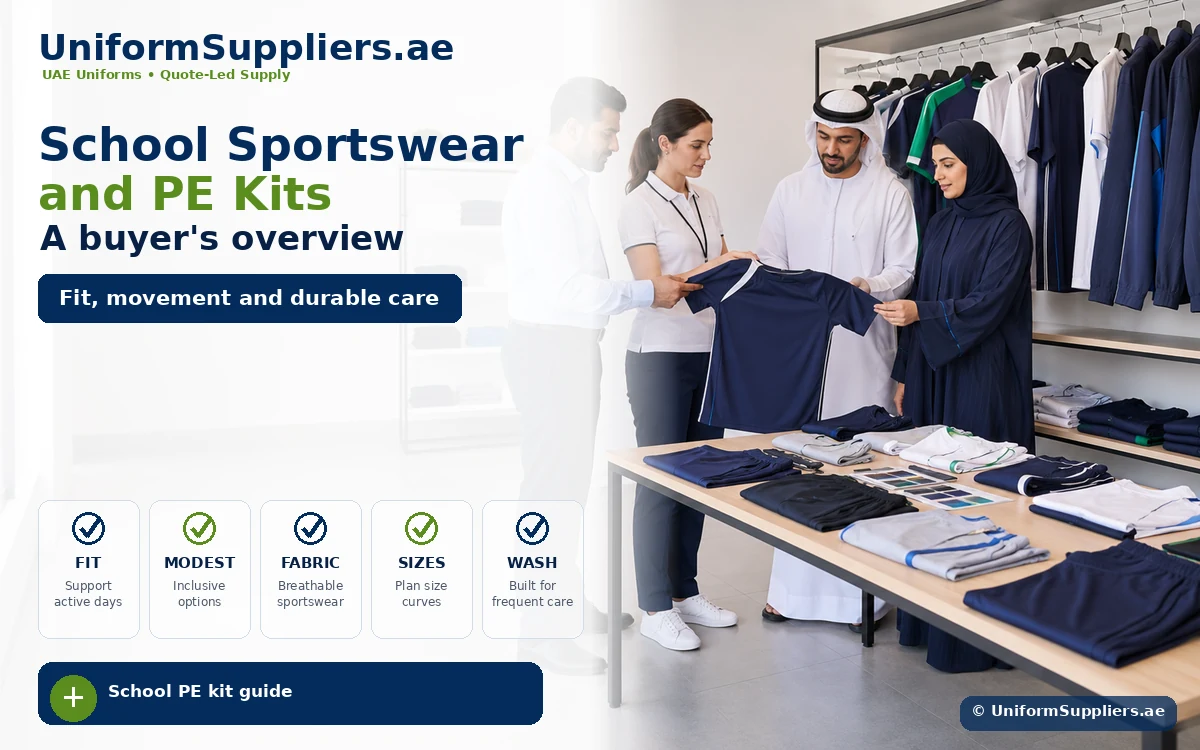
Physical education is a fixed part of the school week in the UAE, and the kit worn for it has to survive far more than a normal school shirt: running, jumping, sitting on hard courts, and being stuffed into a bag between lessons. Getting PE kit right is a different buying decision from the daywear uniform, even though the two are usually ordered from the same supplier at the same time.
This overview is the companion to our guide on school uniforms in the UAE, which covers daywear — shirts, trousers, skirts and blazers. Here we look specifically at sportswear and PE kit: what fabric performs best for active UAE conditions, how house colours and identification work, how kit holds up to heavy washing, and how sizing works across a wide age range.
What this guide covers
- Fabric performance for active UAE conditions
- What a typical PE kit includes
- House colours and team identification
- Durability and laundering
- Sizing across a wide age range
- Branding methods that survive stretch and movement
- Ordering PE kit alongside daywear
- PE kit component checklist
- Frequently asked questions
Fabric performance for active UAE conditions
PE lessons in the UAE often run outdoors or in a semi-covered court, in heat and humidity that a standard cotton daywear fabric was never designed for. Moisture-wicking, breathable performance fabric — typically a polyester or poly-cotton blend with an open, quick-drying knit — keeps students more comfortable than a heavier cotton jersey, and dries faster before the next lesson or the walk home.
Sun exposure matters too, particularly for outdoor sport in the middle of the school day. A fabric with a reasonably tight knit gives better sun protection than a very open mesh, without sacrificing breathability. Final fabric specification — weight, blend ratio and finish — is confirmed during quotation to match the school’s sport programme and age groups.
Colour choice interacts with fabric performance too. Darker house colours absorb more heat under direct sun than lighter tones, which matters for a top worn through an hour of outdoor activity; some schools address this by keeping darker colours to trim and accents rather than the full body of the garment, particularly for kit used in peak summer term fixtures.
What a typical PE kit includes
Most UAE schools specify a core PE kit of a short-sleeve top (polo or crew-neck style), shorts or a skort, and a pair of socks in house or school colours, sometimes with a lightweight tracksuit or hoodie for cooler-season outdoor sessions or travel to fixtures. Some schools add a second, heavier layer for representative or after-school sports teams, distinct from the everyday PE kit worn in lessons.
Footwear is normally specified separately by the school’s own PE policy (plain trainers, indoor court shoes) rather than supplied as part of the uniform kit, though schools sometimes ask for branding guidance on kit bags or bag tags to go with the rest of the identity package.
House colours and team identification
House or team colour-coding is one of the more functional parts of a PE kit, letting teachers and coaches identify groups at a glance across a large playing field or sports hall. This is usually handled through the top colour itself, a chest or sleeve panel, or a printed house name, rather than elaborate design — simplicity keeps kit legible from a distance and keeps reordering straightforward as students move between houses or year groups.
Where a school runs inter-house competitions, it is worth confirming at the specification stage whether all houses share one garment style with different colours (simpler to reorder, consistent fit) or different cuts entirely (more distinct look, more complex to manage for stock and reordering).
Durability and laundering
PE kit is laundered far more often than daywear — frequently every session for the top, given how much students sweat through UAE heat — and needs to survive that cycle without losing shape, colour or print quality. Sublimation printing, which dyes the design into the fibre rather than sitting on top of it, tends to outlast screen printing on performance fabric that flexes and stretches during exercise, though the right method depends on the fabric and design.
Reinforced seams at the shoulder and underarm reduce the most common failure point on a garment used for constant movement, and a slightly generous cut extends usable life across a growing student compared with a very fitted style.
Sizing across a wide age range
A single school PE kit specification typically has to fit students from early primary years through to older secondary students, which is a wider size range than most corporate uniform programmes ever need to cover. Building the sizing chart around this full range from the outset — rather than adjusting after the first bulk order — avoids gaps at either end once students are actively growing through a school year.
Schools that keep a stored specification and sizing chart on file find reordering for new students or replacing worn kit considerably faster than respecifying each term, since sizes, colours and branding are already confirmed and simply need to be repeated against a new headcount.
Branding methods that survive stretch and movement
Performance fabric behaves differently to woven daywear cotton under a needle or a heat press, and the branding method needs to be chosen with that in mind. Embroidery on a stretch knit can pucker or distort at the edges of the design if the backing and stitch density are not matched to the fabric, so a supplier experienced in sportswear branding will typically use a lighter stitch count and a stabiliser suited to stretch fabric rather than treating it like a woven polo.
Sublimation, where the design is dyed into the fibre itself during production rather than applied afterward, avoids this problem entirely and is why it is common on multi-colour house-kit designs and larger printed crests. Heat-transfer vinyl is a workable middle option for smaller, simpler logos on a budget, though it can feel stiffer against the skin during exercise than a sublimated or lightly embroidered mark. Ask your supplier which method they recommend for the specific fabric and design before committing to a full run, and request a sample where the design includes fine detail or multiple colours.
Ordering PE kit alongside daywear
Most UAE schools order PE kit as part of the same overall uniform programme as daywear, since it shares a supplier relationship, a sizing process and, often, a delivery schedule ahead of the new academic year. Running both together also means embroidery or print branding — school crest, house colours — can be applied consistently across both daywear and sportswear rather than looking like two separate identities.
For the daywear side of the programme — shirts, trousers, skirts, blazers and staff uniforms — see our companion guide, the complete guide to school uniforms in the UAE.
PE kit component checklist
| Component | What to specify |
|---|---|
| Top | Polo or crew style, moisture-wicking fabric, house/school colour, branding method |
| Shorts or skort | Breathable fabric, elasticated waist for a wide age range, matching colour |
| Socks | House colour or school colour, standard length |
| Cooler-season layer | Lightweight tracksuit or hoodie for outdoor sessions or fixtures, if required |
| Team/representative kit | Distinct heavier layer for after-school or competitive sport, if the school runs one |
| Kit bag | Optional branded bag or bag tag to complete the identity package |
Mustang recommendation: confirm the full age range and any inter-house or team-kit requirements at the specification stage, so one sizing chart and one branding standard can cover the whole programme rather than being revisited mid-year.
Frequently asked questions
Should PE kit be ordered from the same supplier as school daywear?
It generally works better as one programme, since branding, sizing records and delivery can be coordinated together rather than managed as two separate supplier relationships with potentially different colour matching.
What fabric is best for UAE outdoor PE lessons?
A moisture-wicking polyester or poly-cotton blend with a reasonably tight, breathable knit generally performs better than heavier cotton jersey for active outdoor use in UAE heat. Final fabric weight is confirmed during quotation against the school’s sport programme.
How do house colours usually work on PE kit?
Most schools use the top colour itself, or a simple panel or printed house name, to identify house groups at a glance. Keeping the design simple makes both legibility and reordering easier as students move between year groups.
Does PE kit need to be replaced more often than daywear?
It is laundered and worn under more physical stress than daywear, so it is common to review PE kit condition more frequently, even where the same annual replenishment cycle covers both. Reinforced seams and durable print methods extend usable life.
Can PE kit sizing cover the whole school in one chart?
Yes, provided the chart is built for the full range from the outset — early primary through older secondary — rather than adjusted after an initial order proves too narrow.
Is separate team or representative kit necessary?
Only if the school runs competitive fixtures or after-school sport that benefits from a distinct, heavier-weight kit. Many schools use the same everyday PE kit for both purposes.
What branding method works best on performance fabric?
Sublimation, where colour is dyed directly into the fibre, generally handles stretch and multi-colour house designs best. Embroidery works well for smaller, simpler marks if the stitch density and backing are matched to a stretch knit rather than a woven fabric. Ask for a sample where the design has fine detail.
Can PE kit be reordered mid-year for a single new student?
Yes, provided the specification and sizing chart from the original order are kept on file. A stored repeat-order specification means a single new-starter kit can usually be matched exactly without respecifying colours, fabric or branding from scratch.
To specify PE kit alongside your school’s daywear programme, request a quote from Uniform Suppliers UAE.