Special offers: free digital logo mock-up and free samples against a confirmed LPO. View offers


The Complete Guide to School Uniforms in the UAE

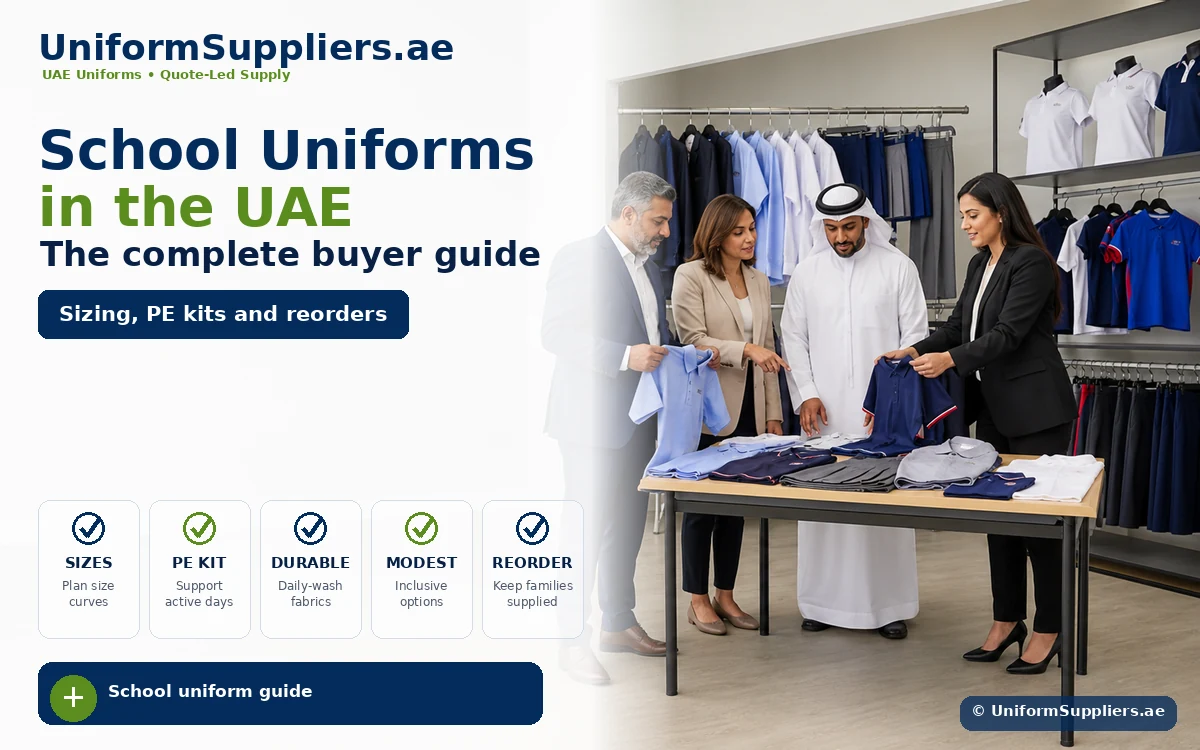
A school uniform is the only garment programme in the UAE that has to satisfy children, parents, teachers and a governing body at the same time, and it has to do it for a full academic year without falling apart.
Schools here follow different curricula and dress conventions, yet the practical problems are almost identical: a hot outdoor break followed by a heavily air-conditioned classroom, children who grow through two sizes in ten months, laundry several times a week, and hundreds of near-identical garments that still have to be told apart.
This guide sets out how to specify, cost and roll out a school uniform programme in the UAE, item by item, with a checklist for the parent-facing side of the change.
What this guide covers
- Two climates in one school day
- Building the uniform list item by item
- Fabrics that survive the wash cycle
- Sizing, growth and the mid-year joiner
- Identifying year groups and houses
- Modest dress as standard provision
- Keeping the programme affordable for parents
- Parent-facing rollout checklist
- PE kit and school sportswear
- Request a quote
- Frequently asked questions
Two climates in one school day
Between May and September a child moves from a thirty-degree walk across a car park to a classroom held at twenty-two degrees, several times a day. That rules out the two obvious answers: a heavy fabric that traps heat outdoors, and a thin one that leaves pupils cold at their desks by the second lesson.
The practical answer is layering. A breathable short-sleeved base garment handles the outdoor portion of the day and a light sweatshirt or cardigan handles the indoor portion. The layer piece matters more here than in cooler countries, because it is worn indoors in summer rather than outdoors in winter, and so is worn almost daily.
Dust is the second factor. Fine sand settles on collars and cuffs, so pale shades look tired quickly unless the fabric releases soil well in a domestic wash.
Building the uniform list item by item
Specify the programme garment by garment rather than as a package. The table sets out the core items, what changes by year group, and where each one usually fails first.
| Item | Year-group considerations | Fabric priority | Durability pressure point | What to specify |
|---|---|---|---|---|
| Polo or shirt | Polo for primary and early years; collared shirt often preferred for senior years | Breathable knit or a poly-cotton weave that releases soil and dries fast | Collar curling and greying at the neckline after repeated washing | Ribbed collar construction, colourfastness, reinforced placket, agreed GSM |
| Pinafore or skirt | Pinafore for younger pupils; skirt with an adjustable waist for older ones | Crease resistance and a stable weave that keeps its shape | Waistband stretch and hem fraying after alterations | Adjustable waist tabs, deep hem allowance for letting down, lining if required |
| Trousers or shorts | Shorts throughout primary; trousers commonly introduced in senior years | Lightweight, crease-resistant blend with a comfortable stretch content | Knees, seat seam and pocket corners | Reinforced knees where possible, elasticated or adjustable waist, secure pockets |
| Sweatshirt or cardigan | Worn indoors year-round for cold classrooms, not just in winter | Soft handle, low pilling, stable shape after frequent washing | Cuffs and hem losing recovery; pilling across the front | Anti-pill finish, ribbed cuff quality, embroidered crest rather than a print |
| Abaya or modest option | Offered across year groups as an equivalent, not an exception | Lightweight, opaque, non-clinging fabric suited to summer | Hem wear and colour drift against the rest of the uniform | Matching colour reference to the core range, length options, sleeve fit |
| Headscarf | Available in all sizes for any pupil who wears one | Soft, breathable, non-slip fabric that stays comfortable in heat | Colour fading out of step with the shirts it is worn with | Same dye reference as the main garment, edge finish, two length options |
| House or year identification | Houses, year groups and bus or trip groupings | Applied to the garment, not to a removable accessory | Badges lifting at the edges; printed marks cracking after washing | Embroidered crest or colour-coded trim, position measured from a named seam |
Where a detail cannot yet be fixed — a trim colour, a lining, a specific fabric weight — record it and move on. Final specification will be confirmed during quotation.
Fabrics that survive the wash cycle
School uniforms are laundered more often than almost any other garment category. A shirt worn five days a week is typically washed at least three times a week, which is well over a hundred cycles in an academic year. Fabric decisions should be made against that number rather than against how the garment looks on day one.
Pure cotton breathes well but creases, shrinks and fades faster under heavy laundering. A poly-cotton blend holds colour and shape better and dries quickly in Gulf humidity, at some cost to breathability. Most UAE schools use a blend for shirts and trousers and reserve softer cotton-rich fabrics for the layer piece worn indoors.
Weight matters as much as fibre. A fabric that is too light becomes translucent and shows wear at the seams; one that is too heavy is uncomfortable outdoors in June. The guide to fabric GSM explains what the figures mean. Ask any supplier to confirm colourfastness, shrinkage and pilling performance on the product datasheet before approving a fabric.
Sizing, growth and the mid-year joiner
Children grow unevenly, and a uniform bought in August has to still fit in May. Buying deliberately large is the usual response and the usual mistake, because a sleeve that hangs over the hand is a safety and comfort problem for a whole term.
Build growth into the garment instead of the size. Adjustable waistbands, deep hem allowances and a slightly longer body length let a garment be let out rather than replaced. Run a sizing day with real garments to try on, so families order against a measured fit rather than a guessed age label; the measurement guide covers how to record sizes consistently.
Mid-year joiners are a constant in the UAE. Decide in advance which sizes are held as spare stock, who releases them, and how a new family orders the rest, so no child spends a fortnight out of uniform.
Identifying year groups and houses
Large year groups create an identification problem on trips, at drop-off and in assemblies. Colour is the fastest system: a house colour on the polo collar, a year-group trim, or a distinct sweatshirt shade per key stage.
Apply identification to the garment rather than to badges that can be swapped or lost. An embroidered crest survives repeated washing better than a printed one and looks considerably better after a term. Record the position of every crest as a measurement from a named seam so that it is consistent across every size and every reorder.
Modest dress as standard provision
Modest options belong in the core specification, not in a footnote. An abaya, a longer tunic, full-length trousers, longer sleeves and a matching headscarf should be listed on the same order form, in the same colours and in the same fabric family as the rest of the uniform.
The most common failure is colour drift. Modest items sourced separately or later rarely match the main range, and the mismatch shows in every school photograph. Specify one colour reference for the whole programme and approve every item against the same physical sample.
Keeping the programme affordable for parents
Parents buy multiple sets per child, often for more than one child, so cost sensitivity is a design constraint rather than a complaint to be managed.
Three decisions do most of the work. Keep the compulsory list short and let optional extras be genuinely optional. Choose durable fabrics for the items washed hardest, so garments last a full year rather than needing replacement in February. And avoid unnecessary bespoke elements — a distinctive crest on a standard garment delivers the same identity with far less complexity.
Mustang recommendation: approve a physical sample of every item before the range is announced to parents. Colour, fabric weight and crest quality cannot be judged on a screen, and a uniform launched from a photograph is the one that generates complaints in week one. Free samples are available against a confirmed Local Purchase Order, and how uniform sampling works explains the approval process.
Parent-facing rollout checklist
- Announce early. Give at least one full term of notice before a change, ideally announced before the summer break so families can plan the purchase.
- Run sizing days. Schedule try-on sessions with real garments across several days, including at least one outside working hours.
- Publish a transition rule. State clearly whether the previous uniform may still be worn, and until when.
- Set a hand-me-down policy. Decide whether siblings may reuse garments and whether a supervised second-hand exchange will be run.
- Specify name labelling. Tell families exactly where the name goes and how, so lost property is actually returnable.
- Hold spare stock at reception. Keep a small set of common sizes for accidents, forgotten kit and unexpected arrivals.
- Plan for mid-year joiners. Publish a simple ordering route for families arriving in October or February.
- Give one contact point. Name one person for uniform queries so parents are not routed between departments.
PE kit and school sportswear
PE kit sits outside the scope of this guide. Sportswear has different fabric requirements, fit expectations and replacement cycles, and is covered separately in school sportswear and PE kits. Specify it as its own line in the tender rather than folding it into the daywear list.
Request a quote
To price a school uniform programme, prepare the garment list, approximate numbers by year group, colour references and the crest artwork. A free digital mock-up of the crest can be produced before anything is manufactured, and the uniform ordering checklist sets out the paperwork sequence.
Request a quote from Uniform Suppliers UAE, part of Mustang Advertising Trading LLC in Dubai, operating since October 2007, combining ready-stock supply with custom uniform manufacturing in a single programme.
Frequently asked questions
What fabric is best for school uniforms in the UAE?
Most schools use a poly-cotton blend for shirts, trousers and skirts because it holds colour and shape through heavy laundering and dries quickly in Gulf humidity. Softer cotton-rich fabrics suit the sweatshirt or cardigan worn indoors. Ask the supplier to confirm colourfastness, shrinkage and pilling performance on the datasheet before approving.
Why is a sweatshirt needed in a hot country?
Because the indoor climate, not the outdoor one, drives the need. Classrooms are air-conditioned to a temperature that many pupils find cold after sitting still for an hour, so the layer piece is worn indoors throughout the year. Treat it as a core item rather than a seasonal extra.
How much notice should a school give before changing uniform?
At least one full term, and preferably before the summer break so families can budget and buy during the holidays. Publish a transition period during which the old uniform remains acceptable, and be explicit about the date it ends. Short notice is the most common cause of complaint.
How should modest options be handled?
List them in the core specification alongside every other item, in the same colours and fabric family, and approve them against the same physical sample. Abayas, longer tunics, longer sleeves and matching headscarves should appear on the standard order form rather than being arranged separately, which is what causes colour mismatches.
Can uniforms be reordered to match the original later?
Yes, provided the specification is recorded at the outset. Keep the approved sample, the colour reference, the fabric details and the crest positions on file, and ask the supplier to store the same repeat-order specification records. Replenishment then matches the existing uniform instead of being re-approved from the beginning each year.