Special offers: free digital logo mock-up and free samples against a confirmed LPO. View offers

Choosing Breathable Sports Fabrics for the UAE Climate

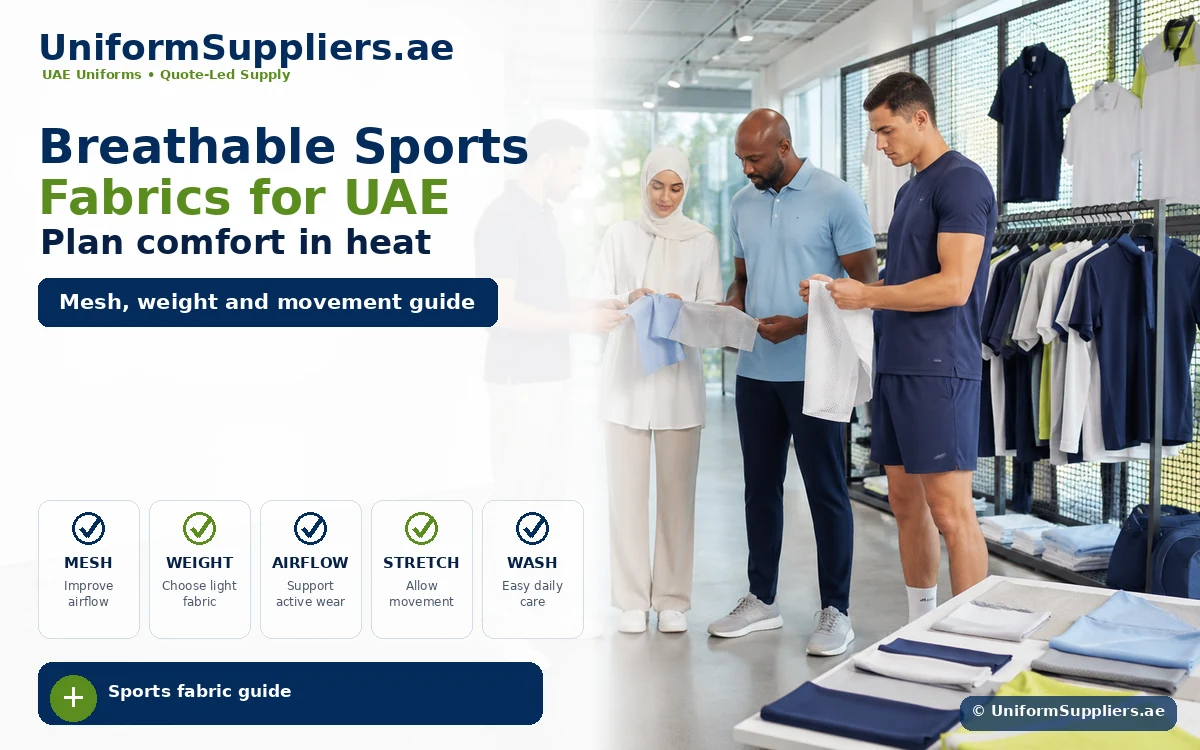
In the UAE, fabric choice is a performance decision. The right sports fabric helps players stay cooler, drier and more comfortable; the wrong one leaves a team struggling by half-time. Here is what to look for.
Every one of our custom sports uniforms is made in fabrics chosen for UAE conditions. This guide explains the choices behind that, so PE heads, club managers and procurement teams can read a fabric description and know what it means on the pitch.
What this guide covers
- What breathable really means
- Knit structures compared
- Fibre choices and fabric weight
- Moisture management: engineered or topical
- Colour, UV and laundering
- Panel mapping and full-coverage kit
- Fabric direction by sport and intensity
- What to ask a supplier to evidence
- Start your kit with us
- Frequently asked questions
What breathable really means
Breathable is used loosely. For sportswear it covers three separate things, and a fabric can be good at one and poor at another.
- Air permeability: how easily air passes through the fabric. Open structures such as mesh score highest.
- Moisture transport: how well the fabric moves sweat from the skin to the outer face, where it can spread out.
- Drying: how soon that moisture evaporates and the garment stops feeling heavy.
The body cools itself by evaporating sweat, so all three matter. Look for lightweight knits that move sweat away from the skin and dry fast. This is what helps players during outdoor sessions in summer.
Why the UAE is a harder test
Evaporation slows as humidity rises. On a humid coastal evening, sweat does not leave the fabric as readily as it does in dry inland heat, so airflow through the garment becomes more important than wicking alone. Indoor sports add a different problem: players move between a warm car park and a strongly air-conditioned hall, and a fabric that holds moisture then feels cold and clammy. Breathable sports fabrics UAE teams choose need to work in both settings.
Knit structures compared
Almost all team sportswear is knitted rather than woven, because knits stretch and let air through. The structure of the knit changes how the fabric behaves more than most buyers expect.
| Structure | What it is | Strengths | Watch for | Typical use |
|---|---|---|---|---|
| Interlock | Smooth double knit, the same on both faces | Stable, opaque, clean surface for sublimated designs | Less airflow than open structures | Main body of match jerseys, shorts |
| Mesh | Open knit with visible holes | Highest airflow | Can be see-through and may snag | Side and underarm panels, bibs, basketball tops |
| Micro-mesh | Very small holes, smooth from a distance | Balance of airflow, coverage and print clarity | Fine detail in artwork can soften slightly | Jerseys, training tops, running vests |
| Piqué | Textured knit with a raised, waffle-like surface | Sits slightly off the skin; holds embroidery well | Heavier feel than jersey fabrics | Polos, coach and staff wear |
| Bird’s-eye | Small repeating eyelet pattern, usually with two different faces | Designed to pull moisture from the inner face to the outer | Texture shows through pale prints | Training T-shirts, PE tops |
You do not have to pick one. Most performance jerseys combine a smoother fabric on the front and back with a more open one at the sides. The terms above are defined in our uniform manufacturing glossary.
Fibre choices and fabric weight
Polyester
Polyester is the default for team kit. It absorbs very little water, so sweat stays on the surface of the fibres where it can move and evaporate, and it is the fibre that sublimation dyes bond with. Recycled polyester behaves in a similar way and is worth asking about if your school or club has sustainability goals.
Elastane blends
A small proportion of elastane adds stretch and recovery. Lighter weights suit running and racquet sports; a little stretch helps range of movement in every sport. Stretch also matters for close-fitting items such as leggings and base layers.
Polyamide
Polyamide, often called nylon, has a softer, cooler feel and resists abrasion well. It is common in swimwear, cycling and gym wear rather than in sublimated team jerseys.
Cotton and cotton blends
Cotton is comfortable at rest but absorbs sweat and holds it, so a cotton shirt becomes heavy and slow to dry during hard exercise. It still has a place in supporter T-shirts, casual club polos and leisure wear.
Weight
Fabric weight is expressed in grams per square metre (GSM). Lighter fabrics are cooler and dry sooner, but they are also less opaque, cling more when wet and wear faster. Heavier fabrics hold their shape and stand up to contact. Contact areas (rugby, martial arts) need more robust constructions. Our explainer on fabric GSM shows how weight is measured, and the same principle applies to sportswear.
Moisture management: engineered or topical
Two fabrics can both be described as moisture-wicking and behave very differently after a season of washing. The difference is how the property is created.
Engineered into the fabric
Here the wicking comes from the yarn and the knit: shaped or fine filaments that draw moisture along their length, or a two-faced structure that pulls sweat outwards. Because it is part of the construction, the effect is not washed out.
Applied as a finish
Here a treatment is added to the finished fabric to make it attract and spread moisture. It works, but a topical finish can diminish with repeated laundering, and kit in the UAE is laundered often.
Neither approach is wrong. What matters is knowing which one you are buying. Ask the question directly, and avoid fabric softener on performance kit either way, because it can leave a coating on the fibres that reduces wicking.
Colour, UV and laundering
Colour and heat
Dark colours absorb more of the sun’s energy than pale ones. For daytime outdoor sport, a lighter base colour with darker trim is more comfortable than a solid dark kit. Under floodlights or indoors, the difference matters far less. White and very pale fabrics need checking for opacity, particularly in shorts and trousers.
Colour stability
With sublimation the colour is inside the fibre rather than on the surface, which helps team kit keep its appearance through strong sun and frequent washing. Our comparison of sublimation, printing and embroidery explains how each decoration method affects the fabric.
UV protection
How much ultraviolet light a fabric blocks depends on knit density, colour, stretch and whether it is wet. Open mesh lets more through than tight interlock. If sun protection is part of your brief, as it often is for junior and school kit, ask for a tested rating for the specific fabric rather than a general description.
Laundering
Polyester can hold odour if damp kit is left in a bag. Wash promptly, use a cool wash, skip the softener and avoid high-heat drying. Our fabric care guide gives general washing advice you can pass on to players and parents.
Panel mapping and full-coverage kit
Panel mapping means putting different fabrics in different parts of the same garment. The aim is airflow where the body needs it and a stable, opaque surface where the design needs it.
- Front and back: a smoother fabric that carries the crest, sponsor and number cleanly.
- Sides and underarms: mesh or micro-mesh for ventilation.
- Upper back or yoke: an open panel releases heat without affecting the number.
- Shorts: a denser fabric for opacity, with a lighter panel at the side if required.
Modest and full-coverage options
Breathable performance is just as important for modest and hijab-friendly kit. More of the body is covered, so the fabric has more work to do. We use light, airy fabrics for full-coverage tops, bottoms and sports hijabs so that coverage does not have to mean discomfort. Long sleeves and leggings benefit from stretch, and a looser cut allows air to move between fabric and skin.
Fabric direction by sport and intensity
| Sport or use | Intensity and setting | Fabric direction |
|---|---|---|
| Football | High; outdoor, often evening | Interlock or micro-mesh body with mesh side panels |
| Cricket | Long duration; direct sun | Light knit in pale colours; opaque trousers; long-sleeve option |
| Basketball, volleyball, netball | High; mostly indoor and air-conditioned | Mesh or bird’s-eye that does not hold moisture |
| Athletics and running | High; outdoor | Lightest micro-mesh; minimal seams |
| Tennis, padel, badminton | Stop-start; indoor or outdoor | Light knit with stretch; piqué for polos |
| Rugby and contact sports | High, with pulling and abrasion | Heavier, tighter knit with reinforced seams |
| School PE | Mixed activities; frequent washing | Durable mid-weight knit that is easy to care for |
| Gym and fitness | Varied; indoor | Stretch knit with elastane |
| Modest and full-coverage kit | Any | Light knit with stretch; looser cut |
For schools, our buyer’s overview of school sportswear and PE kits looks at range planning, and fabrics for the UAE climate covers the same questions for staff uniforms. You can also browse the sports team uniforms category by sport.
What to ask a supplier to evidence
A fabric name tells you little. Ask any supplier, including us, for the following before you approve a kit:
- Fibre composition and fabric weight.
- The knit structure of each panel.
- Whether moisture management is engineered or a topical finish.
- Test evidence for colour fastness to washing, light and perspiration.
- Test evidence for any UV protection claim.
- A physical sample you can wash several times yourself.
Our uniform sampling service explains how samples are arranged. Fabric recommendations are advice based on your sport and conditions, not a performance guarantee. Final specification will be confirmed during quotation.
Mustang recommendation: start from when and where the team plays, not from a fabric name. Choose the knit for each panel, check whether wicking is engineered or applied, pick a lighter base colour for daytime sport, and wash a sample at home before approving the order. A sample that still looks and feels right after several washes tells you more than any description.
Buyer checklist
- Sport, intensity, and indoor or outdoor setting defined.
- Time of day and season the kit will be worn.
- Knit structure chosen for body and panels.
- Fibre composition and weight confirmed in writing.
- Moisture management type confirmed.
- Base colour reviewed for heat and opacity.
- Modest and full-coverage options included.
- Sample washed and checked.
Start your kit with us
Every order begins with a free design mock-up and a free sample against your confirmed order, and your sizes and artwork are stored for repeat orders. Teams and students can try sizes in person at our Jebel Ali showroom before committing. Delivery timelines are confirmed during quotation.
Request a quote or request a sample to get started.
Frequently asked questions
What is the most breathable fabric for sports kit in the UAE?
Open mesh allows the most airflow, but it is rarely used for a whole garment. Most teams combine micro-mesh or interlock on the body with mesh panels at the sides.
Is polyester too hot for the UAE?
Not when it is a lightweight performance knit. Polyester absorbs very little moisture and dries sooner than cotton, which is why it is the standard fibre for team kit in hot climates.
Does moisture-wicking wash out?
It can if it comes from a topical finish. Wicking that is engineered into the yarn or knit structure is part of the fabric. Ask which type you are being offered.
Do sports fabrics protect against the sun?
All fabrics block some ultraviolet light, but the amount varies widely. If sun protection matters, ask for a tested rating for the specific fabric.
Can we check the fabric before ordering?
Yes. A free sample is provided against a confirmed order (LPO), and teams can see and try garments at our Jebel Ali showroom.
Are breathable fabrics available for modest kit?
Yes. Full-coverage tops, bottoms and sports hijabs are made in light, airy fabrics, in the same colours as the rest of the team kit.