Special offers: free digital logo mock-up and free samples against a confirmed LPO. View offers


Uniform Kitting for New Employees: A Day-One Onboarding Checklist

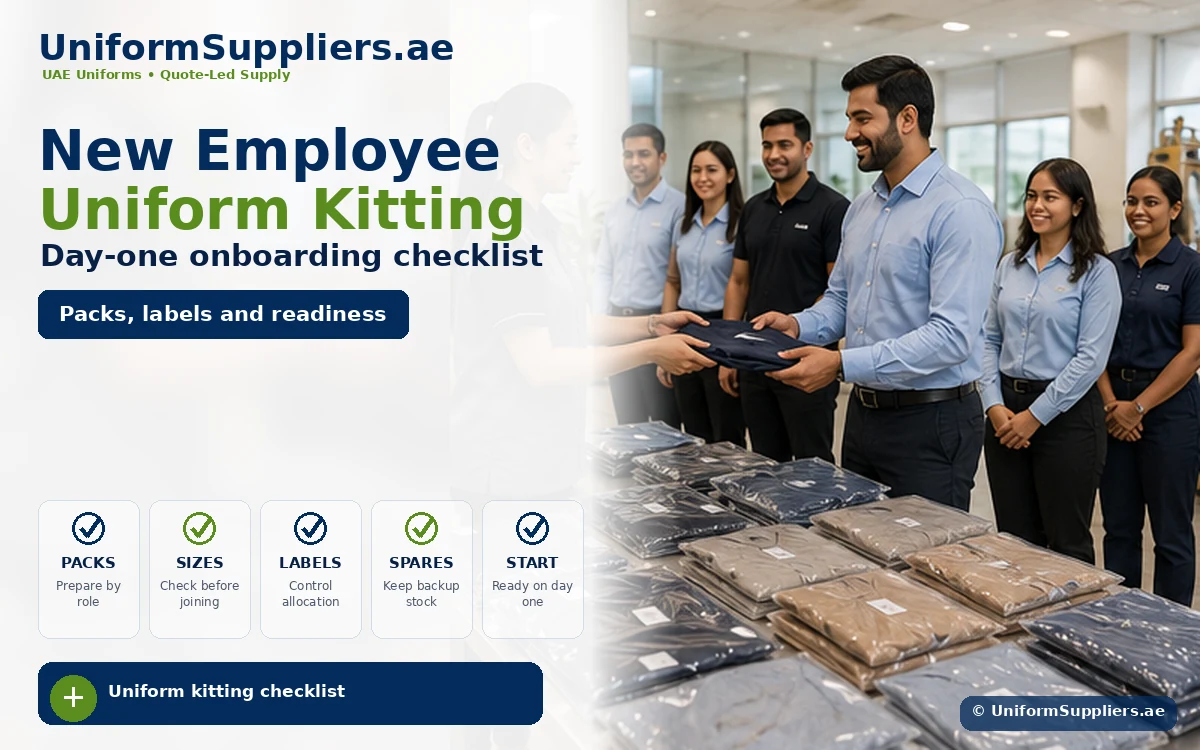
A new employee’s first day says a lot about how organised a company is, and uniforms are one of the most visible parts of that impression. A new hire who arrives to find the wrong size waiting, or no uniform at all, starts the job feeling like an afterthought. One who is handed a properly sized, ready-to-wear kit on arrival starts feeling equipped and expected. The difference usually comes down to whether uniform kitting is treated as part of the onboarding process, or as a task that happens whenever someone gets around to it.
This guide covers how UAE employers can build a simple, repeatable uniform kitting process into new employee onboarding.
In this guide
- Why uniform kitting belongs in onboarding, not after it
- Capturing sizing before day one
- What a standard new-hire kit typically includes
- Building a repeatable kitting process
- Kitting for multi-branch or fast-growing teams
- New-hire kitting checklist
- FAQ
Why uniform kitting belongs in onboarding, not after it
Uniform kitting is often treated as a logistics task that happens somewhere after HR paperwork and IT setup — which is exactly why it tends to slip. In practice, it works best when it’s built into the same onboarding checklist as laptop provisioning, access cards and induction training, with a clear owner and a clear deadline: uniform ready before the employee’s first shift, not after it.
Capturing sizing before day one
The single biggest cause of kitting delays is sizing being captured too late — often on the employee’s first morning, by which point there’s no time to order or exchange a size. Capturing sizing during the offer or pre-boarding stage, using a simple size form or a standard size chart, means the uniform can be ready and waiting when the employee arrives. For larger intakes, an onsite measurement session before the start date is a practical way to size a group accurately in one visit rather than relying on self-reported sizes, which are frequently inaccurate.
What a standard new-hire kit typically includes
What’s in a new-hire kit varies by role, but most UAE employers standardise around a documented list so nothing is missed and every new starter in the same role receives the same items:
- Primary uniform pieces — shirt, polo, dress or trousers appropriate to the role.
- A spare set for daily customer-facing or physically demanding roles, so laundering doesn’t leave staff without a wearable uniform.
- Identification — name badge, ID card or lanyard, usually prepared once the employee’s name and role are confirmed.
- Role-specific safety items — safety shoes, high-visibility vests or PPE where the role requires it.
- A short care guide — a simple sheet on washing and storing the uniform correctly, which reduces early-life damage from incorrect care.
Building a repeatable kitting process
A simple, repeatable process removes the guesswork for whoever is handling onboarding that week. A structure that works well for most UAE teams:
- Capture sizing at offer stage or during pre-boarding, using a standard size form.
- Confirm the kit list for the specific role against a documented standard, not from memory.
- Order or pull from stock with enough lead time before the confirmed start date.
- Quality-check the kit — correct sizes, correct branding, ID prepared — before the employee’s first day.
- Issue and record what was given, so replacement and return tracking has a starting point.
Keeping this list documented — even as a simple shared spreadsheet — means the process survives staff changes in HR or procurement rather than living in one person’s memory.
Kitting for multi-branch or fast-growing teams
For companies hiring across multiple UAE locations, or growing quickly, the kitting process benefits from centralisation: one size-capture form, one documented kit list per role, and one ordering point, rather than each branch handling it independently. This keeps new hires consistent with existing staff regardless of which location they join, and avoids the fabric-batch and sizing drift that can happen when uniform decisions are made separately at each site. For larger or recurring intakes, setting up a standing reorder arrangement means new-hire kits don’t need to be requoted individually each time.
Common causes of new-hire kitting delays
When uniforms aren’t ready for a new starter, the cause is almost always one of a small number of predictable issues rather than a genuine supply problem. Late sizing capture is the most frequent — sizing requested the week of the start date instead of at offer stage leaves no buffer if a size needs adjusting. Unclear kit ownership is another common cause: when it isn’t clear whether HR, procurement or the hiring manager is responsible for triggering the uniform order, it’s easy for the task to fall through between departments during a busy onboarding week. A third is treating every new hire as a one-off order rather than working from a standing arrangement, which adds unnecessary lead time to every single request.
Each of these is straightforward to fix with a documented process and a single clear owner, which is why building kitting into the standard onboarding checklist — rather than treating it as a separate, ad hoc task — tends to solve most delays permanently rather than one hire at a time.
Assigning clear ownership
Perhaps the single most useful thing a company can do to improve its kitting process is simply naming one owner — usually within HR or procurement — who is accountable for making sure every new hire has a ready uniform before their first shift. Without a named owner, the task tends to default to whoever notices it’s missing, usually the new employee’s direct manager on the morning of their first day, which is the least efficient point in the process to be solving a sizing or stock issue.
The wider benefit of a smooth kitting process
Beyond the first-day impression, a reliable kitting process has knock-on benefits that are easy to underestimate. It reduces the number of exchange and replacement requests in an employee’s first weeks, since correctly sized uniforms are issued from the start rather than adjusted after the fact. It also gives HR a cleaner onboarding metric to track — uniform readiness alongside other day-one essentials — and it protects the company’s uniform budget by avoiding the higher cost and slower turnaround of rushed, single-item orders placed at short notice. For companies scaling quickly, a documented kitting process is also one of the easier onboarding elements to hand over to a new HR hire, since it doesn’t rely on institutional knowledge that lives in one person’s head.
New-hire kitting checklist
| Step | Action |
|---|---|
| 1. Capture sizing early | During offer or pre-boarding, not on day one |
| 2. Confirm kit list | Match against the documented standard for the role |
| 3. Order with lead time | Allow enough time before the confirmed start date |
| 4. Quality-check the kit | Verify sizing, branding and ID before issue |
| 5. Issue and log | Record what was given for future replacement tracking |
| 6. Provide a care guide | Set washing and storage expectations from day one |
What to share with your uniform supplier for a smooth kitting process
A supplier can support your kitting process more effectively with a bit of context upfront: your typical monthly or seasonal hiring volume, the roles that need uniforms and what each role’s kit includes, and how sizing is normally captured (self-reported form, onsite measurement, or a mix depending on role). With this in hand, a supplier can suggest a sensible buffer stock level, recommend a sizing process suited to your hiring pace, and set up a standing account arrangement so individual new-hire orders don’t need to be requoted each time. This is usually a short, one-time conversation that pays off across every future hire.
FAQ
How far in advance should sizing be captured?
As early as possible in the offer or pre-boarding stage — ideally as soon as a start date is confirmed, so there’s time to order or adjust before day one.
What if a new hire’s uniform isn’t ready in time?
Having a small buffer stock of common sizes on hand for urgent starts is a practical safety net for fast-moving hiring, particularly in high-turnover roles like retail and hospitality.
Should uniform sizing be self-reported or professionally measured?
Self-reported sizing is faster but less reliable, particularly for fitted corporate pieces. For larger intakes or roles where fit matters most, an onsite measurement session reduces size-exchange requests later.
Who should own the kitting process — HR or procurement?
It varies by company, but what matters most is a single clear owner with a documented process, rather than the task being shared informally between departments.
Can uniform kitting be set up as a standing order for regular new-hire volumes?
Yes — for companies with predictable hiring volumes, a standing reorder arrangement against your account’s sizing and branding standard avoids requoting each new-hire kit individually.
What’s a reasonable buffer stock level for urgent new hires?
This depends on hiring volume and role, and is best worked out with your supplier based on your typical intake pattern rather than a fixed rule — the goal is having enough common sizes on hand to cover a normal week of unplanned starts.
Should kitting records be kept after an employee leaves?
Keeping a simple record of what was issued to each employee is useful for both replacement tracking during employment and for confirming what should be returned when they leave.
Does kitting work differently for remote or field-based new hires who won’t visit an office?
Yes — for staff who won’t be on-site to collect a kit in person, arranging direct delivery to their work location, confirmed against sizing captured during pre-boarding, is the practical alternative to an in-office handover.
Build a repeatable onboarding kit for your new hires
We can help set up a documented sizing standard and a simple reorder process so new-hire uniforms are ready before day one, every time. See our onsite measurement service or read how we support employee uniform programmes. Request a quote or book an onsite measurement to get started.