Special offers: free digital logo mock-up and free samples against a confirmed LPO. View offers
Branded Caps, Headwear and Accessories: Finishing Your Team’s Uniform Look

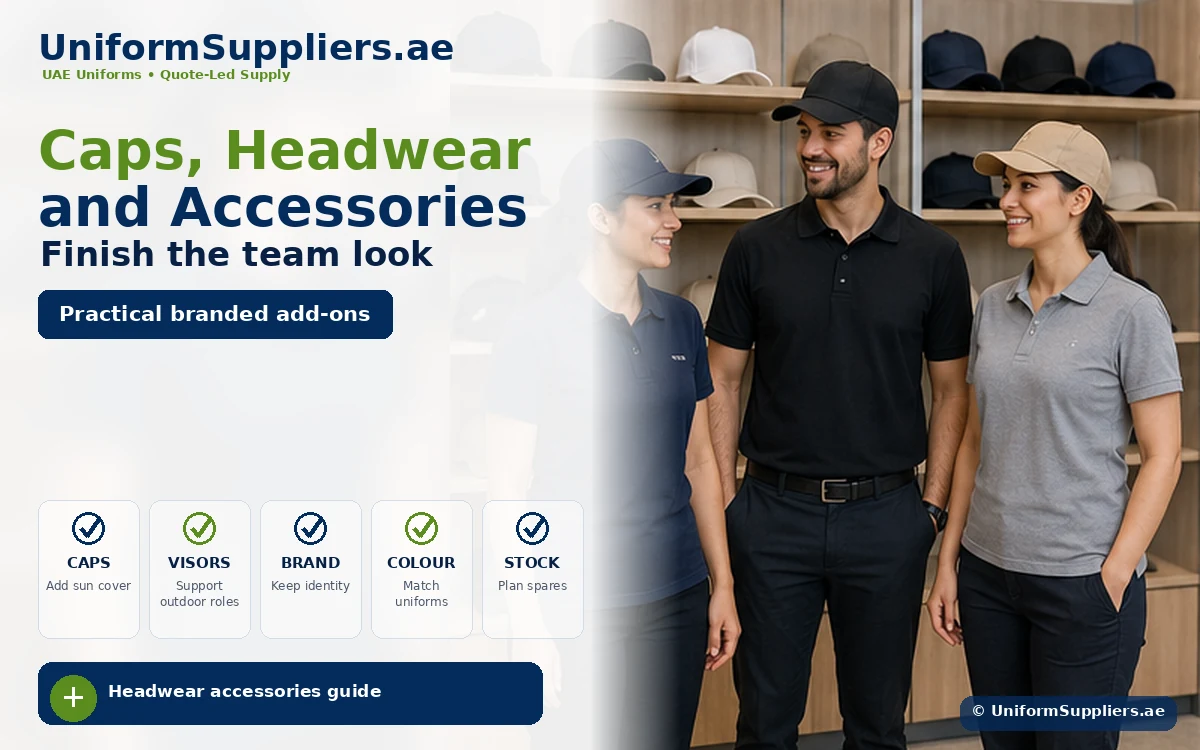
Uniform planning tends to focus heavily on the main garment — the shirt, the polo, the dress — and treat everything else as an afterthought. But caps, headwear and small accessories are often the first thing a customer notices, and they’re frequently the piece that finishes a uniform off or leaves it looking incomplete. Getting this layer right is a small effort for a noticeable improvement in how put-together a team looks.
This guide covers how to choose and brand caps, headwear and finishing accessories for corporate, retail and event teams in the UAE.
In this guide
- Why accessories are worth planning, not defaulting
- Common cap and headwear styles
- Branding methods for caps and headwear
- Other finishing accessories worth considering
- Matching accessories to your existing uniform
- Accessory selection checklist
- FAQ
Why accessories are worth planning, not defaulting
A branded cap, a consistent lanyard colour, or a matching belt can pull an otherwise generic outfit together and make a team instantly recognisable, particularly outdoors or in event settings where a shirt logo might not be visible from a distance. On the flip side, accessories chosen as an afterthought — a cap ordered separately in the wrong shade, or ID badges that don’t match the uniform colour scheme — quietly undercut an otherwise well-planned uniform. Treating accessories as part of the initial uniform brief, not a later add-on, avoids this.
Common cap and headwear styles
The right headwear style depends heavily on role and setting:
- Structured baseball caps — the most common choice for retail, F&B and outdoor event roles, offering a large, clean branding surface on the front panel.
- Unstructured or low-profile caps — a softer, more relaxed look suited to casual retail or hospitality brands.
- Visors — useful for roles needing sun protection without full head coverage, common in outdoor F&B and event settings.
- Beanies or knit caps — for cooler indoor environments like cold storage, or branded giveaways at winter events.
- Sun hats and bucket hats — practical for outdoor event staff and logistics roles working extended hours in direct sun.
Branding methods for caps and headwear
Embroidery is the standard branding method for caps because it holds its shape and colour through repeated wear and washing far better than print on curved, structured fabric. A flat embroidered logo on the front panel is the most legible and durable option for most corporate and retail applications. For lower-cost, short-run event caps, heat transfer or print can work as an alternative, though it typically has a shorter visual lifespan than embroidery. See our embroidery vs printing guide for a fuller comparison of both methods.
Other finishing accessories worth considering
Beyond headwear, a small set of consistent accessories often does more for a polished look than most teams expect:
- Name badges and ID cards — build trust with customers and help internal teams identify colleagues and roles quickly.
- Lanyards — a simple, low-cost way to carry branding colour even where the main uniform is plain.
- Belts — a small detail that’s easy to overlook but noticeable when mismatched with formal trousers.
- Ties and scarves — used in front-of-house hospitality and corporate reception roles to add a formal, branded finishing touch.
- Bags — relevant for delivery, logistics and field-service roles needing a consistent, branded carry solution.
Matching accessories to your existing uniform
The simplest way to keep accessories from looking mismatched is to specify them against the same colour and branding reference used for the core uniform — the same thread colour for embroidery, the same logo file, the same shade reference — rather than approving each accessory separately with a slightly different match. If you’re adding accessories to an existing uniform programme, sharing your current garment’s colour and branding reference with your supplier keeps everything aligned.
Setting a simple accessory brand guideline
For companies with multiple departments or branches ordering accessories over time, a short internal reference — approved logo placement, thread colour code, and which accessory styles are approved for which roles — prevents the slow drift that happens when different managers order slightly different versions of the same item over several years. This doesn’t need to be a formal brand book; a single reference page shared with whoever places uniform orders is usually enough to keep everything consistent.
Ordering accessories in the right quantities
Accessories are often ordered in smaller batches than the main uniform, which can create its own problems if not planned properly. Caps and headwear see heavier daily handling than a shirt worn under a jacket, so they tend to need replacing more often — planning a slightly higher reorder allowance for headwear than for core garments avoids a gap where staff are without a matching cap while a small reorder is processed. Badges and lanyards, by contrast, are usually ordered once per employee and only reordered on loss or role change, so keeping a small buffer stock of blank or common lanyards on hand covers most ad hoc replacement needs without a full reorder each time.
For event-specific accessories — a branded cap or lanyard for a single trade show or company event — ordering against the expected attendee or staff count, with a small margin for last-minute additions, avoids both running short on the day and over-ordering stock that has no use afterward.
Seasonal and event accessory considerations
Accessories are also one of the easiest ways to adapt a uniform for a specific season or event without redesigning the core kit. A beanie or knit accessory can be introduced for a winter trade show or an outdoor evening event without touching the main uniform order, and a lighter visor or sun hat can be swapped in for summer outdoor shifts. For companies running periodic events, corporate days or trade show appearances, keeping a small stock of event-specific accessories separate from day-to-day uniform stock makes it easier to outfit event staff quickly without dipping into regular operational uniform supply.
This approach also gives marketing and events teams some flexibility to introduce a seasonal colour accent or a one-off design for a specific campaign, without requiring sign-off on a full uniform redesign each time.
Accessory selection checklist
| Accessory | Best suited to |
|---|---|
| Structured cap | Retail, F&B, outdoor event staff |
| Visor | Outdoor roles needing sun protection without full coverage |
| Beanie | Cold storage, winter events |
| Name badge / ID card | Any customer-facing or access-controlled role |
| Lanyard | Office and front-of-house roles carrying ID or access cards |
| Tie / scarf | Formal hospitality and corporate reception roles |
| Belt | Roles wearing formal trousers as part of the uniform |
A practical tip for first-time accessory orders
If you’re adding accessories to a uniform programme for the first time, it’s worth ordering a small sample run before committing to a full order — particularly for embroidered caps, where thread colour can look slightly different on a curved cap panel than it does on a flat shirt sample. Reviewing a physical sample against your existing uniform, in the same lighting your team will actually wear it in, catches small colour or sizing mismatches before they show up across an entire order.
FAQ
Is embroidery always better than print for caps?
For most standard corporate and retail caps, yes — embroidery holds up better over time. Print or heat transfer can still make sense for short-run event caps where cost and turnaround matter more than long-term durability.
Can accessories be added to an existing uniform programme later?
Yes, this is common — sharing your current uniform’s colour and branding reference lets us match new accessories to what’s already in use, rather than starting the branding process from scratch.
Do all staff need to wear the same accessories?
Not necessarily — many UAE employers vary accessories by role within the same core uniform, such as a different lanyard colour for supervisors, while keeping the main garment consistent.
What’s the most durable branding option for a cap that gets washed frequently?
Embroidery is generally the most wash-durable option for caps, particularly compared to printed designs, which can crack or fade with repeated laundering.
How do we make sure a new cap order matches our existing uniform colour exactly?
Share your current garment’s colour reference or a sample piece with your supplier so the new order is matched against it rather than approximated from a general colour chart.
How many caps or accessories should we order per employee?
This depends on how frequently the item is worn and washed — headwear used daily outdoors typically needs a higher reorder allowance than an accessory like a lanyard, which sees lighter use. Your account contact can suggest a sensible ratio based on your team’s role and environment.
Can event-specific accessories use a different design to our everyday uniform?
Yes — many companies use a distinct colour accent or a one-off design for a specific event while keeping their core day-to-day uniform unchanged, which is a practical way to mark a special occasion without a full uniform redesign.
Do accessories need to be reordered at the same time as the main uniform?
Not necessarily — because accessories often wear at a different rate than core garments, many companies reorder them on a separate, shorter cycle rather than bundling every reorder together.
Are there accessory options for teams that want a premium, understated look?
Tonal embroidery — logo thread in a close shade to the garment colour rather than a high-contrast colour — is a common choice for corporate and hospitality teams wanting a subtler branded finish on caps and accessories.
Finish your uniform programme with matching accessories
From caps and badges to belts and lanyards, we can help you build a consistent accessory range that matches your existing uniform colours and branding. Read more on our name badges, ID cards and lanyards guide or see our corporate uniforms overview. Request a quote or request a sample to see accessory options.