Special offers: free digital logo mock-up and free samples against a confirmed LPO. View offers
Corporate Dresses and Women’s Corporate Wear: A UAE Guide

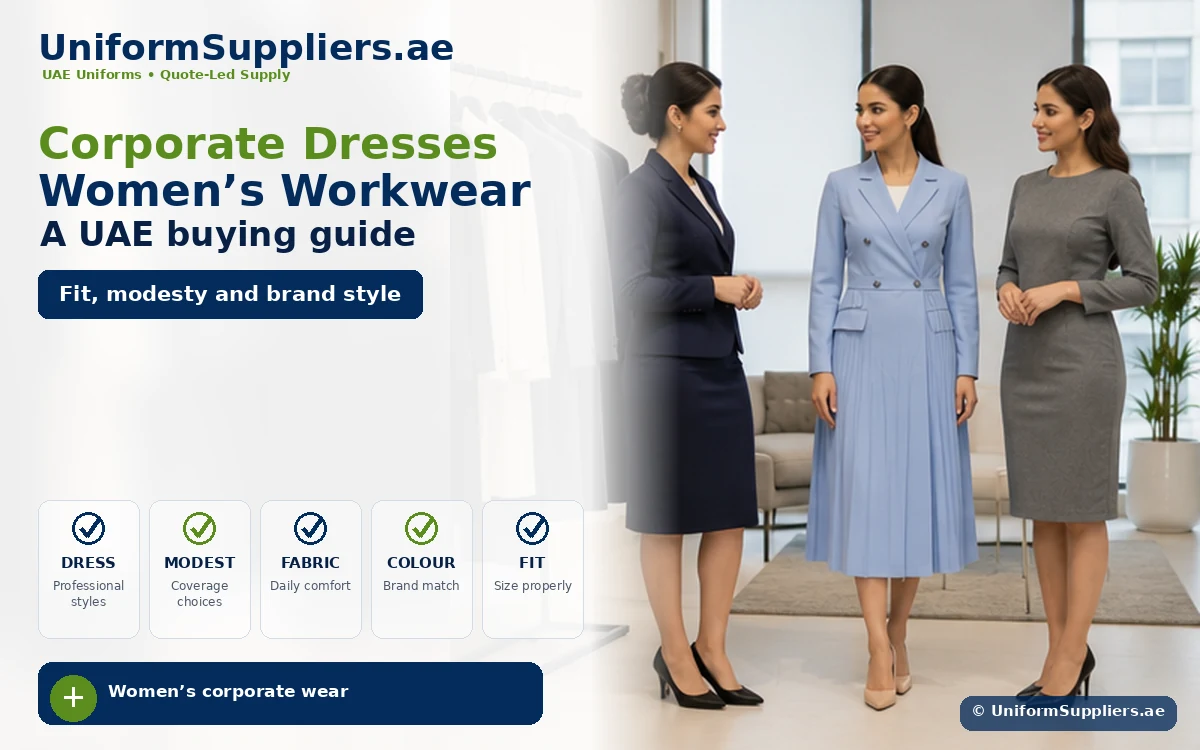
Corporate dress codes across the UAE have grown more flexible, but that flexibility creates its own problem for HR and procurement teams: what does a consistent, professional look actually mean once a workforce includes dresses, tunics, trousers and abayas side by side? A women’s corporate uniform programme built only around shirts and blazers tends to leave gaps – fit issues, inconsistent hemlines, fabric that doesn’t suit an air-conditioned Dubai office, or a range that quietly excludes staff who prefer modest cuts. This guide sets out how to build a corporate dress and knitwear range that looks consistent on every body type, works for the climate, and gives every employee a genuinely comfortable, professional option.
Table of Contents
- Why Corporate Dresses Deserve Their Own Category
- Fabric Choices for UAE Offices
- Core Styles: Dresses, Tunics and Knitwear
- Building In Modest and Inclusive Options From the Start
- Sizing a Dress and Knitwear Range Correctly
- Comparing the Main Style Categories
- Branding a Dress or Cardigan Without Overdoing It
- Building the Programme: A Practical Checklist
- FAQs
Why Corporate Dresses Deserve Their Own Category
Most UAE corporate wardrobes are still designed shirt-first, with a dress or two added as an afterthought. That approach tends to under-serve a meaningful share of the workforce. A well-specified dress and knitwear range does three things a shirt-and-trouser combination alone cannot: it gives staff a genuine styling choice rather than a single default, it accommodates body shapes and personal preference more comfortably than a fitted shirt, and it opens the door to modest, longer-length and layered options without treating them as a special case bolted on separately.
Getting this right at the specification stage – rather than retrofitting it after complaints – saves a full reorder cycle. It also signals, in a small but visible way, that a company’s uniform programme was designed for its actual workforce rather than adapted from a generic template.
Fabric Choices for UAE Offices
Corporate dresses and knitwear live in one of the more demanding environments a garment can face: strong midday sun and heat outside, aggressively air-conditioned interiors, and a commute that moves between the two several times a day. A handful of fabric principles cover most of the decision:
- Mid-weight woven blends (polyester-viscose or polyester-cotton in the 180-220 GSM range) hold shape through a full working day and resist the creasing that pure natural fibres pick up quickly in a car seat or on a commute.
- Ponte and scuba-style knits suit fitted sheath dresses because they recover their shape after sitting and don’t need daily ironing, which matters for a garment worn several days a week.
- Lightweight knitwear – fine-gauge cardigans and layering pieces – should be specified in a blend that resists pilling under repeated laundering, since knitwear is worn as a layer over other garments and gets more friction than a standalone piece.
- Breathability and opacity together. A fabric that is comfortable outdoors but too sheer for the office, or opaque but stifling indoors, will get quiet informal workarounds from staff. Both properties need to be checked, not just one.
Final fabric specification, weight and finish should always be confirmed during quotation once sample garments are reviewed, since supplier mills vary in exactly how a given blend performs.
Core Styles: Dresses, Tunics and Knitwear
A practical women’s corporate range does not need dozens of styles – it needs a small number of well-chosen ones that cover different roles and preferences:
Sheath and A-line dresses
The standard front-of-house or client-facing option. A-line cuts are more forgiving across body types than a fitted sheath and are usually the safer default for a first uniform rollout.
Shirt dresses
A versatile middle ground between a dress and a shirt-and-trouser combination, often popular with staff who want a single-garment option without a fitted silhouette.
Tunics paired with trousers
Tunics extend a corporate shirt programme into a longer, more modest silhouette without requiring a separate dress pattern, and they pair naturally with the same trousers already specified for the wider team.
Cardigans and knitwear layers
Lightweight cardigans solve the single biggest complaint in air-conditioned UAE offices – being cold indoors after being hot outside – while keeping a consistent brand colour palette when worn over a dress, tunic or shirt.
Building In Modest and Inclusive Options From the Start
The most common mistake in corporate dress programmes is treating modest and extended-length options as a special request handled case by case, rather than as a standard part of the range. A more workable approach is to specify every core style – the sheath dress, the tunic, the shirt dress – with a longer-length and higher-neckline variant available from day one, using the same fabric and colour so nothing looks like an exception. This mirrors the inclusive sizing principles covered in our guide to inclusive and diverse uniform sizing, and the two should be planned together rather than as separate projects.
Abaya-style corporate options, where relevant to a company’s workforce, should be specified with the same fabric-weight and durability standards as the rest of the range, not treated as an off-catalogue add-on with a different quality bar.
Sizing a Dress and Knitwear Range Correctly
Dresses are less forgiving of sizing errors than a two-piece shirt-and-trouser uniform, because a poor fit is far more visible in a single-garment silhouette. Two practical steps reduce reorder rates significantly:
- Run a proper size-sample fitting session before finalising quantities, rather than sizing purely from a generic chart – see our onsite measurement service.
- Order a small buffer in the most common two or three sizes rather than spreading the buffer evenly across the full size run, since real-world size distribution is rarely flat.
Comparing the Main Style Categories
| Style | Best For | Fabric Priority | Modesty Flexibility |
|---|---|---|---|
| A-line dress | Front-of-house, client-facing roles | Mid-weight woven blend | Moderate – easy to extend length |
| Fitted sheath dress | Formal corporate, executive roles | Ponte/scuba knit | Lower without a layering piece |
| Shirt dress | Mixed formal/casual offices | Mid-weight woven blend | High – naturally longer and looser |
| Tunic and trouser | Teams already in shirt-and-trouser uniforms | Matches existing shirt fabric | High – longest standard silhouette |
| Cardigan/knitwear layer | All roles, indoor climate control | Fine-gauge anti-pill knit | Adds coverage to any base style |
Branding a Dress or Cardigan Without Overdoing It
Dresses and knitwear carry branding differently to shirts. A small embroidered logo at the chest or sleeve cuff works well on a cardigan; on a dress, a subtle woven label or a single discreet placement (such as a fabric-covered button detail or a narrow trim in the brand colour) usually reads as more polished than a large printed or embroidered mark. Companies weighing embroidery against printing more broadly can review our guide to matching branding method to fabric type before finalising the approach for this category specifically.
Building the Programme: A Practical Checklist
- Confirm which roles will wear dresses/tunics versus shirts and trousers, and whether staff get a choice between the two.
- Select two to three core silhouettes rather than a large catalogue, each with a standard and an extended-length/modest variant.
- Confirm fabric weight and finish against samples for both outdoor comfort and indoor air-conditioning tolerance.
- Run an onsite or in-office fitting session before finalising the size-run quantities.
- Decide on a single, consistent branding placement across dresses, tunics and knitwear.
- Plan a cardigan or knitwear layer as a standard part of the range, not an optional extra.
Our team can walk through sample fabrics and silhouettes as part of a quote request for any company reviewing or introducing a women’s corporate dress and knitwear range.
Care, Laundering and Lifespan
A dress or knitwear piece that looks sharp on day one but loses its shape after ten washes creates more ongoing frustration than almost any other uniform category, because staff wear the same one or two pieces on repeat far more often than a shirt-and-trouser rotation. Two practical steps help extend usable life: specifying a fabric finish that tolerates a normal domestic wash-and-hang cycle without requiring dry cleaning, since most staff will not dry clean a daily work garment consistently, and briefing staff on a simple care routine at rollout – cool wash, no tumble drying for knitwear, and hanging rather than folding sheath dresses to avoid crease lines across the torso. For teams also reviewing wider fabric-care guidance across other categories, our uniform care and laundering guide covers the general principles that apply here as well. Building a simple replacement cycle into the programme from the start – typically an annual top-up order rather than a full reissue – keeps the range looking consistent without requiring a disruptive full reorder each year.
FAQs
Do we need a completely separate size chart for dresses compared with shirts?
Not necessarily a separate chart, but dresses should be fitted against their own sample garments rather than assumed to size the same as a shirt in the same reported size, since cut and stretch vary by style.
Can modest and standard-length options share the same fabric and colour?
Yes, and they should. Using identical fabric and colour across both variants is what keeps the modest option looking like a standard part of the range rather than a separate product.
How many dress styles should a first-time programme include?
Most companies do well starting with two silhouettes – one fitted, one looser or tunic-style – plus a cardigan layer, rather than launching a wide range before seeing how staff respond.
Is knitwear practical for daily wear in a UAE office?
Yes, provided it is specified in a fine-gauge, anti-pill blend suited to frequent wear and washing rather than a heavier consumer-fashion knit not designed for daily use.
Can this range be branded the same way as our existing shirts?
The brand colours and logo can stay consistent, but placement usually needs to be re-thought for dresses and knitwear rather than copying the shirt’s branding position directly – final specification will be confirmed during quotation.