Special offers: free digital logo mock-up and free samples against a confirmed LPO. View offers


Safety Gloves and Hand Protection: A UAE Buyer’s Guide

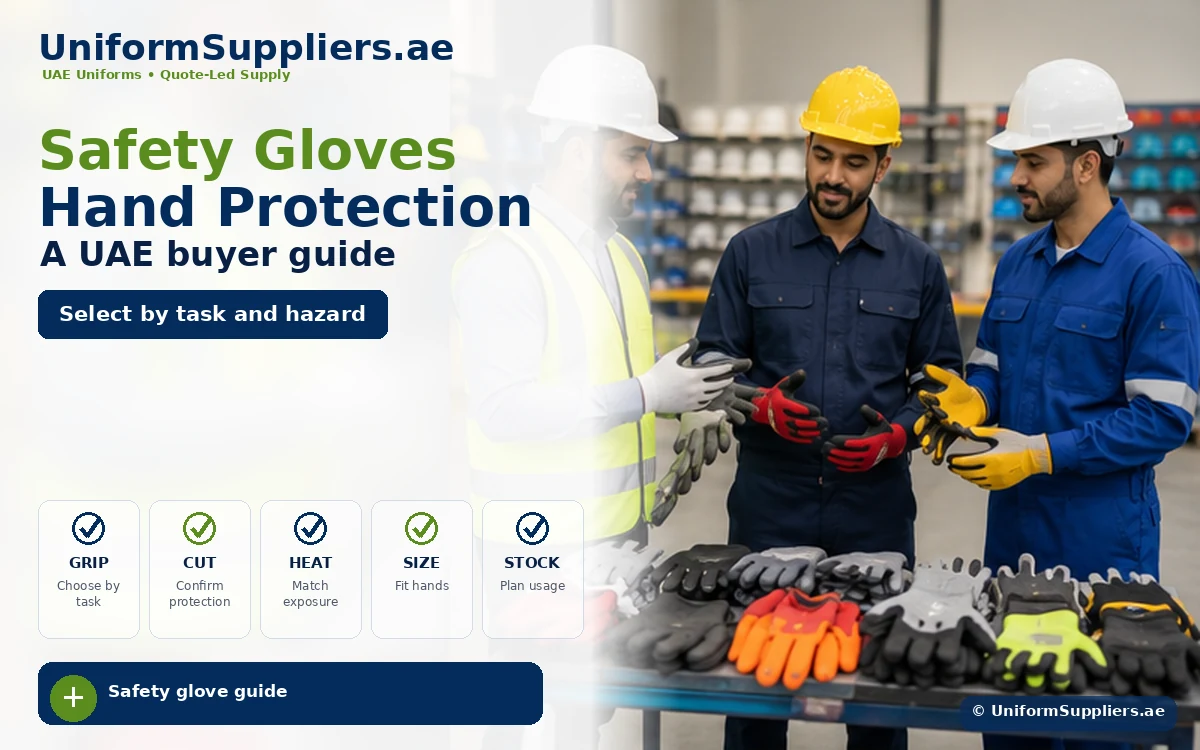
Hand injuries remain among the most common workplace incidents across construction, industrial and warehouse settings in the UAE, yet gloves are frequently the last PPE item properly specified in a uniform programme – often left to individual workers to source themselves, or issued as a single generic type regardless of task. This creates two problems: protection that doesn’t actually match the hazard, and a visibly inconsistent look across a team that is otherwise fully uniformed. This guide covers how to select the right glove types by task, what to look for in fit and durability, and how to build hand protection into a uniform programme properly rather than as an afterthought.
Table of Contents
- Why Gloves Need Their Own Specification
- Main Glove Types and What They’re For
- Matching Gloves to Task and Hazard
- Fit, Sizing and Dexterity
- Comparing Common Glove Categories
- Hygiene, Replacement and Storage
- Branding and Team Consistency
- A Hand Protection Checklist
- FAQs
Why Gloves Need Their Own Specification
General PPE guidance – covered in our safety workwear and PPE guide – sets out the broader employer duties and hazard-mapping process, but hand protection deserves a closer look because a single “safety glove” does not exist as a universal category. Cut protection, chemical resistance, heat resistance and grip in wet or oily conditions each require different glove constructions, and a glove chosen for the wrong hazard can create a false sense of security that is arguably worse than no glove at all.
Main Glove Types and What They’re For
Cut-resistant gloves
Built around a knitted liner reinforced with cut-resistant fibres, these suit tasks involving sheet metal, glass, blades or sharp components. Cut resistance is usually rated on a standard scale, and the correct rating level depends on the specific materials being handled on site.
General-purpose mechanical gloves
A padded palm and flexible knuckle construction, suited to assembly, general handling and light mechanical work where impact absorption and grip matter more than cut resistance.
Chemical-resistant gloves
Nitrile, neoprene or PVC-coated gloves rated for resistance against specific chemical families – the correct glove depends entirely on the chemicals actually in use, since no single chemical-resistant glove protects against every substance.
Heat-resistant gloves
Used around welding, hot surfaces or kitchen environments, typically combining an insulating liner with a heat-resistant outer layer, and rated for a specific temperature and contact-duration range rather than unlimited heat exposure.
Disposable gloves
Nitrile or latex disposables for food handling, cleaning or light chemical contact tasks where a fresh glove per task or per shift is more practical than a reusable pair.
Electrical and insulated gloves
For maintenance staff working near live electrical systems, insulated gloves rated for a specific voltage class are a distinct category from general mechanical protection and should never be substituted with a standard cut-resistant or mechanical glove, since the two protect against entirely different hazards.
Matching Gloves to Task and Hazard
The single most effective step a company can take is mapping glove type to task before ordering, rather than issuing one glove type site-wide. A warehouse team handling packaging has very different needs to a maintenance team working with sheet metal or a cleaning crew using industrial chemicals – see our oil, gas and energy industry guide for an example of how hazard variation plays out across roles on a single site. Where a workforce covers multiple task types, it is usually more practical to issue two or three glove types matched to specific roles than to compromise on a single “does everything reasonably well” option that does nothing particularly well.
Fit, Sizing and Dexterity
An oversized glove reduces both grip and fine motor control, which in practice means workers are more likely to remove it during detailed tasks – defeating the purpose of issuing it at all. Gloves should be sized individually rather than issued in a single “one size fits most” batch wherever the task allows it, and a brief fit-check during rollout, similar in principle to a standard uniform fitting session, catches sizing problems before they become a habit of workers going without protection.
Comparing Common Glove Categories
| Glove Type | Primary Hazard | Typical Use | Reusable? |
|---|---|---|---|
| Cut-resistant | Sharp edges, blades, glass, sheet metal | Fabrication, glazing, metalwork | Yes |
| General mechanical | Impact, abrasion, general handling | Assembly, warehouse, light maintenance | Yes |
| Chemical-resistant | Solvents, acids, cleaning agents | Cleaning crews, workshop fluid handling | Usually yes, task-dependent |
| Heat-resistant | Hot surfaces, welding, kitchen equipment | Welding, kitchen, boiler rooms | Yes |
| Disposable nitrile | Light contamination, food contact | Food handling, light cleaning, healthcare-adjacent tasks | No – single use |
Hygiene, Replacement and Storage
Reusable gloves need a realistic replacement schedule based on visible wear – thinning at the palm, torn seams, or a cut-resistant liner showing through worn fabric – rather than a fixed calendar date that ignores actual condition. Storing gloves in a clean, dry location between shifts, rather than left balled up in a pocket or on a workbench, extends usable life and reduces the buildup of oil or moisture that accelerates material breakdown. Disposable gloves should be treated as genuinely single-use; reusing a disposable glove across multiple tasks defeats its purpose and should be discouraged as standard practice. Where a company issues gloves to a large team, a simple stock-check process – keeping a small buffer of each glove type on hand rather than reordering only once supplies run out – avoids the common situation where workers go without proper protection for days while a reorder is processed.
Branding and Team Consistency
Gloves are rarely branded in the way a shirt or jacket is, but colour-coding by task or department is a practical form of visual consistency worth considering – for example, a consistent glove colour for chemical-handling roles versus general mechanical roles helps supervisors spot at a glance whether the correct glove type is in use on a given task.
Training Staff to Use Gloves Correctly
Issuing the right glove is only half the job – workers also need a short, practical briefing on when to wear it, when to remove it, and how to inspect it before use. Gloves left on during tasks that require fine dexterity often get removed informally and not put back on, which quietly defeats the point of issuing them at all. A brief pre-shift habit of checking gloves for tears, thinning or contamination before starting a task catches most problems before they become an injury, and takes only a few seconds once it becomes routine. Supervisors should also be briefed to spot and correct mismatched glove use – for example, a worker using a general mechanical glove for a chemical-handling task because it was the one available, rather than the correct chemical-resistant option.
General Standards Context
Cut-resistance and chemical-resistance ratings for industrial gloves are typically referenced against recognised international testing standards, which grade performance on a numeric or lettered scale rather than a simple pass/fail. These standards are useful as a shared reference point when comparing glove specifications between suppliers, but Uniform Suppliers UAE does not certify, test or audit gloves on its own behalf – rating information supplied with any glove should be confirmed against the manufacturer’s own documentation at the point of quotation. Buyers with specific regulatory or client-audit requirements should confirm exact standard compliance directly with their glove manufacturer before large-volume procurement.
A Hand Protection Checklist
- Map every task on site to a hazard type before selecting glove categories.
- Avoid issuing a single glove type across a mixed-hazard workforce.
- Size gloves individually where the task requires fine motor control.
- Set a wear-based replacement standard, not a fixed calendar-only schedule.
- Treat disposable gloves as strictly single-use.
- Consider colour-coding by task or department for quick visual verification.
Our team can help map glove types to your site’s specific hazards as part of a broader uniform and PPE quote, or arrange sample gloves via a sample request before committing to a bulk order.
FAQs
Can one glove type cover most tasks on a mixed site?
Rarely effectively. A general-purpose mechanical glove covers light handling reasonably well, but cut, chemical and heat hazards each need a purpose-matched glove rather than a single compromise option.
How do we know what cut-resistance rating we need?
The correct rating depends on the specific materials and tools in use on site; this is best assessed task by task rather than assumed, and can be confirmed during quotation once your hazard list is reviewed.
Should gloves be sized the same way as uniform garments?
Glove sizing is a separate process from garment sizing and should be checked individually per worker where dexterity matters, rather than assumed from body size or garment size.
How often should reusable gloves be replaced?
Replacement should be driven by visible wear and condition rather than a fixed date – thinning, tearing or a compromised liner are the practical signals to watch for.
Can disposable gloves be reused if they still look intact?
No. Disposable gloves are designed for single-task use and reusing them undermines the hygiene and contamination-control purpose they’re issued for, even if they appear undamaged.
Do you supply gloves rated against specific international standards?
Cut and chemical resistance ratings vary by manufacturer and product line; specific standard compliance should be confirmed against the manufacturer’s documentation during quotation, since Uniform Suppliers UAE does not independently certify or audit third-party glove products.
Should office-based staff be issued gloves at all?
Generally no, unless a specific task requires it – issuing PPE to roles that don’t need it dilutes the seriousness with which frontline teams treat their own required protection, and is better avoided outside genuine task-based needs.
Can gloves be branded with our company logo?
Branding on gloves is less common than on garments and is typically limited to a small printed or heat-transferred mark on the cuff, since embroidery is impractical on most glove materials – final options can be confirmed during quotation.