Special offers: free digital logo mock-up and free samples against a confirmed LPO. View offers


Healthcare Footwear and Clinical Clogs: A UAE Guide

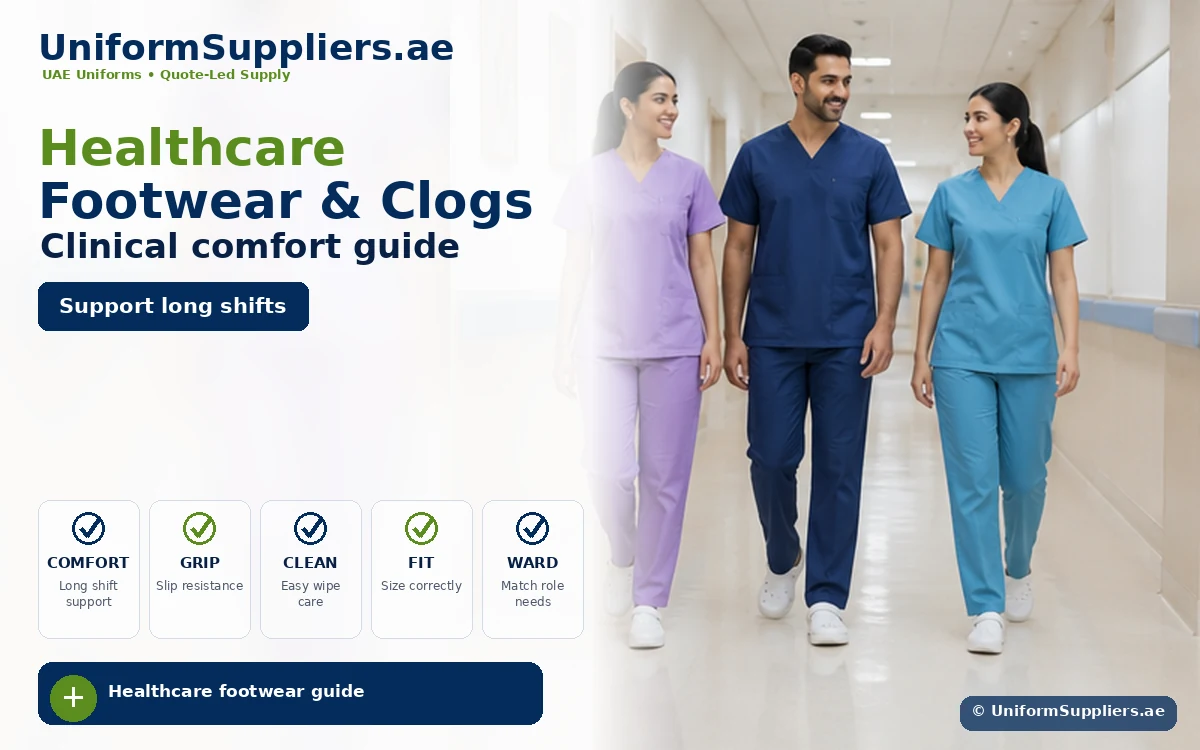
Footwear rarely gets the same attention as scrubs and lab coats when hospitals and clinics plan their uniform programmes, yet clinical staff spend entire shifts on their feet, often on hard hospital flooring, moving quickly between patients and dealing with spills that make slip resistance a genuine safety issue rather than a comfort preference. Generic non-slip shoes bought individually by staff produce an inconsistent look and, more importantly, inconsistent protection. This guide covers what actually matters when specifying healthcare footwear – clog versus closed shoe, slip resistance, cleanability, and how footwear fits into a wider healthcare uniform programme.
Table of Contents
- Why Healthcare Footwear Deserves Its Own Specification
- Clogs, Closed Shoes and Sneakers Compared
- Slip Resistance and Flooring Considerations
- Hygiene, Cleanability and Fluid Exposure
- Comfort for Long Shifts
- Comparing the Main Footwear Types
- Matching Footwear to Role
- A Healthcare Footwear Checklist
- FAQs
Why Healthcare Footwear Deserves Its Own Specification
Our broader guides to healthcare uniforms, fabric and fit and to medical scrubs buying cover garment selection in depth, but footwear is frequently left out of the same planning process entirely, treated as a personal choice rather than part of the uniform standard. That gap matters clinically as well as visually: clinical staff face genuinely different footwear demands to almost any other uniformed role, combining long standing and walking hours with a real risk of fluid spills on hard flooring. Facilities that specify scrubs, lab coats and badges centrally but leave footwear to individual choice often end up with a department that looks coordinated from the waist up and inconsistent from the ankle down – a gap that is easy to close once footwear is treated as a standard line item in the same uniform programme rather than a personal purchase.
Clogs, Closed Shoes and Sneakers Compared
Clinical clogs
The most widely recognised healthcare footwear style, valued for quick on-and-off between shifts and a roomy toe box that suits long standing hours. Closed-back or strapped clog styles are generally preferred in clinical settings over fully open-back designs, since a secured heel reduces slipping and tripping risk during fast movement.
Closed athletic-style shoes
A lace-up or slip-on athletic-style shoe with a healthcare-rated sole offers more ankle stability than a clog and is often preferred by staff who are on their feet continuously rather than moving between short standing and seated tasks.
Consumer sneakers
Standard consumer sneakers, while comfortable, generally lack the fluid resistance, easy-clean surface and slip rating of purpose-built clinical footwear, and staff wearing personal sneakers produce a visibly inconsistent look across a department.
Slip Resistance and Flooring Considerations
Slip resistance should be treated as a genuine safety requirement rather than a marketing term. A rubber or polyurethane outsole with a tread pattern designed for wet, smooth flooring performs meaningfully better than a flat or worn sole, particularly in areas with frequent spills such as scrub rooms, kitchens attached to healthcare facilities, or general ward areas after cleaning rounds. Facilities with particularly demanding flooring conditions should request slip-resistance information directly from the footwear manufacturer at the point of quotation rather than relying on general marketing claims alone.
Hygiene, Cleanability and Fluid Exposure
Footwear in clinical environments needs to be genuinely easy to wipe down and, ideally, resistant to absorbing spilled fluids into the upper material. Closed, non-porous uppers – as opposed to fabric or mesh sneaker uppers – are considerably easier to clean and disinfect between shifts, which matters both for hygiene and for extending the usable life of the shoe. Staff should be briefed on a simple daily wipe-down routine as part of onboarding, similar in principle to the general uniform care guidance in our uniform care and laundering guide.
Comfort for Long Shifts
A cushioned, contoured footbed and a slight heel-to-toe drop reduce fatigue meaningfully over a twelve-hour shift compared with a flat, unsupportive sole. Staff with existing foot or back conditions may need a wider fit or additional arch support, and building a small range of width options into the programme – rather than a single standard fit – avoids staff quietly reverting to personal footwear because the standard option doesn’t work for them. Breathability also matters more than it might first appear: a fully sealed, non-porous upper is easier to clean but can trap heat over a long shift, so many clinical footwear ranges balance a wipeable outer material with a ventilated or moisture-wicking lining to manage both hygiene and comfort at the same time.
Comparing the Main Footwear Types
| Type | Best For | Cleanability | Ankle Support |
|---|---|---|---|
| Closed-back clinical clog | Fast-paced wards, quick shift changes | High – wipeable non-porous upper | Moderate |
| Athletic-style clinical shoe | Continuous standing/walking roles | Moderate – depends on upper material | High |
| Consumer sneaker | Not recommended for clinical settings | Low – fabric uppers absorb fluid | Varies |
Matching Footwear to Role
Not every clinical role has identical footwear needs. Theatre staff spend long periods standing largely in place and often prioritise a supportive, easy-to-disinfect clog; ward nurses covering long walking distances between patients may do better in an athletic-style shoe with more cushioning; and reception or administrative staff in a clinic setting can reasonably wear a smarter closed shoe that still meets a basic slip-resistance standard without the same clinical-grade specification. Building this variation into the programme deliberately, rather than issuing one universal shoe, produces a better outcome for staff comfort without sacrificing consistency in appearance.
Procuring Footwear Across a Department
Rolling out standard footwear across a full clinical department raises different questions to a small uniform reorder. Sizing runs need to account for a genuinely wide range of foot shapes, and unlike a shirt or scrub top, footwear cannot simply be resized after the fact if the initial size run is wrong – a poor sizing decision at the ordering stage tends to result in staff either not wearing the issued shoe at all or wearing it uncomfortably through a full shift. Running a trial with a small group of staff across different roles before committing to a full department order is a practical way to catch sizing and comfort issues early, and mirrors the same logic used for garment fittings via our onsite measurement service. Departments replacing footwear on a rolling basis, rather than all at once, should keep a small buffer stock of common sizes on hand so new joiners and worn-out pairs don’t create a gap in compliant footwear between reorders.
Setting a Simple Footwear Policy
A short, clearly communicated footwear policy – covering approved style, minimum slip-resistance standard, and a basic condition requirement (no visibly worn tread, no torn uppers) – is usually more effective than a long detailed specification document that staff won’t read in full. Making the policy visible during onboarding and periodic uniform checks, rather than only enforcing it reactively after an incident, keeps compliance consistent without needing to single out individual staff members. Where a facility already has a broader uniform policy in place, footwear should be folded into that same document rather than maintained as a separate, easily forgotten standard.
A Healthcare Footwear Checklist
- Confirm slip-resistance rating with the footwear manufacturer for your specific flooring conditions.
- Choose closed-back or strapped styles over fully open-back designs for active clinical roles.
- Prioritise non-porous, easy-to-clean uppers over fabric or mesh materials.
- Offer at least one width option alongside standard sizing.
- Match footwear style to role rather than issuing one universal shoe across the department.
- Brief staff on a simple daily cleaning routine as part of onboarding.
Our team can review footwear samples alongside your existing scrubs and uniform programme as part of a quote request, or arrange a sample request before a full department rollout.
FAQs
Are clogs or closed athletic-style shoes better for clinical staff?
Both work well depending on the role – clogs suit fast on/off changes and largely stationary tasks, while athletic-style shoes offer more ankle support for staff covering long walking distances during a shift.
Can staff wear their own personal shoes instead of a standard clinical shoe?
This is a facility policy decision, but a standard clinical footwear specification is generally recommended over personal footwear, both for consistent appearance and for ensuring every staff member meets a genuine slip-resistance and hygiene standard.
How do we confirm a shoe’s slip-resistance rating?
Slip-resistance information should be requested directly from the footwear manufacturer for your specific flooring type; this can be confirmed as part of the quotation process.
Do all clinical roles need the same footwear?
No. Theatre, ward and reception roles carry different demands, and building in some role-based variation while keeping an overall consistent standard usually produces better comfort outcomes than one universal shoe.
How often should clinical footwear be replaced?
Replacement should be based on visible sole wear and loss of tread pattern rather than a fixed calendar date, since actual wear varies by role, shift pattern and flooring conditions. As a general guide, most facilities find that heavily-used clinical footwear needs replacing well before it looks obviously damaged, since sole grip degrades before the upper shows visible wear.
Can clinical footwear be branded with a facility name or logo?
Branding on footwear is more limited than on garments and is typically restricted to a small embossed or printed mark on the upper or heel strap – available options can be confirmed during quotation.
Should we run a trial before ordering footwear for a whole department?
Yes, this is generally recommended. A small trial group across different roles helps confirm sizing, comfort and slip performance before committing to a full department-wide order.
Do open-back clog styles ever make sense in a clinical setting?
Open-back styles are generally discouraged for active clinical roles due to the higher slip and trip risk during fast movement; a closed-back or strapped style is the safer standard choice for most departments.