


Blog
Uniform Sizing Chart: How to Measure Your Team

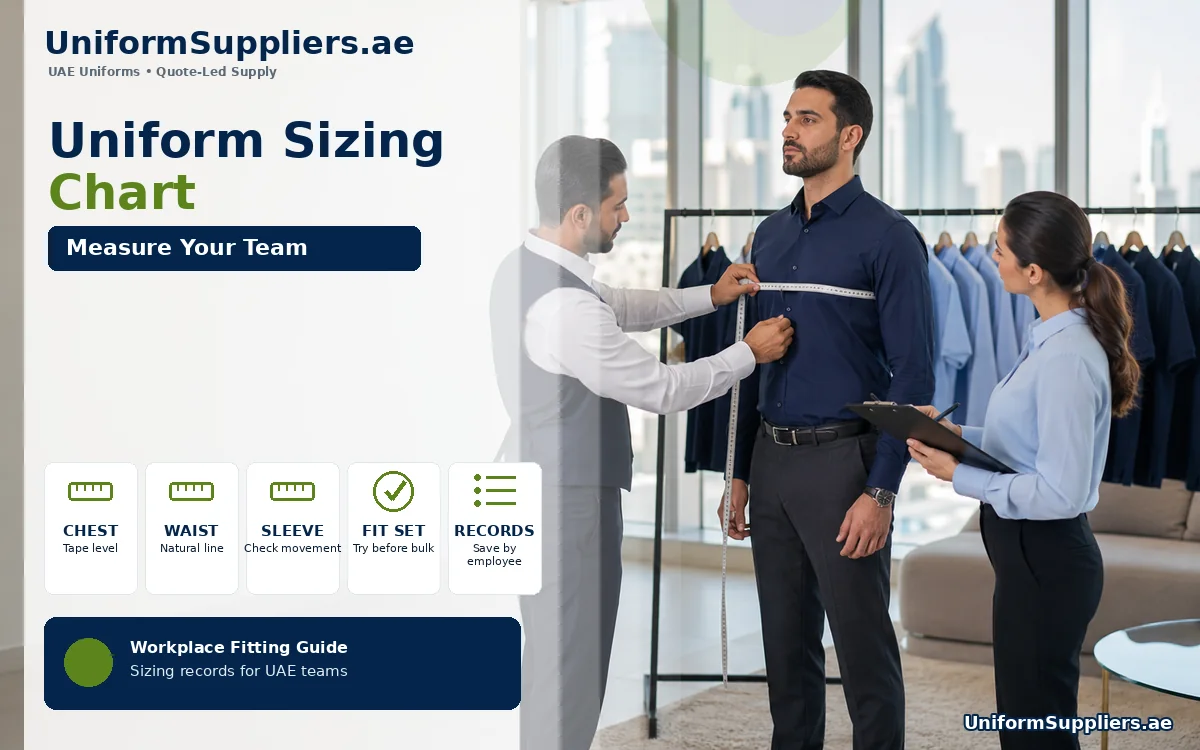
Collecting uniform sizes for a whole workforce looks like an administrative errand until the first delivery is opened. A hundred employees, three branches and a spreadsheet of self-reported sizes usually end the same way: exchanges and a delayed rollout.
The garment is rarely the problem. The size data is. A uniform sizing chart is only as reliable as the measurements fed into it, and in the UAE those measurements come from a workforce drawn from dozens of countries, each with its own idea of what “medium” means.
This guide covers how to measure a team properly, what to record per employee, and how to run a fit-set try-on so the sizes committed at quotation stage are the sizes that fit.
What this guide covers
- Why generic S/M/L charts fail across a multi-nationality workforce
- UK, EU, US and Asian sizing conventions side by side
- Preparing a measurement session
- How to take each measurement, step by step
- The size record template your company should keep
- How to run a fit-set try-on
- Storing size records for new joiners and reorders
- Getting measurements taken for you
- Frequently asked questions
Why generic S/M/L charts fail across a multi-nationality workforce
A letter size is a label, not a measurement. “Large” on a European-cut polo and “Large” on an Asian-cut polo can differ by six to ten centimetres across the chest, and body and sleeve lengths by more. Neither is wrong; they use different base patterns.
A UAE workplace magnifies that gap. In one office you may be dressing colleagues from the Philippines, India, Nepal, Egypt, the United Kingdom and Kenya, most of whom have only bought clothing sized to their home market. Self-reporting adds a second error layer: people give the size they used to wear, or the size printed in an old garment.
The fix is not a better letter chart. It is body measurements in centimetres, recorded per employee and mapped to the chart of the garment being ordered.
UK, EU, US and Asian sizing conventions side by side
The table shows how one chest measurement is labelled under different conventions for a men’s shirt or polo. It is no substitute for the chart of the garment you are ordering.
| Chest (cm) | UK letter | EU numeric | US letter | Common Asian-cut label |
|---|---|---|---|---|
| 88–92 | S | 46 | S | M or L |
| 96–100 | M | 50 | M | L or XL |
| 104–108 | L | 54 | L | XL or 2XL |
| 112–116 | XL | 58 | XL | 2XL or 3XL |
| 120–124 | 2XL | 62 | 2XL | 3XL or 4XL |
Never mix labels from different brands in one order without checking each brand’s chart, and where a chart is published in inches, convert once and record centimetres only.
Preparing a measurement session
Decide first which garments each department receives, because the required fields change: trousers need inseam and hip, jackets need shoulder and sleeve, formal shirts need neck.
- A flexible fabric or fibreglass tape in centimetres — never a steel builder’s tape.
- A record sheet with one row per employee per garment.
- A screened corner, and a same-gender measurer for staff who prefer it.
- A fit set of sample garments in a full size run, where available.
Shift coverage is the real obstacle in most UAE operations. Hotels, facilities contractors, security providers and logistics operators rarely have the whole team on site at once. Book short windows at shift handover, when crews overlap, plus a separate window for nights, and check Ramadan and peak-season schedules before fixing dates.
Measure over light indoor clothing, never over jackets, coveralls or safety gear. Staff stand upright, arms relaxed, breathing normally: a held breath removes centimetres from a chest reading.
How to take each measurement, step by step
One rule applies throughout: the tape sits flat and level all the way round, snug enough not to slip but loose enough to slide a finger underneath. Never pull it tight — garment allowance is already built into the size chart.
Chest
Pass the tape around the fullest part of the chest, across the shoulder blades and under the arms, with the arms down. Keep it parallel to the floor; the commonest fault is a tape riding up at the back.
Waist
Measure the natural waist, the narrowest point of the torso, usually just above the navel. For trousers worn low on the hip, note the intended wearing position too. Do not measure over a belt.
Hip or seat
Measure around the fullest part of the seat with feet together. This is what most often forces a size up on trousers when only the waist was recorded.
Neck
Place the tape at the base of the neck where a collar sits, then allow one to two centimetres of comfort — the classic check is sliding two fingers between tape and neck. Neck size drives formal shirt sizing.
Sleeve length
With the arm slightly bent and the hand on the hip, measure from the shoulder point — the bony tip where shoulder meets arm — down the outside of the arm, over the elbow, to the wrist bone. A straight arm gives a short reading.
Inseam
Measure from the crotch seam down the inside of the leg to the hem, with the employee in the footwear they wear at work. Safety boots change the length, so record footwear type in the notes column.
Shoulder width
Measure across the back from one shoulder point to the other, following the curve of the upper back rather than a straight line through the air. A shoulder that is too narrow cannot be corrected by alteration.
Common errors to watch for
- Pulling the tape tight, which undersizes the whole order.
- Measuring over bulky clothing, adding phantom centimetres.
- A chest tape that is not level front to back.
- Mixing inches and centimetres in one sheet.
- Measuring the garment rather than the body without noting which.
- Skipping hip and neck, then guessing at reorder.
- Recording a letter size only, worthless once the brand changes.
The size record template your company should keep
Build one master record under HR control. These columns are the minimum per employee; add any dimension your programme needs, such as head size for caps.
| Employee name | Employee ID | Department | Branch | Garment | Size | Chest (cm) | Waist (cm) | Inseam (cm) | Notes |
|---|---|---|---|---|---|---|---|---|---|
| A. Fernandes | MU-0142 | Front office | Dubai — Business Bay | Formal shirt | M | 98 | 84 | — | Neck 39 cm; regular fit |
| A. Fernandes | MU-0142 | Front office | Dubai — Business Bay | Trousers | 32 | — | 84 | 78 | Hip 96 cm; formal shoe |
| R. Kumar | MU-0287 | Warehouse | Dubai — Al Qusais | Coverall | XL | 112 | 102 | 80 | Safety boot; roomier fit |
Note the structure: one row per employee per garment. One person may take a medium shirt and a large jacket, and flattening that into a single row is how mixed-size orders go wrong. Keep the employee ID as the key, and for larger workforces add two columns: fit preference and re-measure date.
How to run a fit-set try-on
Body measurements tell you which size to try. A fit set tells you whether it works: one sample garment in each size, in the fabric and cut being ordered, tried on before bulk quantities are confirmed.
Use the recorded chest or waist figure to pick the starting size from the supplier’s chart, then check four things on the body — the shoulder seam at the shoulder point, the chest closing without strain, the sleeve finishing at the wrist bone, and both arms raising fully without the hem lifting.
Staff who fall between sizes need a written policy, not case-by-case judgement. Size up and alter down for structured garments, size down for stretch knitwear such as polos, and size up for anything worn over other clothing.
Mustang recommendation: approve the fit set before signing off bulk quantities, not after. A physical sample in the exact fabric is the cheapest quality control step in a uniform programme, and the last point at which sizing, colour and branding position change without cost. The same logic applies across a full custom range, as set out in our guide to custom uniform manufacturing in the UAE.
Storing size records for new joiners and reorders
The value of a size record is realised on the second order. Turnover in hospitality, security and facilities management makes any uniform programme a rolling replenishment exercise, and every new joiner is a small ordering decision that is easy or slow depending on whether a record exists.
- Keep the master sheet in one place, owned by HR, with a named deputy.
- Add size capture to onboarding, so nobody is measured retrospectively.
- Record the garment and colour reference issued, not only the size.
- Review annually and re-measure anyone raising a fit complaint.
Uniform Suppliers UAE keeps stored specification records for repeat orders, so an approved programme can be re-run against the same garment, fabric and branding details next cycle. Employee-by-employee packing is available, so cartons arrive labelled per person and per branch. For the wider procurement sequence see the uniform ordering checklist or the employee uniform programmes page.
Getting measurements taken for you
Measuring a workforce internally is achievable, but it consumes HR time and depends on whoever holds the tape being consistent across branches. For qualifying company uniform orders in the UAE, Uniform Suppliers UAE provides free onsite individual measurement, with a measurer attending your premises and recording each employee against your garment list. Garments measured by Mustang carry a fit-correction guarantee, so a genuine sizing miss is corrected rather than argued over.
That is usually the better route for multi-branch operations, shift-based teams and any programme where a consistent look across corporate uniforms matters. The data feeds straight into the order and stays on file for the next intake.
To arrange a session at your site, book an onsite measurement. To price the garments first, send your list and quantities through the request a quote page, or read how the onsite measurement service works.
Frequently asked questions
Can we simply ask employees for their sizes?
You can, and many companies start there, but expect a meaningful error rate. Self-reported sizes reflect what someone wore in another country, in a different brand, possibly years ago. Treat them as a starting point for a fit-set try-on, and capture chest and waist in centimetres alongside the letter size.
What is the difference between body and garment measurements?
Body measurements are taken on the person. Garment measurements are taken on a flat, laid-out item, where chest is measured across and doubled. Charts are published either way, so check which applies before using your data. Body measurements are more durable: they stay valid when you change brand or style.
How should we handle staff who fall between two sizes?
Set a written rule rather than deciding case by case. Size up for structured garments such as blazers and formal shirts, where alteration is straightforward. Size down for stretch knitwear such as polos. Size up for anything worn over other clothing, and record the decision in the notes column.
How often should we re-measure the team?
An annual review of the size file suits most companies, with immediate re-measurement for anyone raising a fit complaint or returning from extended leave. High-turnover departments need the onboarding capture step more than the annual review, because most change comes from new faces rather than existing staff.
What should we send a supplier when requesting a quotation?
Provide the garment list, quantity per garment, the size breakdown in the supplier’s own chart, the branding requirement with logo position, and any fabric or colour reference already fixed. If a detail is open, say so rather than guessing. Final specification will be confirmed during quotation.