

Blog
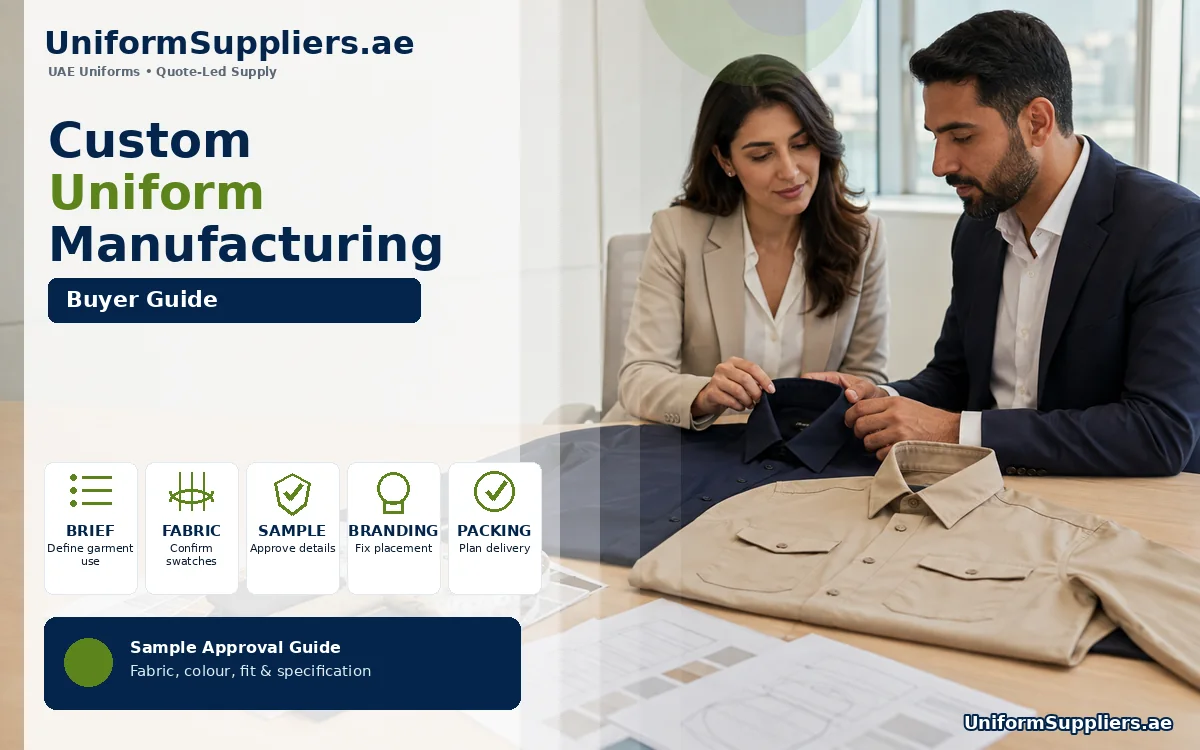
Custom Uniform Manufacturing in the UAE: A Buyer’s Guide

Most companies in the UAE start with off-the-shelf garments. A few dozen polo shirts, a logo on the chest, and the uniform question is answered for a year. It works until the team grows, the branches multiply, or the third reorder arrives in a different shade of navy.
That is usually when custom uniform manufacturing enters the conversation. Custom means the garment is made to your specification — your fabric, pattern, colour, trims and labels — rather than selected from what a supplier already holds.
This buyer’s guide explains how the process runs, what you approve at each stage, and which technical details to lock down before production.
What this guide covers
- When custom manufacturing is worth it, and when it is not
- The manufacturing process, stage by stage
- The technical specification sheet checklist
- Fabric decisions for the Gulf climate
- Controlling colour consistency across repeat orders
- Why the approved sample is the most important document you hold
- Where to go from here
- Frequently asked questions
When custom manufacturing is worth it, and when it is not
Custom manufacturing earns its place when a uniform has to be repeated. A single event or a short pilot is usually better served by ready stock, where the garment exists and only branding is added.
Three situations make custom sensible. The first is multi-branch consistency: when the same role must look identical in Dubai, Abu Dhabi and Sharjah, a specified garment removes the drift that comes from buying whatever a wholesaler stocks. The second is a functional requirement, such as a fabric weight suited to outdoor work. The third is brand ownership: a colour matched to your palette rather than the nearest available shade.
Custom also suits programmes running for several years, because once the pattern, specification and colour reference exist, every later order starts from an approved reference. Many UAE companies run a hybrid: custom for the core garments that define the look, ready stock for high-turnover items and urgent cover.
The manufacturing process, stage by stage
The table sets out the sequence a well-run custom order follows. Read the third and fourth columns carefully: that is where a buyer’s attention changes the outcome.
| Stage | What happens | What you must approve | What to check |
|---|---|---|---|
| 1. Brief | Roles, garments, quantities and working conditions are captured. | The garment list and role breakdown. | Every role is covered, including back-of-house and seasonal staff. |
| 2. Design and spec | Sketches or tech drawings are produced with construction detail. | Style drawings and the written specification. | Pocket, placket, collar and vent details stated, not implied. |
| 3. Fabric selection | Fabric options are proposed with composition and weight. | The chosen fabric and swatch. | Composition, GSM, shrinkage and colourfastness on the datasheet. |
| 4. Pattern and prototype | A pattern is drafted and a first prototype sewn. | The prototype fit and proportions. | Shoulder, armhole and length on a real body, not a hanger. |
| 5. Sample approval | A pre-production sample is made in the final fabric. | The sealed sample, signed and dated. | Everything: colour, fit, stitching, trims, labels, branding. |
| 6. Size set | The approved sample is graded across the full size range. | The size chart and graded measurements. | Grading steps are even and match your measured size data. |
| 7. Bulk production | Fabric is cut and the order sewn against the sealed sample. | Any deviation raised in production. | No substitution of fabric, trim or thread. |
| 8. Branding | Embroidery, printing, sublimation or heat transfer applied. | A branded strike-off before the full run. | Position, dimensions, thread or ink colour, backing and hand feel. |
| 9. Quality control | Garments are inspected against the sealed sample and chart. | The inspection outcome and any rework. | Measurement tolerance, seam quality, shading between batches. |
| 10. Packing and delivery | Garments are sorted, labelled and packed. | Packing method and labelling format. | Cartons match the size breakdown per branch or employee. |
Two checks are skipped more often than any other: buyers accept a size chart without cross-checking their own measured data, and approve branding from a screen image rather than a physical strike-off on the real fabric.
The technical specification sheet checklist
A specification sheet converts an intention into a manufacturable garment, and every field left blank becomes someone else’s decision. Lock down the following before production is released.
- Fabric composition — the exact blend, expressed as percentages, not “poly-cotton”.
- GSM or weight — grams per square metre, with an accepted tolerance.
- Weave or knit — twill, poplin, oxford, piqué, jersey or ripstop, plus yarn count.
- Colour reference — a Pantone or lab-dip reference, plus an approved physical swatch.
- Shrinkage tolerance — the accepted percentage after a stated wash cycle.
- Colourfastness — to washing, perspiration and light, stated on the datasheet.
- Stitch type and density — stitches per inch, and where overlock applies.
- Seam finish — flat-felled, overlocked, bar-tacked stress points, hem depth.
- Thread — type and colour, including contrast topstitching.
- Trims — buttons, zips, press studs, elastic and drawcords, by specification.
- Labels — main, size and care labels with wash instructions and placement.
- Size set — the full graded measurement chart with tolerances per point of measure.
- Branding — technique, position measured from a fixed seam, and finished dimensions.
- Packing — folding, polybag, carton marking, and whether packed per branch or per employee.
Write the branding position as a measurement, never a description. “Left chest” is an argument waiting to happen; “logo centre 90 mm below shoulder seam, 60 mm wide” is a specification. The same discipline applies to size data — if your records are incomplete, fix that first with our uniform sizing chart and measurement guide.
Fabric decisions for the Gulf climate
Fabric choice matters more in the UAE than in most markets, because a working day can move a person between 45 °C outdoors and a heavily air-conditioned interior several times. A garment optimised for one environment is uncomfortable in the other.
For indoor roles, a mid-weight poly-cotton blend holds its shape through frequent laundering and resists creasing across a shift. For outdoor roles between May and September, higher cotton content or a moisture-managing knit improves comfort, though wash care is less forgiving. For roles crossing between the two, a lighter breathable construction is the better compromise.
Three regional factors deserve attention in the specification. Laundering is frequent, often daily, making shrinkage and colourfastness more important than in cooler markets. Sun exposure fades unstable dyes quickly, particularly reds and mid blues. Fine dust settles into open weaves and shows on pale colours.
Ask your supplier to confirm composition, GSM, shrinkage and colourfastness on the product datasheet rather than accepting a verbal description. Our article on fabric and GSM for workwear in the UAE explains how to read those figures.
Controlling colour consistency across repeat orders
Colour drift is the commonest complaint about long-running uniform programmes, and it is almost always a documentation failure rather than a manufacturing one. Dye lots vary. Without a fixed reference, each order is matched to the last delivery and small differences compound until year three looks nothing like year one.
Control it with three habits. Fix a colour reference at the outset — a Pantone number plus an approved lab dip or swatch — and store the physical swatch away from light. Reference that swatch, not the previous shipment, on every purchase order. Where a range spans fabrics, accept that a knit and a woven in the same nominal colour never read identically, so approve them side by side under the same lighting.
For large rollouts, ordering a full cycle in one dye lot removes the problem outright. Otherwise ask for a shade band tolerance in the specification, so there is an agreed standard to inspect against.
Why the approved sample is the most important document you hold
A sealed sample is a physical contract: the garment both parties agreed to, signed and dated, and the reference against which bulk production is inspected. Photographs and digital renders help discussion, but cannot settle a dispute about hand feel, shade or stitch quality.
Sign and date two identical samples, keep one and leave one with the supplier, and attach the specification sheet to both. Store yours somewhere findable: in eighteen months a new procurement officer will need it.
Check the sample on a person, not on a table. Have a member of the actual team wear it for a shift, then judge what a photograph never shows: how the fabric feels against skin in air-conditioning, whether the arms move freely, and where the branding sits when the garment is worn rather than laid flat.
Uniform Suppliers UAE provides free samples against a confirmed LPO, and a free digital logo mock-up beforehand, so branding position is agreed on screen and then verified physically. Specification records are stored for repeat orders, so the approved reference stays available for the next cycle. More detail sits on the uniform sampling page.
Where to go from here
If you are still weighing custom against ready stock, list which garments genuinely need to be specified and which can simply be bought and branded. Most programmes end up mixed: there is no advantage in custom-manufacturing an item that already exists in the right fabric and colour. See ready-stock uniforms.
If you have decided on custom, the practical next step is a physical sample in the fabric you are considering. It settles more questions than any amount of discussion, and everything is still changeable at that point. Request a sample to begin, or send garment details and quantities through the request a quote page.
For a fuller picture of manufacturing capability, garment types and programme structure, see the uniform manufacturer UAE page, and the custom uniform manufacturing service page for the production side.
Frequently asked questions
Is custom manufacturing only for large orders?
Not necessarily, but it suits repeat programmes better than one-off purchases. The setup work — pattern, specification, colour reference, sample — is done once and reused on every later order, so the effort is easier to justify when the garment will be reordered. For trial requirements, branded ready stock is usually more sensible.
What is the difference between a prototype and a pre-production sample?
A prototype tests the idea, often in a substitute fabric, and is expected to change. A pre-production sample is made in the final fabric with the final trims and branding, and it is what you seal and sign. Approving bulk production against a prototype is a common and costly shortcut.
Can we supply our own fabric or specify a particular mill?
Buyer-nominated fabric is normal on established programmes, particularly where a colour or composition is already proven. Confirm who carries responsibility for shrinkage, colourfastness and defects when fabric is buyer-supplied, and agree the inspection point before cutting begins. Final specification will be confirmed during quotation.
How do we stop the colour changing between orders?
Fix a Pantone or lab-dip reference at the start, keep an approved physical swatch away from light, and reference that swatch on every order rather than matching the previous delivery. Ask for an agreed shade band tolerance in the specification, and where budget allows, order a full cycle in one dye lot.
What should a branding approval include?
A physical strike-off on the actual garment fabric, not a screen proof. Check thread or ink colour against your brand reference, the finished dimensions, the position measured from a fixed seam, the backing used, and how the branding feels against skin. Approve the strike-off in writing before the full run.
Can custom and ready stock run in the same programme?
Yes, and most established UAE programmes do. Core garments that define the look are custom-manufactured, while high-turnover items and seasonal additions come from ready stock. Uniform Suppliers UAE supplies both in one programme, including urgent ready-stock supply while custom production is still completing.