Special offers: free digital logo mock-up and free samples against a confirmed LPO. View offers
Sustainable and Ethical Uniforms: A Practical UAE Guide

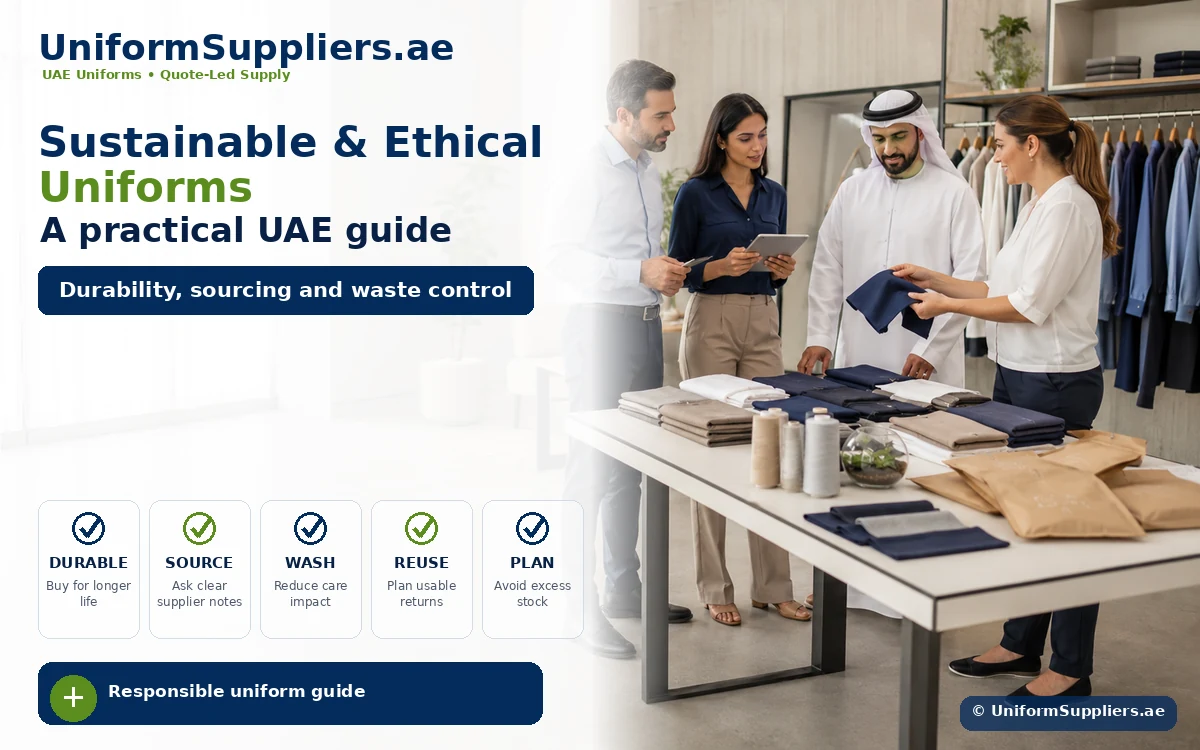
Sustainability questions have reached uniform procurement. A client tender asks what the workwear is made of, an ESG report needs a line about supply chain, or a parent company sends a questionnaire assuming every purchase can be described in environmental terms.
Uniforms are an awkward category to answer for. A garment passes through fibre production, spinning, dyeing, cutting, sewing, decoration and shipping, often across several countries, most of it behind the supplier you deal with.
This guide is written for procurement and ESG leads who need to answer those questions honestly. It explains what common claims mean, what evidence makes a claim real, and where the genuine gains in a sustainable uniforms UAE programme actually sit.
What this guide covers
- Why uniform spend now appears in tenders and ESG reporting
- Claims and evidence table
- What the main schemes actually cover
- The biggest lever: buying the right garment once
- Practical reduction checklist
- Gulf realities: heat, laundering and recycling infrastructure
- Where Uniform Suppliers UAE stands
- Frequently asked questions
- Specifying it in your next quotation
Why uniform spend now appears in tenders and ESG reporting
Large UAE employers increasingly report against group or client ESG frameworks, and those frameworks ask about purchased goods. Uniforms are visible, recurring and easy to name, so they surface more often than their share of spend suggests.
Two things follow. A buyer needs answers that survive scrutiny, because an unsupported claim repeated in a public report is worse than an honest gap. And the specification has to change before the claim can, since nothing becomes sustainable by being described that way.
The practical response is to treat sustainability like any other technical requirement: write it into the tender, ask for evidence, and accept only documentation naming a mill or factory.
Claims and evidence table
These are the claims most often offered to uniform buyers, what each means, and how to convert it into a requirement a supplier can be held to.
| Claim you may be offered | What it actually means | What evidence to request | How to word it in a tender |
|---|---|---|---|
| Recycled polyester content | Some or all of the polyester comes from reclaimed material, commonly post-consumer bottles. The percentage matters and is often modest | A recycled content standard certificate naming the mill, plus a transaction certificate covering your batch | State the minimum recycled content required and require a certificate naming the producing mill for the supplied lot |
| Organic cotton | Cotton grown to an organic scheme. It concerns cultivation, not dyeing, finishing or labour conditions downstream | A scope certificate for the supplying mill and a transaction certificate for the order quantity | Require certified organic cotton with both certificates supplied before production release |
| “Eco”, “green” or “planet-friendly” fabric with no scheme behind it | Nothing verifiable. These words carry no definition and no audit | Ask which scheme, which certificate number and which body issued it. No answer means no claim | State that unsubstantiated environmental descriptions will be disregarded and only named, current certification scored |
| Reduced-water or low-impact dyeing | A process the mill describes as using less water or fewer chemicals than its own conventional route. A process claim, not a product property | A written process description from the dyehouse and any restricted-substance documentation | Ask the supplier to identify the dyehouse and process, and confirm restricted-substance testing on the finished fabric |
| Durability as a sustainability lever | The most defensible claim available: a garment lasting twice as long halves replacement volume | Fabric composition and weight, plus colourfastness and dimensional stability after repeated laundering | Specify minimum fabric weight and require wash-test results at a stated cycle count on the datasheet |
| Ethical manufacturing and audit reports | A factory was assessed against a labour standard on a given date. A snapshot of one site, not a whole supply chain | The audit report or certificate, its date, the auditing body and the exact factory address | Require a current social audit for each named production site, available on request |
| End-of-life or take-back schemes | An arrangement to collect withdrawn garments. What happens next varies from fibre recovery to downcycling into rags | Who operates the scheme, where garments physically go, and the stated end use | Require the operator to be named and the destination described; treat unverified recycling claims as unproven |
What the main schemes actually cover
Knowing the scope of the common schemes lets you read a supplier’s documentation rather than take a summary on trust. None is a general badge of sustainability; each covers a defined and limited thing.
GOTS covers organic fibre textiles through processing, with environmental and social criteria along the chain. OEKO-TEX STANDARD 100 concerns harmful substances in the finished article; it is a human safety standard, not an environmental one. GRS verifies recycled content and chain of custody. BCI is a farm-level cotton programme about growing practices, not a claim about a specific garment.
Two points apply to all of them. A certificate belongs to an organisation and a scope, not to a trading company reselling the fabric, so it should name the mill or factory. And a scope certificate proves eligibility while a transaction certificate ties certified material to your order — a tender asking only for the first is easy to satisfy without certified goods.
The biggest lever: buying the right garment once
The honest position is that the largest environmental gain available to most uniform buyers is not a fibre choice. It is not buying the wrong garment twice.
Uniform programmes waste garments in predictable ways: sizes ordered from a guess and exchanged, a fabric too light for the work, a colour that fades unevenly and forces early replacement, and stock ordered against a headcount that never arrived. Each produces garments manufactured, shipped and barely worn.
Getting sizing right at the point of order removes the biggest single source of that waste, which is why an onsite measurement session and a stored size record matter more than a fabric marketing line. An appropriate fabric weight does the same over a longer horizon; see the guide to fabric GSM for workwear.
Practical reduction checklist
This checklist covers only what a buyer genuinely controls, independent of any supplier claim.
- Buy fewer, better garments. Set the issue quantity per employee deliberately rather than by habit. A smaller number of well-chosen garments in a durable fabric usually outlasts a larger issue of thin ones; see the guide to annual uniform replenishment.
- Get sizing right first time. Measure the team, keep the size record, and check the measurement chart for the style supplied. Exchanges are pure waste: transport, handling and often a garment that cannot be reissued.
- Extend garment life through fabric and care. Specify a weight and construction suited to the work, and issue a clear care instruction. Over-hot washing and tumble drying shorten uniform life faster than wear.
- Repair rather than replace. Seam repairs, replacement buttons and re-hemming keep serviceable garments in use. Decide who does this and where garments are collected, or it will not happen.
- De-brand and redeploy withdrawn stock. Garments withdrawn in a rebrand are often nearly new. Removing branding allows reuse for training or back-of-house roles instead of disposal.
- Consolidate shipments. Combining orders into fewer deliveries, and planning replenishment on a schedule rather than ad hoc, reduces movements — and the urgent air-freighted top-up that no programme intends but most experience.
Gulf realities: heat, laundering and recycling infrastructure
Three regional factors shape what is achievable. Heat and humidity from May to September mean uniforms are laundered more often than in temperate markets, and laundering frequency is a major driver of garment life. A fabric chosen for a cooler climate wears out sooner.
Commercial laundering compounds this. Hospitality, healthcare and facilities garments are processed at high temperatures with strong chemistry, and a garment specified without that in mind fails early however it was made.
Regional textile recycling capacity is also limited. Mixed-fibre workwear with prints, trims and embroidery is difficult to recycle anywhere, and Gulf options are narrower than in markets with established collection systems. Reuse, repair and de-branded redeployment are more realistic than recycling for most withdrawn stock, and honest reporting should say so. The same applies to short-life garments such as promotional t-shirts and event crew kit.
Where Uniform Suppliers UAE stands
Uniform Suppliers UAE does not claim certification on its own behalf and will pass through whatever documentation the fabric or garment source provides.
A certified fabric is therefore something you specify in your tender and the supply chain evidences with a valid certificate naming the mill or factory. Where a fabric’s certification status, composition or test data is not confirmed at enquiry stage: final specification will be confirmed during quotation.
What needs no certificate is the durability side: a considered fabric weight, correct sizing, a stored specification for repeat orders and a structure that avoids over-ordering. Those are the mechanics of an employee uniform programme, and they apply equally to corporate uniforms and industrial workwear.
Frequently asked questions
Are recycled polyester uniforms actually better?
Recycled polyester diverts material from waste streams and is a legitimate specification, but the benefit depends on the recycled percentage and on the garment lasting. A low-content recycled garment that fails early is worse than a durable conventional one. Specify a minimum content, require a certificate naming the mill, and set durability requirements too.
What is the difference between a scope certificate and a transaction certificate?
A scope certificate shows an organisation is certified to work with certified material within a defined scope. A transaction certificate links a specific shipment to a specific buyer and order. A supplier can hold a valid scope certificate and still supply uncertified goods, so require both.
How should we word a sustainability requirement in a uniform tender?
Write it as a measurable specification, not an aspiration: state the minimum recycled or organic content, name the scheme, require current certificates identifying the mill or factory, and ask for wash-test and colourfastness data. Add that unsubstantiated descriptions such as “eco” will not be scored.
Is durability really a sustainability argument?
It is the most defensible one available. Every garment avoided removes the impact of making, decorating and shipping it. An appropriate fabric weight, correct sizing and a construction suited to the laundering regime reduce replacement volume, and unlike most fabric claims this can be verified through wash testing and service life.
Does Uniform Suppliers UAE operate a take-back or recycling scheme?
No. Uniform Suppliers UAE does not claim certification on its own behalf, does not operate a take-back or recycling programme, and passes through whatever documentation the fabric or garment source provides. For withdrawn stock, de-branding and internal redeployment are usually the most practical route.
How do we know when uniforms genuinely need replacing?
Replace on condition rather than on the calendar. Fading that no longer matches the brand palette, thinning fabric, failed seams and stretched collars are the usual triggers, and a periodic condition check is more accurate than a fixed cycle. The article on signs it is time to upgrade uniforms covers the assessment.
Specifying it in your next quotation
Bring the requirement in writing: the fibre and content you want, the scheme you will accept, the evidence you require and when it must be produced. That is a specification a supply chain can be tested against, unlike a general request for something sustainable.
Uniform Suppliers UAE, the uniform brand of Mustang Advertising Trading LLC, has operated from Dubai since October 2007 and can quote against a written sustainability specification, sourcing to the requirement and passing through the documentation the source provides. Repeat-order specifications are stored so replacements match without re-specifying.
Request a quote with your sustainability wording attached, and the requirement can be priced and evidenced as part of the quotation.