Special offers: free digital logo mock-up and free samples against a confirmed LPO. View offers


Nurse Uniforms: Balancing Comfort, Hygiene and Identity

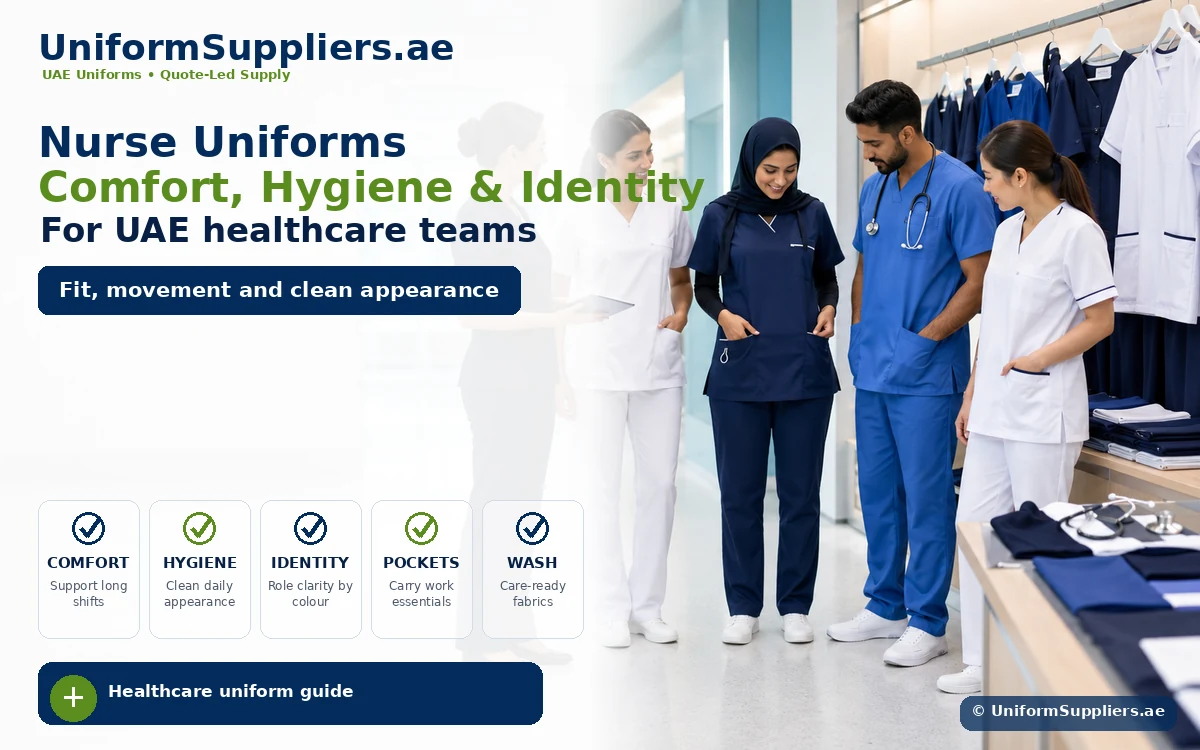
A nurse’s uniform works harder than almost any other garment in a UAE workplace. It is worn for 8 to 12 hours at a stretch, through fast walking, bending, lifting and reaching, in buildings that swing between cool air conditioning and warm corridors, and it still has to look presentable at the end of the shift.
This guide looks at the nurse uniform from the wearer’s side: what makes a shift more comfortable, how the design should work with the tools nurses carry, what hygiene practice looks like day to day, and how a well-designed uniform supports patient trust and quick recognition on a busy ward. For fabric technical detail, fit and modest-dress options and the department colour-coding framework, see our companion guide on healthcare uniform fabrics, fit and compliance. For bulk scrub buying guidance, see the medical scrubs buying guide for UAE clinics and hospitals.
Uniform Suppliers UAE, part of Mustang Advertising Trading LLC, has supplied uniform programmes across the UAE since October 2007, including for healthcare teams.
What this guide covers
- Comfort through a long shift
- Functional design: pockets, movement and everyday tools
- Hygiene practice from a nurse’s perspective
- Identity, trust and ward recognition
- Checklist: what to look for in a nurse uniform
- Frequently asked questions
Comfort through a long shift
Most UAE hospitals and clinics run nurses on long shifts, often 12 hours, sometimes back to back across a rota. Over that time, small discomforts compound. A collar that rubs, a waistband that digs in when seated, or a fabric that traps heat becomes noticeably worse by hour ten than it felt at hour one.
The UAE climate adds its own layer. Outside, summer heat and humidity from May to September are intense; inside, wards and clinics are often heavily air-conditioned. Nurses move between these zones repeatedly during a shift, sometimes stepping out to a car park, an ambulance bay or a covered walkway. A uniform that breathes well and manages moisture helps the body cope with that swing rather than fighting it all day.
Stretch fabric matters as much as breathability. Nursing is physical: bending to adjust a bed, reaching for equipment on a high shelf, crouching beside a wheelchair, walking briskly between rooms. Modern scrub and tunic fabrics with two-way or four-way stretch move with the body instead of against it, which is one reason many nurses now prefer a stretch-blend scrub over a stiffer traditional weave. Lighter, mid-weight fabrics that still hold their shape after repeated washing also tend to suit the UAE indoor climate better across a full shift than heavier weaves.
Functional design: pockets, movement and everyday tools
A nurse’s uniform is also a piece of equipment, carrying a pen or two, trauma shears, a torch, a phone, an ID badge and hand sanitiser through a shift, without any of it falling out, digging in, or getting in the way when leaning over a bed.
Pocket placement is one of the most practical things to get right. A chest pocket sized for a pen and a badge clip sits within easy reach and keeps the ID visible, which matters both for quick checks and for patients seeing a name and role at a glance. Side or cargo-style hip pockets, deep enough to hold a phone securely when bending, are valued far more by working nurses than a uniform that simply “looks” clinical. A dedicated pocket for shears or a torch, positioned so it does not catch on bed rails or trolleys, avoids one of the more common minor snags reported on busy wards.
Freedom of movement extends beyond stretch fabric. Underarm gussets, side vents, and a slightly looser cut through the shoulders let a nurse reach overhead or lift without the top riding up or straining at the seams. An elasticated or drawstring waist, rather than a rigid fitted waistband, keeps trousers comfortable through a shift that includes sitting, crouching and standing for long stretches. Extra fabric, oversized rarely-used pockets, or decorative details that snag on equipment add weight and risk without adding function — the best-performing nurse uniforms are designed around what is actually carried and done during a shift, not how a garment looks on a hanger.
Hygiene practice from a nurse’s perspective
Hygiene is central to how a nurse thinks about their uniform, but from the wearer’s side it is mostly a question of practical habits rather than technical specification. Many nurses change into a fresh uniform at the start of each shift and change out of it before leaving the facility, a habit supported by facilities that provide changing areas and laundering arrangements. The uniform itself needs to support that routine rather than complicate it.
This is where easy-care fabric behaviour becomes a daily, lived concern rather than an abstract spec. A uniform that survives frequent hot laundering, sometimes daily, needs to resist shrinking, pilling and colour fade so it still looks and fits correctly after dozens of wash cycles. A fabric that stretches out of shape or fades noticeably after a few weeks of hot washing quickly stops looking professional, even if it started out well fitted. Quick-drying fabric also matters practically where laundry turnaround time between shifts can be tight.
General infection-control awareness also shapes everyday habits: keeping sleeves short or easily rolled for hand hygiene, avoiding loose ties or drawstrings that could contact a patient or a surface, and choosing fabric that does not visibly hold odour between washes. These are practical, day-to-day considerations nurses build into their routine rather than clinical claims about a particular garment. Department-level colour-coding, where different colours identify different wards or roles, is a separate facility-level framework covered in detail in our healthcare uniform fabrics, fit and compliance guide.
Identity, trust and ward recognition
A consistent, well-fitted uniform does real work for patient trust. In a busy ward or clinic, patients and visitors are often anxious and unfamiliar with the building. Being able to identify a nurse quickly, by uniform colour, style and a clearly visible badge, reduces confusion and helps patients feel oriented and cared for from the first interaction.
UAE healthcare teams are frequently multinational, with nurses and support staff from many different backgrounds working the same ward. A shared uniform standard becomes a genuine unifying identity marker in that context: it signals team membership and consistent professional standards regardless of where an individual nurse trained. For newer staff, wearing the same well-designed uniform as experienced colleagues supports a sense of belonging to the team from day one.
Ward and department recognition also has a practical, everyday function beyond first impressions. Colleagues from other departments, porters, physicians doing rounds and administrative staff often rely on uniform cues to identify who is best placed to help with a request. A uniform that stays consistent, clean and correctly fitted across the whole nursing team supports that quick recognition far better than a mix of ageing, mismatched garments.
None of this depends on elaborate design. Consistency, a correct and flattering fit for a range of body types, and a uniform that still looks sharp after a full shift do more for professional identity than logos or trim. That is also why fit correction matters: a uniform measured and fitted properly for each individual nurse looks considerably more professional than a generic size-run garment.
Checklist: what to look for in a nurse uniform
Use this checklist when reviewing a nurse uniform or briefing a supplier on a new one. It focuses on features that affect a nurse’s actual shift, not appearance alone.
- Pocket placement — a chest pocket for pen and badge, a secure hip or cargo pocket for a phone, and a dedicated pocket for shears or a torch positioned away from bed rails.
- Stretch panels — two-way or four-way stretch fabric, or stretch panels at the back and underarms, to support bending, reaching and lifting.
- Moisture-wicking performance — a fabric finish that pulls sweat away from the skin and dries quickly between the air-conditioned ward and warmer areas.
- Easy-care fabric — resistance to shrinking, pilling and colour fade under frequent hot laundering, so fit and appearance hold up over months of daily washing.
- Comfortable waistband — elasticated or drawstring trousers that stay comfortable through long periods of sitting, standing and crouching.
- Breathable underarm and back panels — mesh or vented panels to manage heat during fast-paced periods on the ward.
- Durable seams — reinforced stitching at pocket corners and high-movement seams.
- Correct individual fit — fitted to the individual nurse, not just a standard size chart, for comfort and appearance.
Mustang recommendation: where a hospital or clinic is reviewing nurse uniforms for a team, free onsite individual measurements are available in the UAE for qualifying company uniform orders, so each nurse is fitted individually rather than assigned a generic size. See onsite uniform measurement, or arrange a fitted programme across a department through employee uniform programmes.
Frequently asked questions
How often should a nurse’s uniform be replaced?
There is no single fixed answer, as it depends on laundering frequency and wear on a given roster. A practical approach is to check garments regularly for fading, thinning fabric or stretched-out seams and waistbands, and replace individual items as they show wear rather than waiting for a full annual changeover.
What fabric weight works best for UAE hospital wards?
Most nurses find a lighter to mid-weight stretch-blend fabric more comfortable across a full shift in an air-conditioned UAE ward than a heavier, stiffer traditional weave. Final fabric weight and composition should be confirmed during quotation to match the ward environment and laundering method used.
Can nurse uniforms be fitted individually rather than by standard sizing?
Yes. Free onsite individual measurements are available in the UAE for qualifying company uniform orders, allowing each nurse to be measured and fitted rather than relying on a generic size chart, which improves both comfort and how consistently professional a team looks.
Do nurse uniform colours need to follow a strict department code?
Many UAE facilities use colour to distinguish departments or roles, which supports quick recognition for patients and colleagues. The framework for setting up department colour-coding is covered separately in our healthcare uniform fabrics and compliance guide, since it is a facility-level decision rather than an individual comfort feature.
How many pockets does a nurse uniform actually need?
Enough to carry the items used every shift without overloading the garment: typically a chest pocket for a pen and badge, a secure pocket for a phone, and a dedicated pocket for shears or a torch. More than that can add bulk without adding practical use.
Does uniform fit really affect how patients perceive a nurse?
Fit has a noticeable effect on how professional a uniform looks, even when fabric and colour are identical across a team. A well-fitted uniform, consistent across the department, supports the quick, confident recognition that helps patients feel oriented and cared for.
What is the easiest way to keep a nurse uniform hygienic between washes?
The main practical steps are changing into a fresh uniform for each shift, choosing fabric that resists holding odour and stands up to frequent hot laundering, and avoiding loose ties or excess fabric that can contact patients or surfaces. These habits, combined with an easy-care fabric, do most of the work day to day.
For the wider healthcare uniform range, visit our healthcare uniforms UAE pillar page or the healthcare industry page.
To have your nursing team measured individually and fitted with uniforms designed around comfort, function and identity, request a quote from Uniform Suppliers UAE.