Special offers: free digital logo mock-up and free samples against a confirmed LPO. View offers


GCC Uniform Supply: A Guide to Multi-Country Rollouts

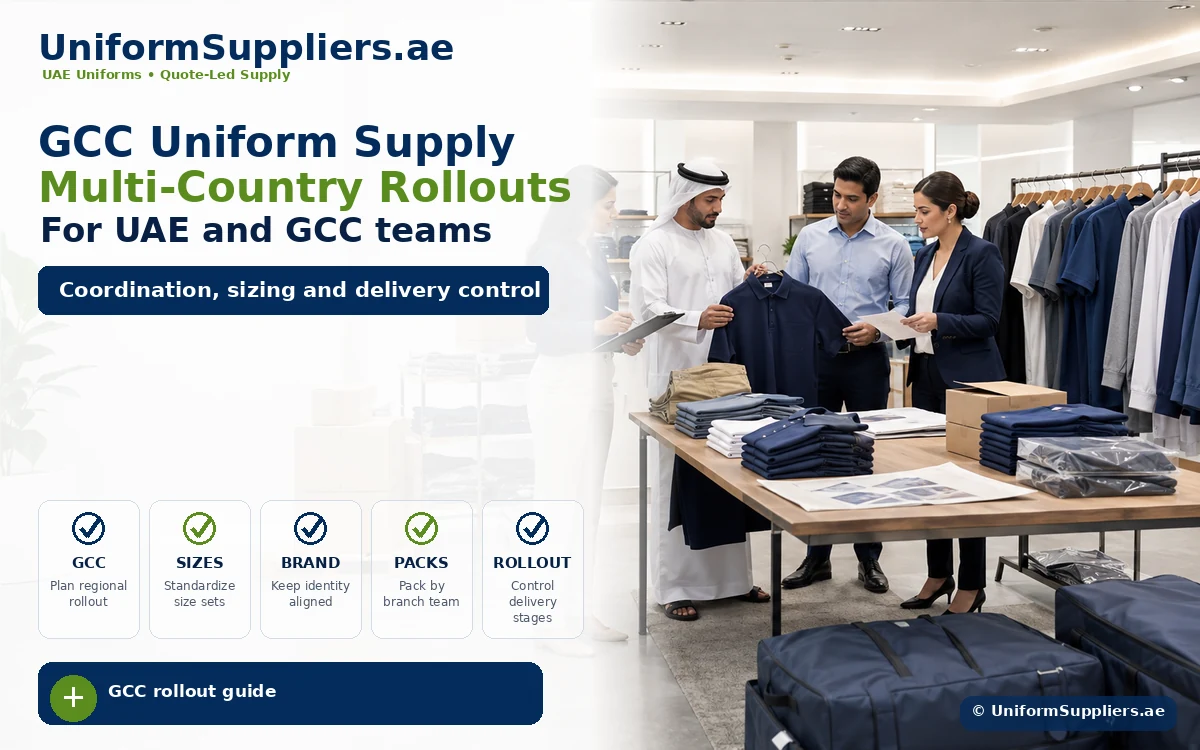
When a UAE-based business grows into Saudi Arabia, Qatar, Oman, Bahrain or Kuwait, uniforms rarely stay high on the priority list until a new site is close to opening. By then the buyer is often trying to match an existing UAE specification across several countries at once, with different HR teams, different budgets and very little shared history between them.
A multi-country uniform rollout is not simply “order the same shirt six times.” It involves keeping one specification consistent, deciding where sizing is collected, planning how garments move between countries, and coordinating purchase orders across separate legal entities that may each have their own procurement rules.
This guide sets out a practical way to plan a GCC-wide uniform rollout from a UAE base, covering specification control, sizing, logistics, procurement coordination and phasing. It draws on general GCC project coordination and delivery practice rather than country-specific promises, since customs and freight timelines vary by shipment and are confirmed at quotation stage.
What this guide covers
- Why a GCC rollout is different from a single-site order
- Keeping specification and branding consistent across countries
- Centralised vs local sizing collection
- Delivery and logistics planning across borders
- LPO and procurement coordination for multi-entity groups
- Planning a phased rollout
- Specification-consistency checklist
- Working with a single coordination point
- Frequently asked questions
Why a GCC rollout is different from a single-site order
A single-site uniform order has one HR contact, one delivery address and one set of sizes to collect. A GCC rollout multiplies every one of those variables. Each country may have a separate operating entity, a separate finance sign-off chain and a local HR or facilities contact who has never dealt with uniforms before.
The garment itself also has to work across a wider range of conditions. A polo shirt specified for a Dubai office needs to perform just as well in Riyadh’s summer heat, in an air-conditioned Doha mall, or in a Muscat warehouse with more manual movement. Fabric weight, colour stability and cut should be reviewed once for the whole group rather than re-decided site by site.
Recognising these differences early — before the first local order goes out — is what keeps a six-country rollout looking and feeling like one brand instead of six loosely related ones.
Keeping specification and branding consistent across countries
The starting point for any GCC rollout is a single master specification document: fabric, GSM, colourway, logo placement, embroidery or print method, and sizing standard. This document should be agreed once at group level, then issued to every country as the fixed reference — not re-negotiated locally.
Fabric and construction
Locking fabric composition and weight at group level avoids the common problem where a local supplier substitutes a “close enough” fabric because the original was unavailable. Ask any supplier to confirm the exact GSM and blend against the master specification before cutting, and to flag any proposed substitution for approval rather than making the change quietly.
Logo, colour and branding rules
Logo colours, thread codes and placement measurements should be documented once — ideally with a signed-off digital mock-up — and referenced by every country team. This prevents the drift that happens when five different embroidery operators each make a small, independent judgement call on where a crest sits on a collar.
Sizing standard
Even the sizing chart itself should be shared across countries, since regional size labelling can vary between suppliers. A single UAE-based reference chart, tied to actual body measurements rather than label size alone, keeps a “medium” consistent whether it is issued in Dubai or Manama.
Centralised vs local sizing collection
Sizing is usually the first practical decision a multi-country buyer has to make: collect measurements centrally through one process, or let each country handle its own sizing locally.
Onsite individual measurement is available free of charge in the UAE for qualifying company uniform orders, which makes it a strong option for UAE headquarters staff and any group-wide launch event held in the UAE. For teams based outside the UAE, sizing typically has to be collected locally by the on-the-ground HR or facilities team, using a shared size chart and a standard measurement or self-reported sizing form issued from the UAE side.
A hybrid approach works well in practice: measure the UAE population directly, and issue a simple, standardised sizing form and reference chart to each other country so that local HR teams collect and submit data in the same format. This keeps the sizing dataset consistent even though the collection method differs by location.
Delivery and logistics planning across borders
Moving uniforms between GCC countries involves cross-border freight, and every shipment has its own customs and documentation requirements depending on quantity, value and destination. Rather than assuming a fixed delivery timeline, build the rollout plan around confirmed dates at quotation and dispatch stage for each shipment, with enough buffer before the target wear date.
It helps to think in terms of shipment batches rather than one single group-wide delivery. A large first-phase order to the UAE, followed by staged batches to each other country as local launch dates are confirmed, is usually easier to plan and track than trying to align every country to one delivery date.
Because customs and freight specifics differ by shipment, treat any date discussed before a purchase order is confirmed as indicative. Final delivery windows are confirmed once quantities, destination and documentation are set at quotation stage — this is a normal part of GCC project coordination and delivery for a multi-country order.
LPO and procurement coordination for multi-entity groups
Many GCC groups operate as separate legal entities per country, each with its own LPO process, budget owner and approval chain. Coordinating uniform procurement across these entities works best when there is one group-level point of contact who holds the master specification and one local point of contact per country who raises the actual LPO.
A simple two-tier structure
The group-level contact — often a regional HR or procurement lead — owns the specification, the pricing conversation and the supplier relationship. Each country’s local contact then raises its own LPO against the agreed specification and quantities, keeping local finance sign-off intact without renegotiating the product itself.
Documentation each entity will need
Every country’s LPO should reference the same specification code, the same garment images or mock-up, and the same size chart used elsewhere in the group. Keeping this documentation consistent across entities is what allows a supplier to quote and produce efficiently, and it gives each local finance team a clear, auditable basis for their own PO.
Planning a phased rollout
Rolling out uniforms to six countries at once is rarely realistic. A phased plan — grouped by country readiness, headcount, or launch date — is easier to manage and easier to correct if an issue appears in an early phase before it reaches the rest of the group.
| Phase | Typical activity | Lead consideration |
|---|---|---|
| Phase 1 — UAE baseline | Finalise master specification, sample approval, onsite measurement for UAE staff | Get sign-off on fabric, colour and fit before any other country orders |
| Phase 2 — First external country | Issue specification pack and sizing form; local HR collects sizing; LPO raised locally | Allow time for local sign-off and sizing collection before production is confirmed |
| Phase 3 — Remaining countries | Repeat the Phase 2 process per country, staggered by readiness | Stagger rather than batch together, so learnings from earlier phases are applied |
| Phase 4 — Steady state | Repeat and replenishment orders using stored specification records | Specification is already on file, so reordering references the approved pack rather than starting again |
Treat the lead-consideration column as planning guidance rather than a promise of specific days or weeks — every shipment’s actual timeline is confirmed once quantities and destination are set at quotation stage.
Specification-consistency checklist
Before extending an order to a new country, it is worth working through a short checklist to confirm nothing has drifted from the master specification.
- Fabric composition and GSM match the master specification, with any substitution flagged and approved in writing.
- Logo colours, thread codes and placement measurements are taken from the signed-off digital mock-up, not re-interpreted locally.
- The sizing chart used matches the group reference chart, not a local supplier’s own size labelling.
- Local HR or facilities has a named point of contact for sizing collection and delivery coordination.
- The LPO references the same specification code and quantities agreed at group level.
- A sample or mock-up has been approved locally before the full run is confirmed, especially for a country ordering for the first time.
Working with a single coordination point
For a multi-site or multi-country workforce, it is generally easier to manage the whole rollout through one supplier relationship rather than sourcing separately in each country. Uniform Suppliers UAE, part of Mustang Advertising Trading LLC, has been supplying uniforms from Dubai since October 2007, with production and warehouse operations in Dubai, including Al Qusais Industrial Area, and additional storage in Sharjah.
An employee uniform programme set up on this basis combines ready-stock supply for urgent needs with custom manufacturing for the full specification, all tracked against one set of stored repeat-order specification records — useful when a second or third country phase begins months after the first. For background on setting up the wider programme structure this rollout sits inside, see the guide to choosing and vetting a uniform supplier in the UAE.
To start planning a phased, multi-country order, request a quote and outline the countries, approximate headcounts and target phase dates so the specification and logistics conversation can begin from a single brief.
Frequently asked questions
Do we need a separate uniform supplier in each GCC country?
Not necessarily. Many groups coordinate the full specification, branding and production centrally from the UAE, then manage local delivery and LPOs per country. This keeps the garment consistent across the group and avoids re-approving the same specification in every market. GCC project coordination and delivery is handled as part of this kind of programme.
How do we collect sizing for staff who are not based in the UAE?
Onsite individual measurement is offered free of charge in the UAE for qualifying company orders. For teams elsewhere in the GCC, sizing is typically collected locally using a shared reference chart and a standard sizing form issued from the UAE side, so the data stays consistent with the UAE population.
Can we order for one country first and add others later?
Yes. A phased approach — UAE first, then one or two additional countries, then the remainder of the group — is the most common way to manage a GCC rollout, and it allows any issue from an early phase to be corrected before it reaches later phases.
Will delivery timelines be the same in every GCC country?
No. Cross-border shipments each have their own customs and documentation requirements depending on quantity, value and destination, so timelines are confirmed per shipment at quotation and dispatch stage rather than promised in advance for the whole rollout.
How do we keep branding consistent when different local teams are involved?
A single master specification document, a signed-off digital mock-up and one shared sizing chart, issued to every country team, are the main tools for keeping branding and fit consistent. Any proposed local substitution should be flagged and approved centrally before production.
Do we need to reorder from scratch for repeat or replacement uniforms in each country?
No. Once a specification is on file, repeat and replacement orders can reference the stored repeat-order specification records rather than starting the design and approval process again, which is particularly useful once a group has multiple countries live.