Special offers: free digital logo mock-up and free samples against a confirmed LPO. View offers
FAQ: Garment Branding Methods Explained

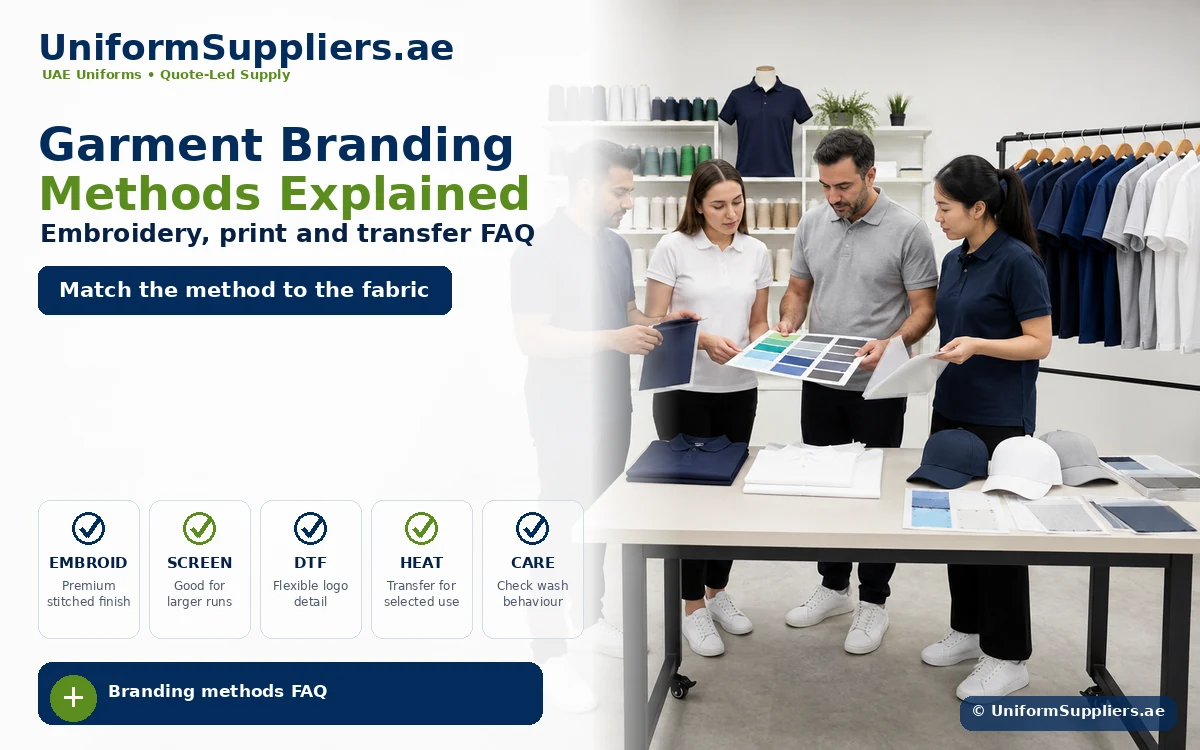
Garment branding looks simple until a logo cracks after a few washes, puckers a lightweight shirt or disappears into a textured fabric. The method has to suit the fabric, the artwork and the way the garment is worn and laundered.
This FAQ answers the questions procurement, HR and marketing teams ask most often about garment branding methods, with one comparison table you can use when briefing a supplier. For a longer discussion, read our complete uniform branding guide.
What this guide covers
- The methods and how they work
- Garment branding methods compared
- Choosing a method for your logo and garments
- Artwork, approval and ordering
- How to decide, with a buyer checklist
The methods and how they work
What garment branding methods are used on uniforms?
The main methods are embroidery, screen printing, heat transfer and sublimation. Uniform programmes also use woven badges stitched onto the garment, and engraved or printed name badges worn on it. We offer these through in-house printing, embroidery, engraving and branding support, summarised on our branding methods page.
How is embroidery different from printing?
Embroidery stitches the logo into the fabric with thread, giving a raised, textured result. Printing lays ink or a transferred film onto the surface or, in the case of sublimation, dyes the fibre itself. See our embroidery and garment printing service pages for how each is ordered.
What is the difference between heat transfer and sublimation?
A heat transfer is a printed or cut design carried on a film and bonded to the garment surface with heat and pressure. Sublimation uses heat to turn dye into a gas that bonds with polyester fibres, so the design becomes part of the fabric and cannot be felt by hand. Heat transfer works on many fabrics and colours. Sublimation needs polyester-rich, light-coloured fabric.
Garment branding methods compared
Use this table as a first filter. The right method for a specific garment also depends on the fabric weight, the logo and the wash routine.
| Method | Best for | Limits | Fabric suitability |
|---|---|---|---|
| Embroidery | Company logos and names on polos, shirts, jackets, caps and aprons | Very fine text and gradients do not stitch cleanly; large filled designs add weight and stiffness | Most woven and knitted fabrics; thin or stretchy fabrics need backing to avoid puckering |
| Screen printing | Bold, flat-colour designs, large back prints, T-shirts and event wear | Each colour needs its own screen; photographic detail is harder | Cotton and blends print readily; polyester and coated fabrics need suitable inks |
| Heat transfer | Full-colour or detailed logos, individual names and numbers, small batches of varied designs | Sits on the surface; sensitive to hot ironing and harsh tumble drying | Most smooth fabrics; heat-sensitive or heavily textured fabrics need testing |
| Sublimation | All-over designs, sports and team kits, colourful event wear | Needs light-coloured, polyester-rich fabric; not suited to cotton | Polyester and polyester-rich fabrics only |
| Woven or engraved badges | Names, job titles and logos that must stay crisp or move between garments | Woven badges must be stitched on; engraved badges are worn, not applied | Woven badges suit most fabrics; engraved badges are independent of the fabric |
Final specification will be confirmed during quotation.
Choosing a method for your logo and garments
Which method lasts longest under frequent laundering?
Embroidery is very durable for logos and names because the thread is locked into the garment. Sublimation is permanent for all-over designs on polyester because the dye is in the fibre. Screen prints and heat transfers also last well when they are matched to the fabric and washed according to the care label, but they are more exposed to hot washes, strong detergents and direct ironing. Our fabric care guide covers washing branded garments.
Which method suits large or full-colour designs?
Screen printing and sublimation suit bold, large or full-colour designs. A large embroidered back logo is possible, but it adds weight and can feel stiff in hot weather, so many buyers embroider the chest and print the back. This is common for crew and promotional wear in events and promotions.
Does the fabric limit which method I can use?
Yes. Lightweight or stretchy knits can pucker under dense stitching. Textured fabrics such as piqué and fleece break up fine printed detail. Waterproof and coated fabrics can be compromised by needle holes, and sublimation only works on polyester. Tell your supplier the fabric before the artwork is finalised.
Can hi-vis and protective workwear be branded?
Usually, but with care. Logos should not cover large areas of fluorescent or reflective material, and branding added to flame-resistant or other protective garments should follow the garment manufacturer’s guidance. Ask your HSE team to approve the position and size before production. Related garments are listed under high-visibility clothing.
When is a badge better than branding the garment?
Use a badge when the information changes more often than the uniform: employee names, job titles or languages spoken. Woven badges give crisp small lettering, and engraved name badges move with the employee between garments. Eligible engraved badges carry a one-year no-fading warranty; see our warranty terms and the engraved badges range. Our article on name badges, ID cards and lanyards covers the options.
Artwork, approval and ordering
What artwork do I need to supply?
A vector file of the logo and your brand colour references give the cleanest result. For embroidery the logo is converted into a stitch file, a step known as digitising, and small details may need simplifying. If you only have an image file, send it anyway and we will advise what is workable.
Will I see the logo before production?
Yes. We provide a free digital logo mock-up before production, showing the position and size on the garment. Check spelling, colours and placement carefully, because the approved mock-up becomes the reference for the order.
Can I combine methods in one order?
Yes. We often use different methods across an order for the best result on each item: for example, embroidery on polos and jackets, screen print on event T-shirts and engraved badges for front-of-house names.
How are repeat orders kept consistent?
We keep stored records of the approved logo position, branding, colour, fabric and sizing, so replacement garments and new-joiner kits match the original issue. This matters for multi-branch teams where uniforms are ordered at different times of the year.
How to decide
Mustang recommendation: start from the garment and the wash routine, not the logo. Choose embroidery for daily-wear polos, shirts and jackets that are laundered often. Choose screen print or sublimation for large, colourful or event designs. Use heat transfer for individual names and small varied batches, and put anything that changes with the person onto a badge. Approve the mock-up on the actual garment colour before production starts.
- List each garment, its fabric and its colour.
- Supply the logo as a vector file with colour references.
- State the logo position and approximate size for each garment.
- Say how the garments will be laundered: at home or commercially.
- Flag hi-vis, flame-resistant or waterproof garments for separate review.
- Decide which details belong on a badge instead of the garment.
- Check and approve the digital mock-up before production.
Upload your logo for a free digital mock-up
Send your logo and garment list through Request a Quote and we will suggest a branding method for each item and prepare a mock-up. You can also request a sample; free uniform samples are provided against a confirmed Local Purchase Order (LPO). For anything else, contact us.