Special offers: free digital logo mock-up and free samples against a confirmed LPO. View offers


How to Design a Custom Football Kit for Your UAE School or Club

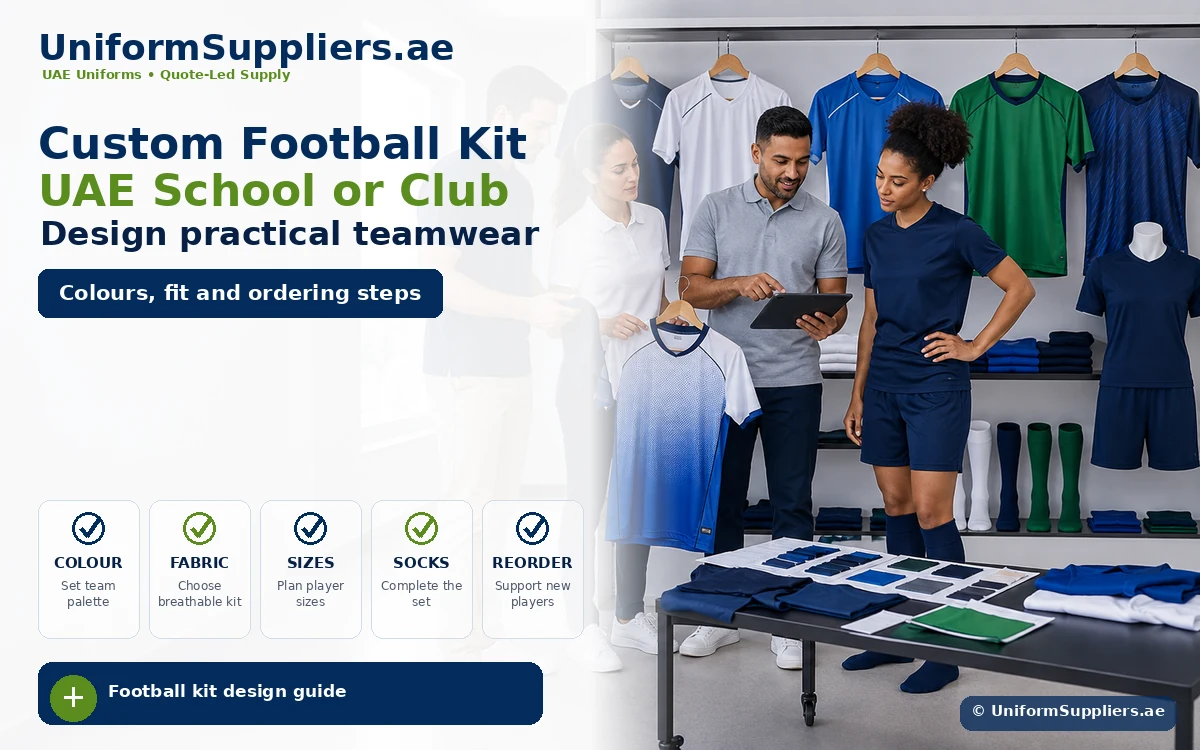
A good football kit does two jobs at once: it looks sharp on the pitch and it makes your school or club instantly recognisable. Designing one in the UAE is easier than most teams expect — the key is getting the colours, crest, names and sizing right before production starts.
This guide walks through how we help UAE teams design a full custom football kit, from a blank template to a ready-to-play set. It is written for PE heads, club and academy managers, coaches and anyone who has to sign off a kit order and then live with it for a full season.
What this guide covers
- The design process, step by step
- Kit components: options and decisions
- Home, away and goalkeeper kits
- Numbering and naming conventions
- Fabric and fit for UAE conditions
- Running a sizing day
- Artwork preparation and common mistakes
- Reorder planning and buyer checklist
- Start your kit with us
- Frequently asked questions
The design process, step by step
A custom football kit UAE teams are still happy with at the end of the season is usually the result of six decisions taken in the right order. Skipping ahead — fixing quantities before the squad is sized, for example — is what creates leftover shirts and missing numbers.
1. Start with your colours and crest
Bring your house colours, club badge or school crest and any sponsor logos. We rebuild artwork cleanly for sublimation so that colours are reproduced consistently across shirt, shorts and socks. If you only have a rough idea, our team creates a free design mock-up so you can see the whole kit together before deciding.
2. Choose the pieces in the kit
A full football kit usually includes a jersey, shorts and socks, with an optional goalkeeper set, training tops and warm-up jackets. Decide early whether you want a home and away set, so numbering and colourways stay consistent. The football kits category shows the item types a range can be built from.
3. Review the design mock-up
The mock-up shows the kit with crest, sponsor, number and name positions in place. Circulate it to everyone with a say — head of PE, club committee, sponsor contact — and collect comments in one round. Changes are simple at this stage and disruptive once production has begun.
4. Check a sample
A free sample is available against a confirmed order (LPO), so you can check colour, fabric handle and print on a real garment rather than on a screen. Screens show colour differently from fabric, so a physical check matters for house colours and sponsor logos. You can request a sample as part of your enquiry.
5. Size the squad
Collect a confirmed size for every player before quantities are fixed. The sizing day section below explains how to do this in a single session.
6. Sign off one squad list
The last approval is a single list: player, size, number, name spelling and kit items. Production follows that list exactly, so have two people check it before it is sent.
Kit components: options and decisions
Use the table below as the agenda for your first kit meeting.
| Item | Typical options | What to decide |
|---|---|---|
| Match jersey | Short or long sleeve; round neck, V-neck or collar; men’s/unisex, women’s modest or hijab-friendly fit | Sleeve policy, neckline, which fits the squad needs, how much of the design is sublimated |
| Shorts | Standard or longer leg; drawcord waist; plain or panelled | Leg length, whether a number goes on the shorts, colours for home and away |
| Socks | Plain, hooped or contrast turnover | Team-supplied or player-supplied, and a second colour for clashes |
| Goalkeeper set | Long-sleeve jersey with shorts or trousers in a contrasting colourway | One keeper colour or two, and which numbers keepers wear |
| Training top and bibs | T-shirt or sleeveless top; bibs in contrast colours | Whether training wear carries numbers or initials, and how many bib colours are needed |
| Warm-up jacket or tracksuit | Full-zip jacket, half-zip top, track trousers | Crest by embroidery or print, and whether coaches wear the same item |
| Base layers and modest additions | Long-sleeve base layer, leggings, sports hijab | A colour rule so additions match sleeves and shorts across the whole team |
Schools often need one design across several age groups, while clubs and academies usually add coach wear. Our pages for school sports kits and club and academy kits set out how each type of range is normally structured.
Home, away and goalkeeper kits
The point of an away kit is contrast, not variety. If the home shirt is dark, make the away shirt light, so that it works against the widest possible range of opponents. A navy home kit with a black away kit solves nothing under floodlights.
Keep the layout identical
Crest, sponsor, number and name positions should sit in exactly the same place on both kits. Only the colourway changes. One layout then covers both sets when you reorder.
Give goalkeepers their own colours
A goalkeeper has to be distinguishable from outfield players on both sides and from the match officials. Choose a keeper colour that clashes with neither your home nor your away kit. Teams with frequent fixtures often specify two keeper colourways.
Rules on colour clashes, sock colours and what officials may wear differ between competitions. Check your own league or federation’s current regulations before colours are approved.
Numbering and naming conventions
Number positions and contrast
Most teams place a large number on the back of the shirt and a smaller one on the front or on the shorts. The number must read clearly from the touchline, which means strong contrast with the shirt colour. If the shirt carries a busy sublimated pattern, leave a plain panel behind the number or add an outline. Size and position requirements vary by competition, so confirm them with your league or federation.
Schools: number by size, not by player
School match shirts are usually handed back and reused. Numbering by size — lower numbers on smaller shirts, higher numbers on larger ones — makes shirts easy to hand out and keeps the set usable when the squad changes. Player names are best left off any shirt the school intends to reuse.
Clubs: squad numbers and name rules
Where each player owns the shirt, set a naming rule before collecting details: surname or first name, capitals or mixed case, and a maximum length that fits across the shoulders of the smallest size. Ask every player or parent to confirm the spelling in writing. This matters most for names transliterated from Arabic and other languages, where several spellings may be in use.
Squad numbers and player names can be sublimated as part of the design or printed onto the finished shirt. Sublimated numbers are part of the fabric and cannot be changed later, while printed numbers allow a name to be added to a plain shirt after the main order. Our branding methods guide and the article on embroidery versus printing explain the trade-offs. We keep your number layout on file so new signings match the rest of the squad exactly.
Fabric and fit for UAE conditions
Sublimated football kits are made from polyester knits, because sublimation dyes bond with polyester fibres. Within that family there are real differences: smooth interlock for the main body, open mesh or micro-mesh for side and underarm panels, and heavier knits for shorts that need to hold their shape.
In the UAE, most outdoor football is played in the late afternoon or evening, and coastal humidity is high for much of the year. We recommend breathable, quick-dry sublimation fabrics suited to those conditions, so players stay comfortable in training and match play. Lighter base colours absorb less heat from the sun than dark ones, which is worth considering for daytime school fixtures. These are recommendations based on how and when your team plays, not a performance guarantee. Final specification will be confirmed during quotation.
Fit options in the same design
Kits are available in men’s/unisex, women’s modest and Muslim women’s hijab-friendly fits. The crest, colours and number layout stay the same across every fit, so a mixed squad or a girls’ team still looks like one team.
Running a sizing day
Sizing is where most kit orders go wrong. Bring your squad to our Jebel Ali showroom to try a size set, and we can hold sizes so students collect as they need them. Showroom details are on our contact page.
Whether the session happens at the showroom or you collect sizes yourselves, the method is the same:
- Have every player try the shirt and the shorts separately. Many players need a different size in each.
- Record the result on one sheet per team, with a named adult writing the sizes down rather than players reporting their own.
- For juniors, agree a growth rule with coaches and parents before the session, so the allowance is applied the same way to everyone.
- Note which players need a modest or hijab-friendly fit, long sleeves or leggings.
- For absent players, take chest and height measurements and compare them with the size chart rather than guessing.
Our size and fit guide and the article on how to measure for a uniform sizing chart show which measurements to take. Finish the session by agreeing how many spare shirts to add in your most common sizes, and which numbers those spares will carry.
Artwork preparation and common mistakes
What to send
- Crest or badge: a vector file (EPS, SVG or vector PDF) if you have one. If the only copy is a photograph or a low-resolution image, tell us and the artwork can be rebuilt.
- Colour references: colour codes from your brand guidelines where they exist, or a physical item in the correct colour, such as a previous shirt.
- Sponsor logos: files supplied by the sponsor, with any rules on minimum size, clear space and single-colour versions.
- Permissions: written confirmation that you may use each third-party logo on the kit.
- Lettering: the typeface for names and numbers if your school or club already has one.
Mistakes that cause reprints and delays
- Approving colours from a phone screen instead of a physical sample.
- Placing the order before the squad list is final.
- Choosing home and away colours that are too close in tone.
- Putting low-contrast numbers over a patterned panel.
- Sublimating a sponsor logo into the shirt when the sponsorship may change mid-season. A printed logo on a plain panel is easier to update on later batches.
- Ordering no spares and having no plan for players who join after the season starts.
Reorder planning and buyer checklist
New players, lost shirts and growth spurts mean almost every team reorders. Your sizes and artwork are stored for repeat orders, along with the approved fabric, colours, logo positions and number layout, so a top-up matches the original set.
Keep the same design for more than one season where you can, maintain a register of which numbers are issued or spare, and collect new-joiner sizes as players register rather than the week before the first fixture.
How long a top-up takes depends on quantity, the fabrics involved and how many items carry individual names and numbers. Delivery timelines are confirmed during quotation.
Mustang recommendation: treat the kit as a two-to-three-season programme, not a one-off purchase. Approve one layout for home, away and goalkeeper kits, number school shirts by size, keep sponsor logos on plain panels, and size the whole squad on real garments before quantities are fixed.
Buyer checklist
- Crest, colour references and sponsor logos collected, with permissions.
- Kit list agreed: match, goalkeeper, training and warm-up items.
- Home and away colours contrast clearly in tone.
- League or federation kit regulations checked for the current season.
- Fits confirmed: men’s/unisex, women’s modest, hijab-friendly.
- Design mock-up approved by every decision-maker in one round.
- Sample checked for colour, fabric and print.
- Squad sized on a size set; shirts and shorts recorded separately.
- Number and name convention written down; spellings confirmed.
- Spares and new-joiner plan agreed.
Start your kit with us
Every order begins with a free design mock-up and a free sample against your confirmed order, and your sizes and artwork are stored for repeat orders. Teams and students can try sizes in person at our Jebel Ali showroom before committing. Delivery timelines are confirmed during quotation.
Request a quote and upload your crest for a free design mock-up, request a sample, or explore the full sports uniforms range to plan kits for your other teams.
Frequently asked questions
Can we see a sample before the full order is made?
Yes. A free sample is provided against a confirmed order (LPO), so colour, fabric and print can be checked on a real garment before production of the full set.
Do you offer modest and hijab-friendly football kits?
Yes. Kits are available in men’s/unisex, women’s modest and Muslim women’s hijab-friendly fits, produced in the same colours and layout so the whole team matches.
Can new players get matching kit later in the season?
Yes. Your sizes, artwork and number layout are kept on file, so shirts for new signings are produced to the same approved design as the original set.
What number size and position should we use?
That depends on the competition you play in. Check your own league or federation’s current regulations, then tell us the requirement and we will apply it to the layout.
How long does a custom football kit take to produce?
It depends on quantity, the number of items in the kit, the amount of individual naming and numbering, and when the design and sample are signed off. Delivery timelines are confirmed during quotation.