Special offers: free digital logo mock-up and free samples against a confirmed LPO. View offers

Sublimation vs Printing vs Embroidery for Sports Jerseys — Which Is Best?

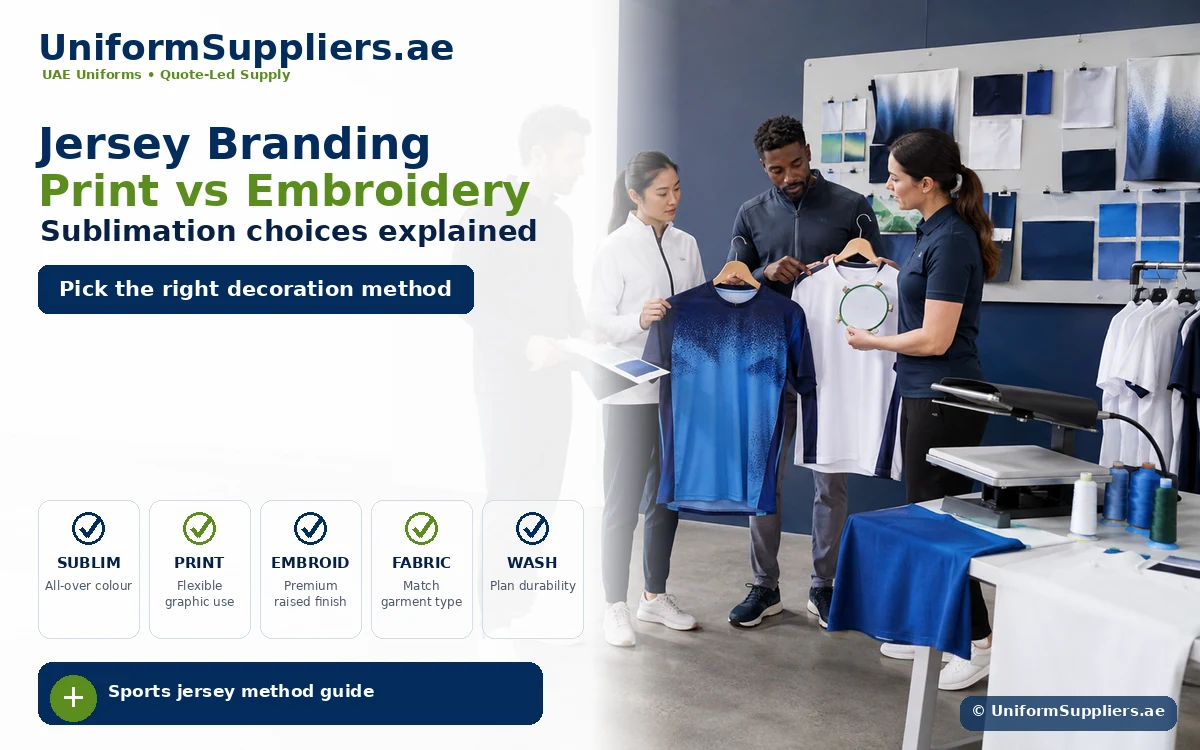
The decoration method you choose affects how your kit looks, how long it lasts and what designs are possible. Here is a simple comparison for team sportswear.
Explore our garment printing and decoration options, or browse custom sports uniforms by sport. If you are weighing up sublimation vs printing for sports jerseys, or wondering where embroidery fits, the short answer is that most teams use more than one method across a kit.
What this guide covers
- How the three methods work
- Comparison table
- Which method for which item
- Names and numbers
- What changes in UAE conditions
- How to choose
- Start your kit with us
- Frequently asked questions
How the three methods work
Sublimation
Ink is bonded into the fabric, so there is no surface layer to crack or peel, and the design can cover the whole garment edge to edge. It is ideal for full-colour team jerseys, gradients, patterns and all-over sponsor branding. The process needs polyester performance fabric with a white or pale base, because the dyes bond with polyester fibres and cannot show on a dark ground.
Screen and heat-transfer printing
Both lay the design on top of the fabric. Screen printing pushes ink through a mesh screen, one colour at a time, and suits bold logos repeated across many identical garments. Heat transfer presses a pre-made design onto the garment, which makes it practical for individual names and numbers. Either works well for simpler designs on a smaller area, on cotton, blends or polyester.
Embroidery
A premium, textured finish for crests, badges and names on polos, tracksuits, caps and bags. It reads as high quality and is very durable, though it suits logos rather than large full-colour artwork. Stitching adds weight and needs a backing behind it, which matters on thin, stretchy match fabrics.
Comparison table
| Factor | Sublimation | Screen or heat-transfer print | Embroidery |
|---|---|---|---|
| Durability | Part of the fabric; no surface layer to wear away | Depends on ink or film, application and laundering; large prints show wear first | Very durable thread; edges can catch on rough surfaces |
| Breathability impact | None; no layer is added | Printed area is less breathable; noticeable on large panels | Stitched area is dense and backed; small crests have little effect |
| Colour and detail | Unlimited colours, gradients and photographic detail | Strong solid colours; fine detail depends on method | Limited thread colours; no gradients; small text is hard to read |
| Fabric compatibility | Polyester with a white or pale base | Cotton, blends and polyester, including dark colours | Stable fabrics such as piqué, fleece, twill and caps |
| Best use | Match jerseys and all-over designs | Logos, names and numbers on plain garments | Crests on polos, jackets, caps and bags |
For a wider comparison that includes staff uniforms, see our guide to embroidery versus printing and the branding methods reference page.
Which method for which item
The fabric usually decides the method. Work through the kit list item by item rather than choosing one method for everything.
| Item | Usual choice | Why |
|---|---|---|
| Match jersey | Sublimation | Crest, sponsors, numbers and pattern are produced together with no added weight |
| Training top | Sublimation, or print on a plain top | Sublimate if the design is multi-coloured; print if you only need a crest on a plain colour |
| Polo | Embroidery, with print for large back text | Piqué holds stitching well and an embroidered crest suits a club or coach polo |
| Tracksuit | Embroidered crest; printed name or initials | Heavier fabric supports stitching; print keeps large back lettering flexible |
| Cap | Embroidery | The structured front panel is made for a stitched crest |
| Bag | Print or embroidery, depending on material | Print suits smooth synthetic bags; embroidery suits heavier woven fabric; numbers are added by heat transfer |
The sports jerseys category shows jersey styles, and our article on polo shirts and branding looks at polo fabrics in more detail.
Names and numbers
If the squad list is final before production, names and numbers can be sublimated with the rest of the jersey. They cannot be changed afterwards.
If players join during the season, or a school reuses shirts from year to year, numbers applied by heat transfer are more flexible. A plain or part-sublimated shirt can be numbered later to match the rest of the set. Our guides to designing a football kit and cricket whites versus coloured kits cover numbering conventions and logo positions for those sports.
What changes in UAE conditions
- Heat and sweat: a large printed panel on the chest or back reduces airflow exactly where players want it. On match jerseys, keep surface prints small or sublimate instead.
- Frequent laundering: kit worn several times a week is washed far more often than staff uniforms. Wash printed garments inside out and avoid high-heat drying; our fabric care guide has the general rules.
- Skin comfort: the backing behind embroidery can rub during play. It is better placed on polos, jackets and caps than on a close-fitting match shirt.
- Sun: ask any supplier how a decoration method has been tested for colour fastness rather than accepting a general assurance.
Which inks, films, threads and fabrics are used depends on your design and garment. Final specification will be confirmed during quotation.
How to choose
For performance jerseys with lots of colour, sublimation usually wins. For premium club polos and jackets, embroidery. Many teams combine methods across a kit. We advise on the mix for your design and fabric during quotation, and embroidery, printing and sublimation are all handled in-house.
Mustang recommendation: sublimate the match jersey, embroider the crest on anything with a collar or a zip, and keep heat-transfer numbering for garments that need to be personalised after the main order. Then check a physical sample of each method before approving the full kit, because texture and colour are hard to judge on screen.
Buyer checklist
- List every item in the kit and its fabric.
- Mark which items need individual names or numbers, and when the squad list will be final.
- Supply vector artwork for crest and sponsor logos.
- Decide whether sponsor logos may change mid-season.
- Ask for a sample showing each decoration method on the actual fabric.
- Agree washing instructions to pass on to players and parents.
Start your kit with us
Every order begins with a free design mock-up and a free sample against your confirmed order, and your sizes and artwork are stored for repeat orders. Teams and students can try sizes in person at our Jebel Ali showroom before committing. Delivery timelines are confirmed during quotation.
Request a quote or request a sample to get started.
Frequently asked questions
Is sublimation better than printing for sports jerseys?
For multi-colour polyester match jerseys, usually yes, because the design becomes part of the fabric and adds no layer. For a single logo on a plain cotton or blended top, printing is often the more practical choice.
Can you sublimate onto cotton or dark fabric?
No. Sublimation dyes bond with polyester and need a white or pale base. Dark colours are created by printing them as part of the design onto pale polyester.
Can a jersey have an embroidered crest?
It can, but on thin, stretchy match fabric a dense crest may pull or rub. Most teams sublimate the crest on the match jersey and embroider it on polos, jackets and caps.
Which method is right for names and numbers?
Sublimation if the squad list is fixed before production; heat transfer if names and numbers need to be added or changed later.
Can we combine methods in one order?
Yes. Most kits do. A typical set has sublimated jerseys, embroidered polos and caps, and printed training wear, all produced from the same stored artwork.