
Blog
Polo Shirts for Business: Comfort Meets Branding

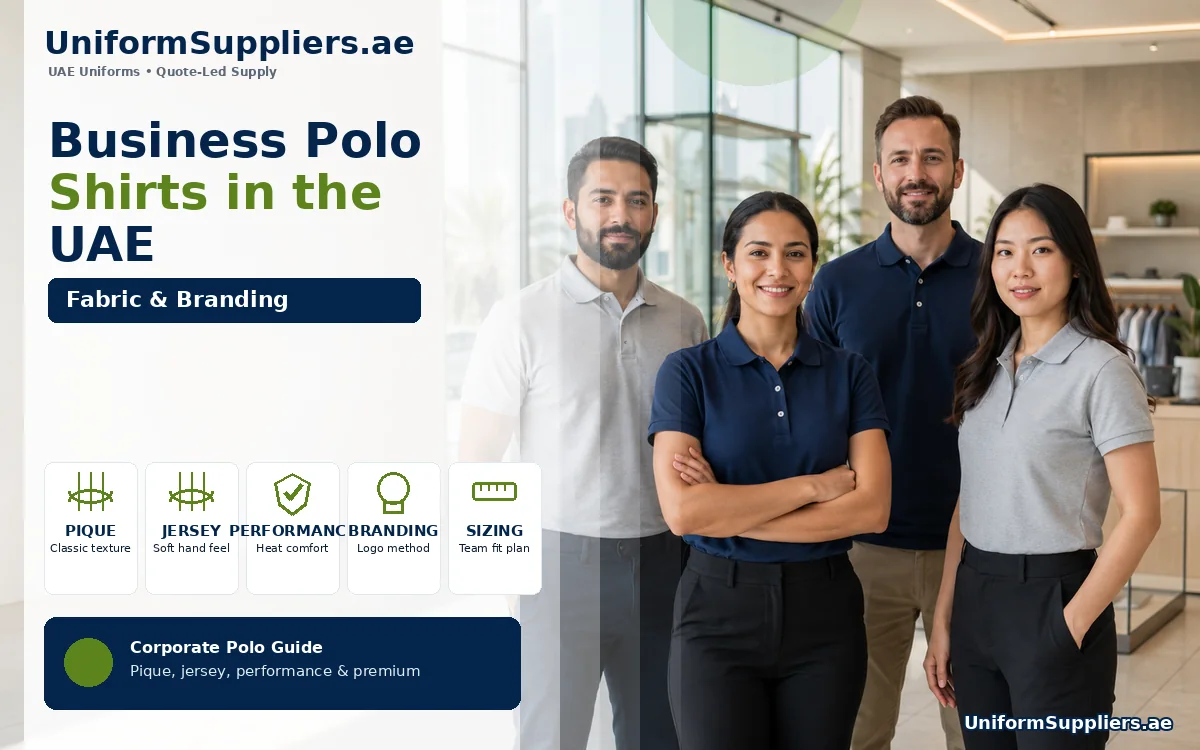
The polo shirt has quietly become the default working garment for a large share of UAE service teams. It sits between a shirt and a t-shirt, carries a logo well, and survives the daily move between air-conditioned interiors and 45°C car parks.
That is also the problem. Because polos look simple, they are often bought on colour and unit price alone — and the result appears three months later as sagging collars, faded shoulders and staff avoiding last season’s stock.
This guide covers how to choose business polo shirts in the UAE properly: the knits available, how they behave in Gulf conditions, which branding methods suit knitted cloth, and how to size a multi-nationality team.
What this guide covers
- Why polos dominate UAE service and retail uniforms
- Polo fabric and knit comparison table
- Reading GSM and weight for Gulf summer
- Collar, placket and cuff durability
- Colour choice and fade under UAE sun
- Branding methods for knitted polo fabric
- Sizing across a multi-nationality team
- Building a polo programme that lasts a year
- Mustang recommendation
- Frequently asked questions
Why polos dominate UAE service and retail uniforms
Smart-casual is the operating dress code of most customer-facing roles in the Emirates. Mall retail staff, showroom advisors, facilities supervisors and exhibition crews must look organised without looking corporate-formal.
The polo answers that. A collar signals staff status across a shop floor, a button placket lets it be worn open at the neck, and the knit moves with people on their feet all day.
There is a procurement reason too. Polos are one of the few garments where ready-stock and custom manufacturing run side by side. If you are building a wider wardrobe, read this alongside the corporate uniforms pillar.
Polo fabric and knit comparison table
Most decisions about comfort, longevity and print quality trace back to the knit. Piqué is a textured, waffle-like knit; jersey is the smooth, flat knit used in t-shirts. Composition then decides how the garment handles sweat, heat and washing.
| Fabric / knit | Composition | Typical GSM | Feel | Best UAE use case | Care notes |
|---|---|---|---|---|---|
| Cotton piqué | 100% combed or ring-spun cotton | 180–220 | Textured, breathable, structured | Indoor retail, showrooms, reception | Holds moisture; wash 30–40°C, dry in shade |
| Cotton jersey | 100% cotton, single jersey | 150–190 | Smooth and soft; drapes rather than holds shape | Casual brand teams and events | Hems curl, collars relax; no tumble drying |
| Poly-cotton piqué | Typically 65/35 or 50/50 | 180–220 | Cotton hand feel with added shape retention | General-purpose: facilities, logistics, multi-site service | Strong colour retention; resists shrinkage |
| Performance polyester | 100% polyester, sometimes with elastane | 140–180 | Light, dry-touch, quick-drying, slight sheen | Outdoor roles, marshals, sports, summer crews | Wash cool; softener reduces wicking |
| Heavier premium piqué | Cotton-rich, often mercerised or with elastane | 220–260 | Dense and substantial; holds a crisp collar | Management and brand ambassadors, indoors | Warmest option; air-conditioned roles only |
Where a mill specification cannot be confirmed from a catalogue image, ask for the datasheet. Final specification will be confirmed during quotation.
Reading GSM and weight for Gulf summer
GSM means grams per square metre — fabric weight, not quality. A 240 gsm polo is not better than a 180 gsm polo; it is denser, warmer and more opaque.
The calculation is seasonal here. Between May and September, anyone outdoors is better served by a lighter performance knit at 140–180 gsm. Indoor teams under strong air conditioning often prefer 200–220 gsm, because a thin polo feels cold under vents.
Check opacity on light colours: white and pale grey below roughly 180 gsm can turn semi-transparent when damp. Fabric weight is covered further in the guide to fabric GSM for UAE workwear.
Collar, placket and cuff durability
A polo fails at the collar first. Once the collar rolls or loses shape, the whole uniform reads as tired even if the body is perfect.
- Rib collar with elastane — helps collar and cuffs recover shape after washing; pure cotton rib relaxes faster.
- Taped neck and shoulder seams — stops the seam stretching under repeated wear and hanging.
- Reinforced placket — an interlined button stand stays flat; unsupported plackets ripple within a dozen washes.
- Side vents with bar tacks — lets the hem sit correctly worn in or out without tearing.
If garments go to a commercial laundry rather than home washing, weight these points more heavily. Industrial washing is hotter, faster and far less forgiving.
Colour choice and fade under UAE sun
Ultraviolet exposure in the Gulf is intense most of the year and treats dyes unevenly. Navy, black and burgundy hold up reasonably but develop a chalky cast on shoulders and sleeve tops. Bright reds, oranges and mid-blues shift fastest.
Favour reactive-dyed cotton or solution-dyed polyester where permanence matters, since polyester holds saturated colour longer in strong sun. Avoid ordering a full year in one lot: dye lots vary, and a top-up ordered months later may not match the original batch under showroom lighting.
Where a brand colour must be matched exactly, approve a lab dip before bulk production and record the reference so repeat orders start from the same point.
Branding methods for knitted polo fabric
Knitted fabric stretches in both directions. That single fact governs what works on a polo and what does not.
Embroidery on the chest
Embroidery is the default for polos because stitched thread outlasts the garment and never cracks or peels. It suits chest logos, sleeve marks and small back-neck branding. Its limits are detail: fine text, thin serifs and gradients do not translate to stitch. Dense stitching on a light knit needs backing to prevent puckering, so approve a digitised proof. See the embroidery service.
Printed transfer on the back
Transfers handle larger back panels, department names and multi-colour artwork that embroidery cannot reach economically. Keep prints flexible — a rigid ink block over stretchy jersey cracks along fold lines. Avoid placements over side seams, vents or the placket, and avoid large solid blocks on performance polyester, which trap heat where the fabric should breathe. Options are outlined under garment printing.
Sublimation on performance polyester
Sublimation dyes the polyester fibre itself, so there is no hand feel, nothing to peel and no blocked airflow. It is the strongest choice for full-colour graphics on moisture-wicking polos. The constraints are firm: polyester or high-polyester blends only, white or pale base cloth only, and no true white detail.
What to avoid on knitted fabric
- Oversized rigid prints across areas that stretch in movement.
- Heavy embroidery on lightweight jersey without adequate backing.
- Branding where a bag strap or seatbelt sits all day.
- Dark artwork on dark polyester for sublimation — not possible.
Sizing across a multi-nationality team
A typical UAE service team may include colleagues from South Asia, the Philippines, East Africa, the Levant, Europe and the wider GCC. Body shapes and expectations of fit vary widely, and one European size chart produces complaints in week one.
Polos complicate this further: nominal sizes differ between manufacturers, and knitted garments relax after the first wash.
- Run a size set — one piece per size, tried on before the bulk order.
- Order by chest and body length measurement rather than assumed size.
- Offer a ladies’ cut where the workforce is mixed; a men’s small is not a substitute.
- Allow for shrinkage on cotton-rich knits and check the stated tolerance.
- Keep a size list per employee so replacements do not restart the process.
Free onsite individual measurements are available in the UAE for qualifying company uniform orders, with a fit-correction guarantee on garments measured by Mustang. To start from a chart, the sizing and measurement guide explains each measurement.
Building a polo programme that lasts a year
Treat polos as a rolling programme, not a one-off purchase. Most UAE teams need three to five pieces per person, because garments worn in 40°C conditions are washed after every shift.
Plan a buffer in common sizes for new joiners and agree a replenishment point rather than reordering in a panic. Peaks here are predictable: exhibition season from autumn to spring, Ramadan and Eid trading, National Day and summer retail promotions.
Ready-stock blanks can cover an immediate gap while custom manufacturing completes — useful for pre-opening retail units and short-notice event teams.
Mustang recommendation
Most UAE service teams: 200–220 gsm poly-cotton piqué in a dark or mid-tone brand colour, with an elastane rib collar, taped neck, side vents and left-chest embroidery.
Outdoor and high-movement roles: a 150–170 gsm moisture-wicking polyester polo, sublimated or embroidered, in a colour that hides perspiration.
Supervisors and brand-facing staff: premium piqué above 220 gsm, indoors only, creating visible hierarchy without a second garment type.
Brands including Gildan, Fruit of the Loom, Bella + Canvas, B&C, Russell, AWDis, Next Level and SOL’S are available through Uniform Suppliers UAE alongside custom-manufactured pieces, so one programme can mix stock blanks with made-to-specification garments.
Frequently asked questions
Which polo fabric is best for outdoor work in a UAE summer?
A moisture-wicking polyester knit in the 140–180 gsm range performs best outdoors between May and September. It moves perspiration to the surface where it evaporates, dries between shifts and stays lighter against the skin than cotton, which absorbs sweat and holds it. Choose a mid or dark tone to keep sweat marks less visible.
Is cotton or polyester better for a branded company polo?
Neither is universally better. Cotton feels natural indoors and takes embroidery well, but absorbs moisture, shrinks and fades faster in Gulf sun. Polyester dries fast, holds colour and accepts sublimation, but feels warm in still air. Poly-cotton piqué is the practical compromise for mixed indoor and outdoor teams.
Will embroidery damage a lightweight polo?
Not if it is digitised and backed correctly. Problems arise when a dense, oversized design is stitched onto a thin knit without stabiliser, which causes puckering around the logo. Keeping chest embroidery to a sensible size, simplifying fine detail and approving a stitch-out proof prevents almost every issue of this type.
How many polo shirts should each employee receive?
Most UAE employers issue three to five per person for a full-time customer-facing role. Summer conditions mean daily washing, and a two-shirt allocation forces staff into a garment that has not fully dried. Heavy outdoor exposure or high brand visibility justifies the higher end, plus buffer stock.
Can we match our exact brand colour on a polo shirt?
Close matching is achievable on custom-manufactured garments through a lab dip approved before bulk production. Ready-stock ranges are limited to the manufacturer’s published colour card, so an exact match is not always possible off the shelf. Where accuracy is critical, check a physical sample under your own lighting.
Do dark polos fade faster in the UAE?
Dark shades do not necessarily fade faster, but fading is more visible on them, particularly across shoulders and sleeve tops where direct sun lands. Reactive-dyed cotton and solution-dyed polyester hold up better than cheaper dye routes. Washing inside out, drying in shade and avoiding chlorine detergents extend usable colour life.
Next step
Polos are one of the few uniform items where five minutes of handling tells you more than any specification sheet. Feel the collar rib, stretch the placket, and imagine the garment after fifty washes in a Dubai summer. A free digital logo mock-up can be prepared before anything is committed.
Free samples are available against a confirmed LPO. Request a sample to compare knits and weights in person, or send your specification through the quote request form. Teams in food service and venues may also want the companion hospitality uniform buying guide.