Special offers: free digital logo mock-up and free samples against a confirmed LPO. View offers
Uniforms for UAE Cleaning and Janitorial Service Companies

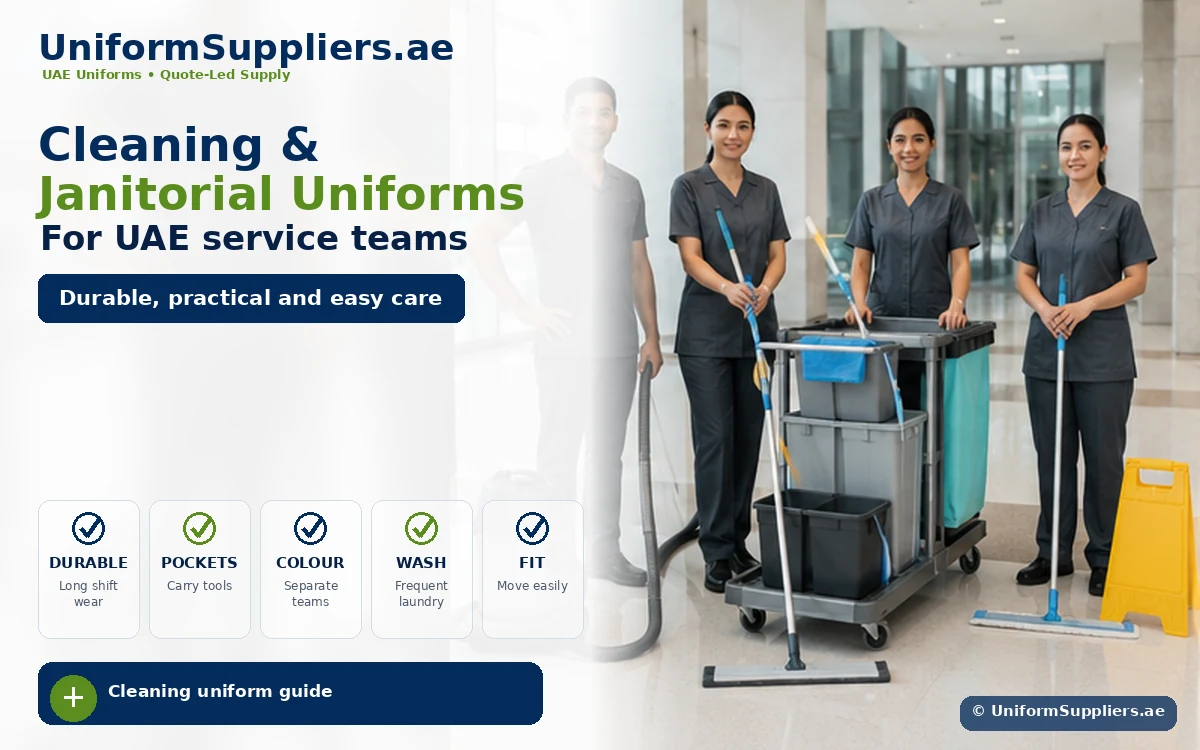
Cleaning and janitorial service companies operate one of the most physically demanding, chemical-exposed uniform briefs in the UAE B2B services sector, yet their frontline staff uniforms are often specified using generic industrial workwear templates that don’t fully account for the specific realities of the job. This guide looks at what UAE cleaning and janitorial contractors should consider when specifying uniforms for their teams, distinct from the broader multi-site facilities management brief covered in our facilities management uniforms guide.
Table of Contents
- Why Cleaning Staff Uniforms Are a Distinct Brief
- Fabric and Chemical Exposure
- Hygiene, Colour-Coding and Cross-Contamination
- Presenting Well at Client Sites
- Footwear and Protective Accessories
- Branding for Contract and White-Label Work
- Comparison: Uniform Needs by Cleaning Environment
- Checklist: Specifying a Cleaning Company Uniform
- FAQs
Why Cleaning Staff Uniforms Are a Distinct Brief
A cleaning or janitorial team member spends a shift in direct, repeated contact with cleaning chemicals, water, and a wide range of surfaces and environments — sometimes an office, sometimes a hospitality kitchen, sometimes a healthcare facility, often more than one of these in a single day for a contractor servicing multiple client sites. That combination of chemical exposure, physical activity and variable client environments makes cleaning-company uniforms a genuinely different specification problem from either general industrial workwear or hospitality housekeeping, even though it borrows elements from both.
Fabric and Chemical Exposure
Fabric choice for cleaning staff needs to account for repeated exposure to common cleaning chemicals — bleach-based products in particular can discolour or degrade standard fabrics quickly, leading to a uniform that looks worn and unprofessional within weeks even though it’s structurally fine. Fabrics with better chemical resistance and colourfastness under repeated industrial laundering are worth the modest cost premium over a standard workwear fabric, since they directly extend how long a uniform looks presentable client-facing rather than faded or stained.
Water resistance is a related but separate consideration — staff doing wet mopping, window cleaning or pressure washing benefit from a fabric and cut that dries quickly and doesn’t cling uncomfortably when wet, rather than a heavier fabric that stays damp through a shift.
Hygiene, Colour-Coding and Cross-Contamination
Many professional cleaning operations, particularly those servicing healthcare, food service or hospitality clients, use colour-coded uniforms or accessories to help prevent cross-contamination between different cleaning zones — for example, a distinct colour for washroom cleaning versus food-preparation-area cleaning, mirroring the same colour-coding principle often applied to cleaning cloths and equipment. Where your cleaning contracts require this kind of zone separation, building it into the uniform itself, not just the equipment, reinforces the discipline for staff and demonstrates a visibly organised process to client-side facilities managers and auditors.
Frequent laundering is a practical reality of this role, and uniform quantities should be planned generously enough that staff aren’t wearing the same garment across multiple days between washes — typically at least two to three sets per staff member is a reasonable starting point, to be confirmed based on your specific laundering cycle and shift pattern.
Presenting Well at Client Sites
For a cleaning contractor, staff uniform is often the only visible brand presence at a client site — there’s rarely a branded office or reception desk the way there is for most other B2B service providers, so the uniform carries a disproportionate share of the professional impression a client forms. A clean, well-fitted, clearly branded uniform signals a well-run contractor; a mismatched, faded or ill-fitting one raises doubts about operational standards even if the actual cleaning work is excellent. This is particularly relevant when pitching for new contracts, where facilities managers evaluating competing contractors often form an impression from how the existing or trial team presents on site.
Footwear and Protective Accessories
Non-slip, waterproof footwear is a near-universal requirement for cleaning staff given constant exposure to wet floors, and should be specified as a core part of the uniform rather than left to individual staff discretion. Gloves suited to the specific chemicals in use, and where relevant, basic eye protection for tasks involving spray chemicals, round out the practical accessory set — these sit closer to PPE than to uniform branding, and should be confirmed against your specific chemical safety data sheets rather than assumed generically. See our related guide to safety workwear and PPE in the UAE for the broader employer obligations around this kind of protective equipment.
Branding for Contract and White-Label Work
Some cleaning contractors service client sites under their own brand, while others operate on a white-label or client-branded basis, particularly for large facilities management or hospitality contracts where the end client prefers their own branding to be visible rather than the contractor’s. Both models are common in the UAE market, and uniform specification should follow the contract terms — if your business handles a mix of both, planning for two coordinated uniform ranges (own-brand and blank/client-brandable) from the outset avoids scrambling to produce a one-off unbranded batch every time a white-label contract comes up.
Managing Uniforms Across a Large, Multi-Site Workforce
UAE cleaning contractors often run large, distributed workforces across many client sites simultaneously, with staff sometimes rotating between sites as contracts and staffing needs shift. This creates two practical uniform challenges that a smaller, single-site business doesn’t face to the same degree: keeping sizing and reorder records accurate across a large, sometimes high-turnover staff base, and ensuring a consistent uniform standard across every site a client might visit or audit, not just the ones under direct daily supervision.
A centralised sizing and reorder record, rather than relying on individual site supervisors to track and request replacements independently, helps larger contractors avoid the two most common failure modes: staff appearing in visibly mismatched or worn uniforms at some sites while others are well kitted, and slow turnaround when a new starter needs to be uniformed quickly to meet a contract’s staffing deadline. Our guide to uniform kitting for new employees sets out a general onboarding framework that applies directly to a cleaning contractor’s fast-moving hiring cycle.
Uniform Standards and Client Audits
Many commercial cleaning contracts, particularly larger facilities management and healthcare-adjacent contracts, include periodic client audits that assess staff presentation alongside cleaning quality itself. A documented uniform standard — covering which garments are mandatory, how PPE accessories should be worn, and how frequently uniforms should be replaced — gives supervisors a clear reference point ahead of an audit, rather than relying on informal expectations that can drift over time or vary by site supervisor. Keeping this standard as a simple, written one- or two-page reference, distributed to all site supervisors, is a low-effort way to protect consistency across a large contract portfolio.
Where a specific client contract sets its own uniform or PPE requirements beyond your standard specification — which is common in healthcare and industrial facilities contracts — it’s worth confirming those requirements in writing at the contract stage, so uniform ordering can account for any site-specific variation from day one rather than discovering a gap during an audit.
Comparison: Uniform Needs by Cleaning Environment
| Environment | Key fabric need | Additional consideration |
|---|---|---|
| Office / commercial | Chemical and stain resistance | Presentable for occupied-hours cleaning |
| Healthcare-adjacent | High colourfastness, frequent laundering | Colour-coding for cross-contamination control |
| Hospitality / food service | Water resistance, quick-dry | Zone colour-coding |
| Facade / window cleaning | Freedom of movement, water resistance | Integration with safety harness equipment |
Checklist: Specifying a Cleaning Company Uniform
- Choose fabric with proven resistance to your specific cleaning chemicals
- Plan for frequent laundering — specify at least two to three sets per staff member
- Apply colour-coding by cleaning zone where cross-contamination control matters
- Specify non-slip, waterproof footwear as a core uniform component, not an afterthought
- Confirm PPE accessory needs (gloves, eye protection) against your chemical safety data
- Plan for both own-brand and white-label uniform needs if you service mixed contracts
FAQs
How many uniform sets should we provide per cleaning staff member?
A common starting point is two to three sets per person to accommodate frequent laundering, though the right number depends on your specific shift pattern and laundering cycle. We can help you plan quantities during your quotation.
Can uniform colour-coding really help prevent cross-contamination?
Colour-coding uniforms and accessories by cleaning zone is a widely used practice in professional cleaning operations, particularly in healthcare and food-service-adjacent settings, as a visible reinforcement of zone-separation protocols. It complements, rather than replaces, your existing chemical and equipment colour-coding and cleaning procedures.
Do you supply unbranded uniforms for white-label contracts?
Yes, we can produce unbranded or client-brandable uniform ranges alongside your own-brand range. Let us know your contract mix during quotation so we can plan both efficiently.
What fabric holds up best against bleach-based cleaning chemicals?
Chemical resistance varies by fabric composition and finish. Final fabric specification will be confirmed during quotation based on the specific chemicals your teams use most frequently.
How should we prepare our uniform standard for a client audit?
Keep a simple, written reference covering mandatory garments, PPE accessories and replacement frequency, and share it with every site supervisor. This gives your team a consistent standard to work to and a clear document to reference if a client raises a question during an audit.
Can uniform requirements differ between our client contracts?
Yes, and this is common — some clients, particularly in healthcare or industrial facilities, set their own PPE or uniform requirements on top of your standard specification. Confirming these in writing at the contract stage lets us plan any site-specific variation into your ordering from the start.
Specifying uniforms for your cleaning or janitorial team? Request a quote and our team will help you plan a range built for chemical exposure, frequent laundering and consistent client-site presentation.