


Blog
Safety Workwear and PPE in the UAE: What Employers Must Know

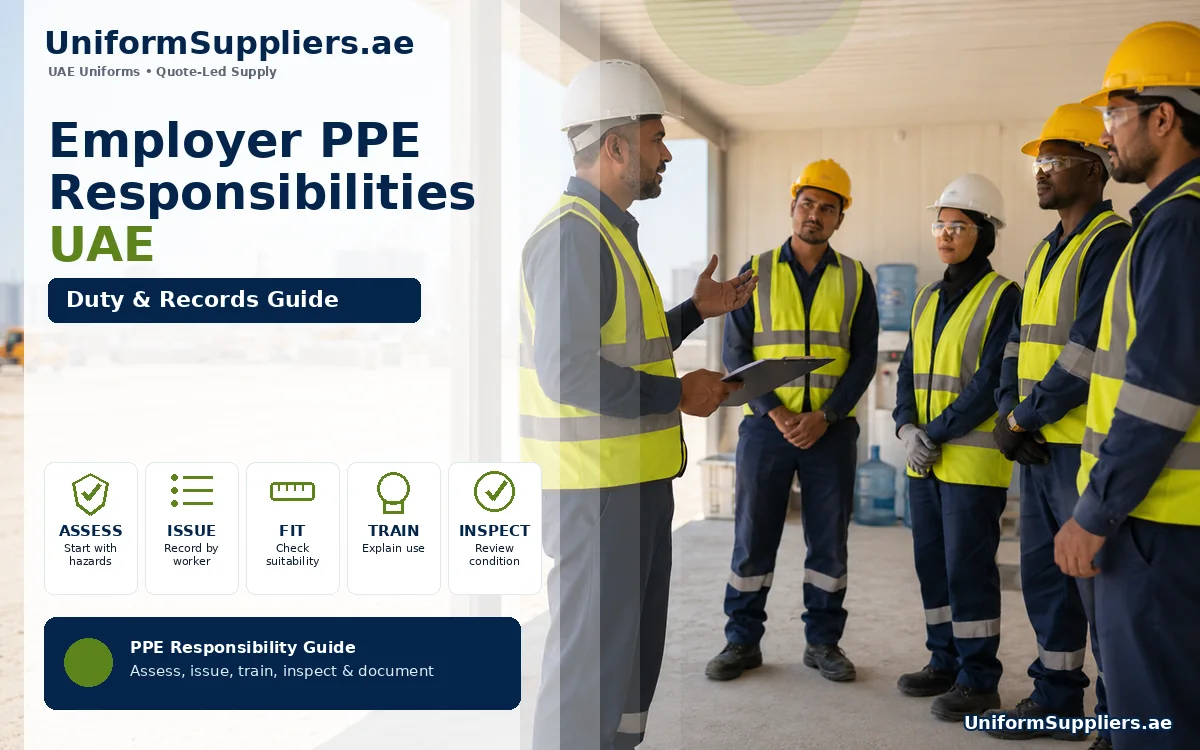
Providing personal protective equipment is only the visible part of an employer’s duty. The harder part is proving that the right equipment was chosen for the right hazard, issued to the right person in the right size, explained in a language they understand, and replaced when it wore out.
In the UAE that applies year round, and tightens in summer, when heat becomes a hazard in its own right and outdoor work is restricted in the hottest part of the afternoon.
This article sets out the duties an employer is generally expected to meet, the records that demonstrate them, and how uniform and PPE choices support heat management on UAE sites. It is general guidance, not legal advice: confirm current requirements with MOHRE or the relevant free-zone authority before setting policy.
What this guide covers
- Where employer PPE duties come from in the UAE
- The employer PPE duty framework
- Summer heat and the midday break
- PPE on multi-contractor sites
- Instruction a multilingual workforce can actually use
- The PPE issue record template
- What auditors actually ask to see
- Frequently asked questions
Where employer PPE duties come from in the UAE
UAE labour legislation places general occupational health and safety obligations on the employer, administered by the Ministry of Human Resources and Emiratisation for mainland companies. Free zones run their own health and safety regimes, and several of the larger industrial and energy zones publish detailed requirements.
Most large clients also impose contractual standards through the project HSE plan. These are often stricter than the general legal baseline, and they are audited most frequently.
So a UAE employer usually has three sets of expectations to satisfy at once: the federal or free-zone requirement, the client’s HSE plan, and its own internal policy. Because the detail varies by jurisdiction and changes over time, this article describes duties in general terms. Verify the current position with the authority that regulates your entity.
The employer PPE duty framework
The table below turns those duties into something a manager can act on: each has a practical meaning, a document that evidences it, and a review trigger.
| Duty | What it means in practice | What to document | How often to review |
|---|---|---|---|
| Hazard assessment | Identify the hazards each role faces before choosing any equipment | Written assessment per role, task and site area | On any change of task, site or equipment |
| Selecting suitable PPE | Match equipment to the hazard and the working conditions, not to the lowest price | A specification per role, with the supporting datasheet | Whenever the assessment or the product changes |
| Providing at no cost | Required protective equipment is supplied by the employer, never deducted from pay | Issue records showing items provided free of charge | At every issue and replacement |
| Fit and individual suitability | Equipment must fit the individual, including women and outsize wearers | Size records per employee and any fit adjustment made | At issue and when the workforce changes |
| Instruction and training | Workers must understand what to wear, when, why and how to check it | Attendance record, topic covered and language used | At induction and at set refresher intervals |
| Storage and maintenance | Provide clean dry storage and a practical way to clean or launder items | Storage arrangement and cleaning or laundry schedule | Periodically, and after any complaint |
| Inspection and replacement | Check condition, withdraw damaged items and replace them promptly | Inspection log showing the defect found and the action taken | On a fixed cycle and after any incident |
| Record keeping | Hold evidence that each of the duties above was actually carried out | Issue register, assessments, training and inspection records | Continuously, with a formal annual review |
Note the pattern: every duty produces a document. An employer who can produce those documents is far better placed than one relying on the fact equipment was bought.
Summer heat and the midday break
Across the peak summer months the UAE restricts outdoor work during the hottest part of the afternoon. Work in direct sun and open air stops for a defined period each day, shaded rest facilities and drinking water must be available, and the rule is enforced by site inspection. Certain continuous operations are exempt under permit.
The months, hours and exemptions are confirmed by the authorities each year, and free zones may apply their own equivalent arrangements. Confirm the current dates and times with MOHRE or your free-zone authority rather than reusing last year’s notice.
The break does not remove heat stress from the rest of the day. What people wear for the other nine hours is a procurement decision as much as an HSE one.
- Breathability first. Fabric weight and construction decide how much heat a worker carries. Lighter weights and open weaves move moisture faster, at some cost in durability.
- Light colours outdoors. Dark garments absorb more solar heat. Where the client permits it, a lighter base colour with high-visibility banding beats a dark coverall.
- Cover, do not expose. Long sleeves in a light breathable fabric protect against sun better than short sleeves, and helmet neck flaps reduce exposure to the head and neck.
- Design for hydration and rest. Garments quick to open at the neck and cuffs, and easy to remove in a shaded rest area, support the rest-and-rehydrate cycle.
- Plan the laundry. Summer sweat means daily laundering. A two-set or three-set issue per worker keeps people in clean dry garments and extends the life of the issue.
For the garment-by-garment side of this, including fabric choices by hazard, see the complete industrial workwear safety guide. Footwear has its own selection logic, covered in choosing safety shoes and boots for UAE worksites.
PPE on multi-contractor sites
Most UAE projects involve a main contractor and several subcontractors, with different employers of record and different PPE standards. Three problems recur.
The first is inconsistency. If the HSE plan specifies one standard and a subcontractor issues something lesser, the gap surfaces at audit rather than at induction. Requiring subcontractors to submit their PPE specification and issue records before mobilisation prevents most of it.
The second is identification. Colour coding by company, or an embroidered company name on the garment, lets a supervisor see who belongs to which team and who is unaccounted for during an evacuation. That is a uniform decision with a safety benefit.
The third is visitors. Sites need managed stock of visitor helmets, vests and footwear in a usable size range, cleaned between uses. Borrowed equipment two sizes too large is a hazard, not a control.
Instruction a multilingual workforce can actually use
A signature on an induction sheet is not evidence of understanding if the briefing was delivered in a language the worker does not read. A typical UAE site workforce may speak Hindi, Urdu, Malayalam, Bengali, Tagalog, Nepali, Arabic and English between them.
Practical steps: deliver toolbox talks in the languages actually present, use pictograms and demonstration rather than text-heavy handouts, have workers demonstrate fitting and checking rather than only watching, and record which language was used. Where supervisors translate, name the translator.
The same applies to sizing: a worker who cannot read the chart will accept whatever is handed over. Onsite fitting removes that problem, which is why onsite measurement is worth building into the mobilisation plan.
The PPE issue record template
One record per employee, updated at every issue, is the most useful document in a PPE file. Keep the fields simple enough that a storekeeper completes them accurately.
- Employee name and labour card or staff ID number
- Job role and the hazard group it sits in
- Site or project, and the reporting supervisor
- Items issued, listed individually rather than as a kit
- Size issued for each item, including footwear and gloves
- Date of issue, and whether it is a first issue or a replacement
- Reason for replacement: wear, damage, incident or size change
- Confirmation that instruction was given, and in what language
- Next inspection or replacement review date
- Signature of the employee and of the issuing storekeeper
Hold the same information centrally as well as on site. Where a supplier keeps stored specification and size records for repeat orders, reissuing after a size change becomes a short instruction rather than a fresh measuring exercise.
What auditors actually ask to see
Audits tend to follow the same route. The reviewer picks two or three names from the site roster, then asks for the hazard assessment covering that role, the specification chosen against it, the issue record with sizes and signature, the training record showing the language used, and the last inspection entry. If those line up, the audit moves on.
Mustang recommendation: run PPE and uniform as one programme rather than two purchase orders. Uniform Suppliers UAE supplies workwear, safetywear and PPE with stored size and specification records for repeat orders, employee-by-employee packing that maps onto an issue register, and free onsite individual measurements in the UAE for qualifying company uniform orders. Protective properties are those declared by the manufacturer on the datasheet, and final specification will be confirmed during quotation.
Structuring it as an employee uniform programme keeps sizing, issue and replacement in one place, whether the workforce sits in construction and engineering or facilities management. The industrial uniforms and safety workwear pillar page sets out what can be combined in one supply arrangement.
Frequently asked questions
Can an employer deduct the cost of PPE from wages?
Protective equipment required for the job is generally the employer’s responsibility to provide, and deducting its cost from wages runs against that principle. Some employers apply a deposit for lost or deliberately damaged items, which is a separate matter. Confirm the position with MOHRE or your free-zone authority before applying any deduction.
Who is responsible for PPE on a subcontracted site?
Each employer remains responsible for its own workers, while the main contractor is normally accountable through the project HSE plan for the standard across the site. Both layers get audited, so main contractors should require subcontractors to submit specifications and issue records before mobilisation.
Does the midday break apply to every kind of outdoor work?
The restriction targets work in open air and direct sun during the hottest part of the afternoon in the peak summer months, and certain continuous operations are exempt under defined conditions. Because scope, dates and exemptions are set by the authorities and can change, confirm the current position rather than relying on precedent.
How long should PPE records be kept?
Keep them while the worker is employed and for a reasonable period afterwards, since records are often requested during incident investigations long after the issue date. Client contracts frequently set their own retention period, so check the HSE plan. Digital copies held centrally are easier to produce at audit.
Does buying certified PPE make an employer compliant?
No. Certification describes the product, not the employer’s system. Compliance depends on assessing the hazard, selecting equipment against it, fitting it to the individual, training the wearer, inspecting and replacing it, and documenting all of that. A well-specified product is one step in the chain, not a substitute for it.
Turning duties into a working system
Most PPE failures in the UAE are administrative rather than technical: the equipment existed but the record did not, the wearer did not understand the briefing, or nobody owned replacement. A simple duty framework, one issue record per employee and a supplier who keeps size and specification records closes most of those gaps.
Uniform Suppliers UAE supplies uniforms, workwear and PPE across the UAE and the GCC, and can align the issue structure with your HSE documentation. Request a quote with your roles, headcount and site list to get started.