Special offers: free digital logo mock-up and free samples against a confirmed LPO. View offers


Driver and Delivery Team Uniforms: Practical Workwear for UAE Fleets

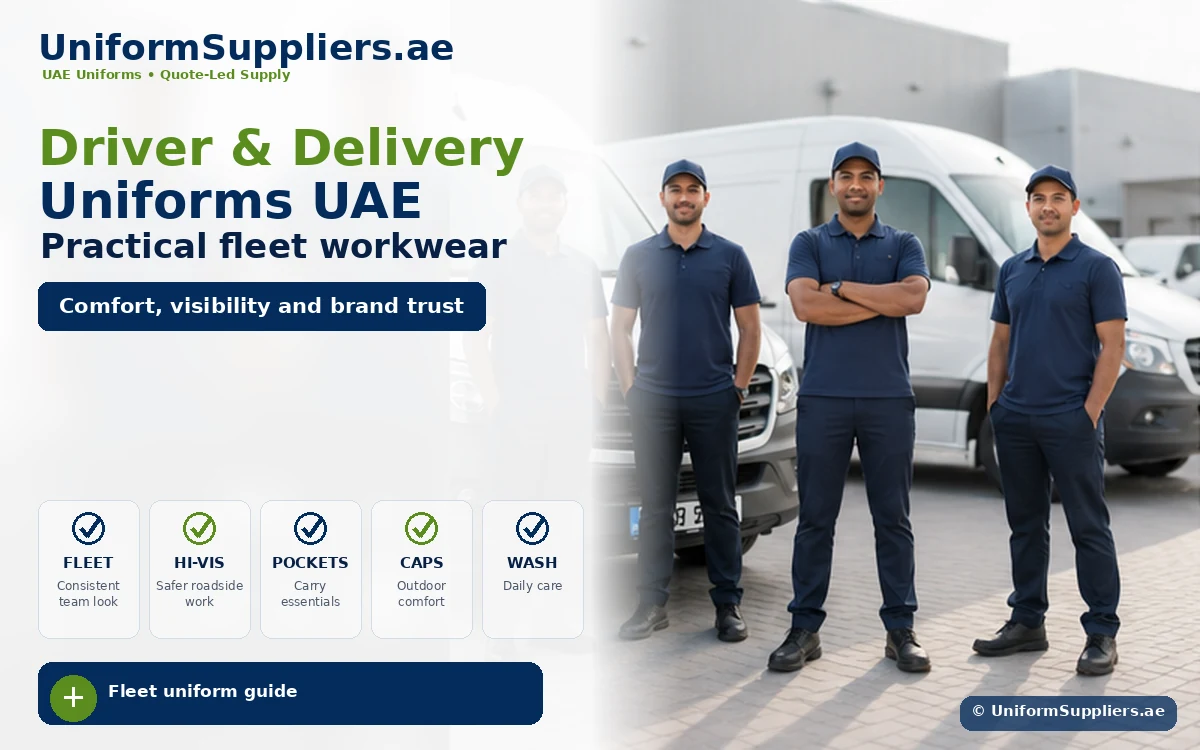
The UAE’s delivery and last-mile logistics sector has grown fast, and with it a large, highly visible workforce of drivers and delivery riders who represent a brand on the road, at customer doorsteps and in shared building lobbies, often more frequently than any office-based employee. Yet driver and delivery uniforms are often specified as an afterthought to warehouse or back-office workwear, rather than as their own distinct brief. This guide sets out what to consider specifically for on-road driver and delivery teams, distinct from the indoor warehouse and logistics uniforms covered in our warehouse and logistics uniforms guide.
Table of Contents
- Why Driver Uniforms Are a Distinct Brief
- Visibility and Road Safety
- Climate Considerations for Outdoor Roles
- Branding for Doorstep and Roadside Visibility
- Footwear and Practical Accessories
- Managing Uniforms Across a Large, Distributed Fleet
- Comparison: Vehicle-Based vs. Two-Wheeler Delivery Roles
- Checklist: Specifying a Driver and Delivery Uniform
- FAQs
Why Driver Uniforms Are a Distinct Brief
A warehouse worker spends most of a shift indoors, in a controlled environment, with predictable movement patterns. A driver or delivery rider spends most of a shift outdoors or in a vehicle, in direct UAE sun and heat, in unpredictable traffic and weather conditions, and interacting face-to-face with customers at every stop. That combination — heat exposure, road safety and constant customer visibility — makes driver and delivery uniforms a genuinely different specification problem from general industrial workwear, even though both fall under the same broad category.
Visibility and Road Safety
Road safety is the single biggest practical difference between a driver uniform and an indoor workwear uniform. Riders and drivers making frequent stops, especially during early morning, evening or low-light hours, benefit from visibility features that a warehouse-only uniform doesn’t need — reflective trim on jackets or vests, and high-contrast colour choices that stand out against both daytime and low-light backgrounds. Our guide to hi-vis and reflective workwear covers classification and tape placement in more depth; the same principles apply directly to delivery fleet uniforms, particularly for two-wheeler riders who spend more time exposed to moving traffic than van or car-based drivers.
Where a role involves any two-wheeler riding, uniform specification should be planned alongside, not instead of, proper safety equipment such as an approved helmet — the uniform is one layer of a broader road-safety approach, not a substitute for it.
Climate Considerations for Outdoor Roles
Outdoor roles in UAE summer conditions need fabric that manages heat and moisture more aggressively than an indoor uniform. Lightweight, breathable, moisture-wicking fabrics reduce discomfort and fatigue across a full shift spent largely outdoors or in a non-air-conditioned vehicle cab. Loose, ventilated cuts around the underarm and back panel areas help with airflow, and darker colours that show less staining from sweat and road dust are a practical, if unglamorous, consideration worth raising during specification.
Layering also matters for drivers who move between air-conditioned vehicle cabins and outdoor heat repeatedly through a shift — a lightweight base layer that performs well on its own, with an optional branded outer layer for cooler early mornings or winter months, tends to work better than a single heavy uniform designed for only one condition.
Branding for Doorstep and Roadside Visibility
For many customers, a delivery driver at the door is the only in-person representative of a brand they ever encounter, which makes uniform branding disproportionately important for this role compared with, say, a back-office warehouse picker. Clear, legible branding — company name and logo positioned where it’s visible at a normal doorstep interaction distance, not just up close — helps reinforce brand recognition and also gives customers a straightforward way to confirm they’re dealing with a legitimate representative of the company, which matters for both trust and basic personal safety on both sides of the interaction.
Footwear and Practical Accessories
Driver and delivery footwear needs differ by role: van and car drivers need comfortable, non-slip footwear suited to pedal use and short walks to a doorstep, while two-wheeler riders and walking delivery staff need more durable, supportive footwear built for repeated walking and standing across a full shift. Accessories worth considering alongside the core uniform include a lightweight, ventilated cap or sun protection for roles with significant outdoor exposure, and a practical, weather-resistant bag or pouch for two-wheeler and walking delivery roles where a rider needs both hands free.
Managing Uniforms Across a Large, Distributed Fleet
Delivery and logistics operators often manage larger, more geographically distributed and higher-turnover workforces than a typical office uniform programme, which changes how reordering and replacement should be planned. A simple, centrally managed reorder process — rather than relying on individual drivers or local depot managers to request replacements ad hoc — helps maintain a consistent look across a large fleet and avoids some drivers appearing in visibly worn or outdated uniforms while others are freshly kitted. Our guide to rolling out uniforms across multiple branches covers the underlying logistics principles that apply well to a distributed driver fleet, even where the individual “branches” are really depots or hubs rather than retail locations.
Onboarding New Drivers Quickly
Delivery and logistics operators frequently onboard new drivers at short notice to meet demand, particularly around seasonal peaks such as major shopping events or the summer sales period. A uniform programme that depends on individual measurement and made-to-order production for every new hire can create a bottleneck exactly when speed matters most. Holding a modest ready-stock buffer across common sizes, rather than relying solely on made-to-order production, lets new drivers be kitted and on the road within days rather than weeks. Our guide comparing ready-stock versus custom uniforms covers this trade-off in more depth and applies directly to fast-scaling delivery operations.
Where a new driver starts before their uniform has arrived, it’s worth having a clear interim policy — whether that’s a temporary branded vest over plain clothes, or a short grace period — documented in advance rather than decided ad hoc at each depot.
Seasonal and Weather Variations
UAE weather is relatively consistent for most of the year but does include a genuine seasonal shift, with cooler, more comfortable conditions from roughly November through March and considerably harsher heat through the summer months. A driver uniform programme benefits from at least a light seasonal variation — for example, a lightweight long-sleeve or light jacket option for cooler early mornings in winter months, layered over the same base uniform used year-round — rather than a single fixed specification that assumes constant peak-summer conditions. Rain is infrequent in the UAE but does occur, and a compact, packable water-resistant layer is a reasonable addition for delivery fleets that continue operating through occasional wet weather, particularly for two-wheeler riders with no vehicle cab for shelter.
Our guide to winter vs summer uniform planning sets out a general framework for thinking about seasonal variation that applies well to a driver fleet’s uniform calendar.
Comparison: Vehicle-Based vs. Two-Wheeler Delivery Roles
| Factor | Van/car drivers | Two-wheeler/walking riders |
|---|---|---|
| Visibility priority | Moderate — mainly at doorstep | High — continuous road exposure |
| Heat exposure | Intermittent (cab is climate-controlled) | Continuous |
| Footwear priority | Comfort for pedal use and short walks | Durability for sustained walking |
| Accessory needs | Minimal beyond core uniform | Weather-resistant bag, sun protection |
Checklist: Specifying a Driver and Delivery Uniform
- Confirm whether the role is vehicle-based, two-wheeler or on-foot — specification priorities differ
- Include reflective or high-contrast visibility elements for any road-exposed role
- Specify lightweight, breathable, moisture-wicking fabric for outdoor and cab-based roles
- Position branding for doorstep-distance legibility, not just close-up appearance
- Match footwear to the specific physical demands of the role
- Plan a centralised reorder process suited to a large, distributed fleet
FAQs
Do delivery riders need certified high-visibility garments, or is reflective trim enough?
This depends on your operation’s own risk assessment and any applicable road-safety requirements for your fleet, which we’d recommend confirming with your safety officer or relevant authority. We can discuss visibility features and trim placement during your quotation.
What’s the most durable footwear option for two-wheeler riders?
This depends on your specific operating conditions and existing footwear policy. Final footwear specification will be confirmed during quotation based on your team’s day-to-day duties.
Can we brand delivery uniforms with QR codes or contact details rather than just a logo?
Many delivery operators do include additional practical branding elements such as a customer service contact or QR code alongside the main logo. This can be incorporated into your uniform design during specification.
How often should driver uniforms be replaced given heavier outdoor wear?
Outdoor and road-exposed roles typically show wear faster than indoor roles, so a shorter replacement cycle is often appropriate. Our guide to annual uniform replenishment can help you plan a realistic cycle for your fleet.
Is it better to hold ready stock for driver uniforms given fast onboarding needs?
Many fast-scaling delivery operators find a ready-stock buffer across common sizes reduces onboarding delays compared with relying entirely on made-to-order production for each new hire. The right balance depends on your hiring volume and how predictable your sizing distribution is — we can help you plan this during your quotation.
Do we need different uniforms for third-party contracted drivers versus directly employed staff?
This is a business decision rather than a uniform-specification one. Some operators issue the same uniform to all drivers representing their brand regardless of employment status, while others differentiate. Either approach can be accommodated — let us know your structure during quotation.
Planning uniforms for a driver or delivery fleet? Request a quote and our team will help you specify a uniform built for the realities of a road-based, customer-facing role — from fabric and visibility through to fleet-wide reordering.