Special offers: free digital logo mock-up and free samples against a confirmed LPO. View offers
Barista and Cafe Uniforms That Match Your Brand

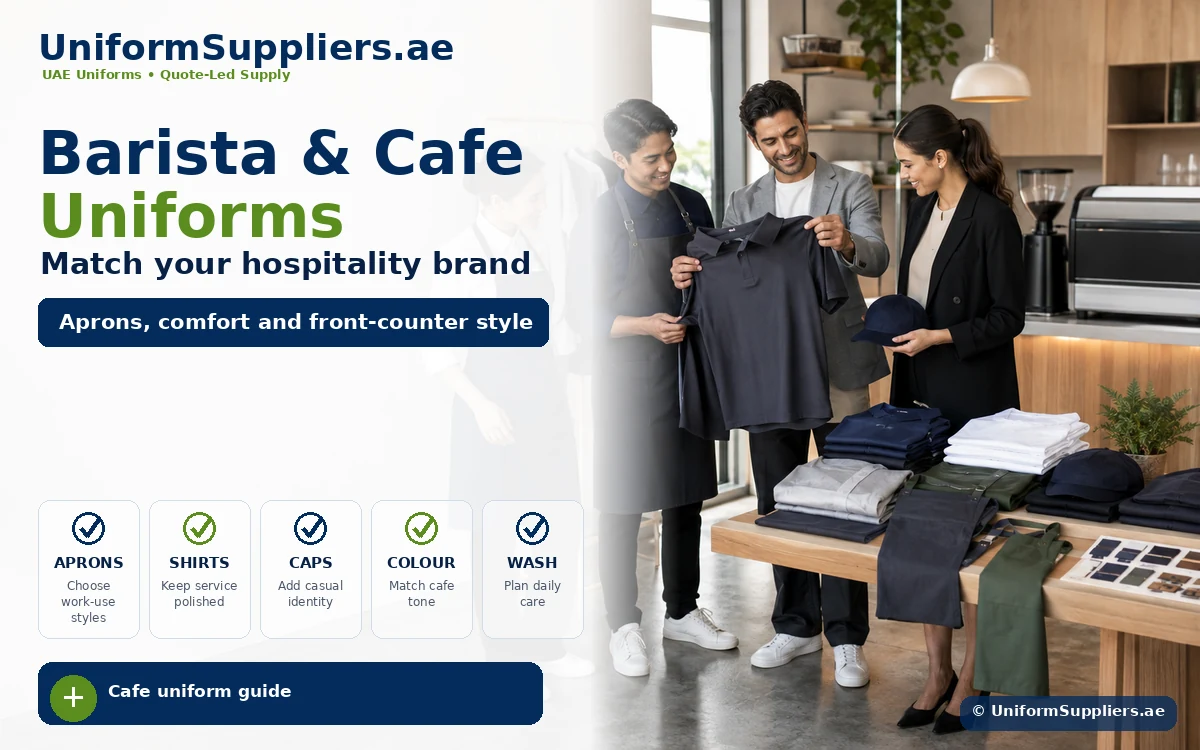
A cafe’s uniform does a different job to a restaurant’s. Baristas and counter staff work close to customers, often across a small footprint, handling spills, steam and constant hand-to-hand transactions — and the uniform is one of the clearest signals of a cafe’s brand personality, from a minimalist specialty coffee bar to a warm, colourful neighbourhood cafe.
This guide covers what genuinely matters when specifying uniforms for a cafe or barista team in the UAE: apron styles, fabric for a spill-and-steam environment, comfort for a standing, moving role, and how to match uniform choices to your cafe’s own aesthetic. It is distinct from our broader guide to restaurant staff uniforms and our dedicated aprons guide — both are referenced here rather than repeated.
What this guide covers
- Apron styles: bib versus waist
- Fabric for spills, heat and steam
- Comfort for a standing, moving role
- Matching your cafe’s aesthetic
- Practical pockets for order pads and card machines
- Headwear, sleeves and food-service basics
- Seasonal layering for cafe teams
- Laundering given frequent staining
- Style comparison table
- Frequently asked questions
Apron styles: bib versus waist
A bib apron, covering the chest and torso, gives the most coverage against splashes from steam wands and pour-overs, and tends to suit baristas working directly at an espresso machine for most of a shift. A waist apron, covering from the hip down, suits counter and floor staff who move between the till, tables and the machine, where full chest coverage matters less than freedom of movement across the upper body.
Many cafes issue both styles by role rather than choosing one for the whole team — bib aprons for the machine station, waist aprons for counter and floor — which keeps each role dressed for what it actually does during a shift. For a broader comparison of apron types across trades, see our aprons guide.
Fabric for spills, heat and steam
A barista’s shift involves near-constant exposure to hot liquid, steam and milk spills, so fabric choice should prioritise quick-drying, stain-resistant performance over anything decorative. A cotton-poly blend with a tight weave sheds spills better than pure cotton, dries faster between incidents, and holds up to the frequent laundering a cafe uniform needs.
Heat resistance close to the espresso machine is also worth considering for the apron and any sleeve or forearm coverage, since steam wands and portafilters run hot throughout service. This does not require specialist flame-resistant fabric — a dense, tightly woven cotton or cotton-blend generally provides adequate everyday protection from incidental contact.
Comfort for a standing, moving role
Barista and counter roles are almost entirely on-feet, often within a tight service area, requiring reach, bending and quick turns rather than long walking distances. Breathable base layers underneath the apron — a t-shirt or polo in a breathable knit — matter more here than in seated or slower-paced roles, particularly given the added heat from the espresso machine and steam.
Fit should allow full arm movement for reaching overhead to shelving, operating the machine, and leaning across the counter, without excess fabric that risks catching on equipment. A slightly closer fit through the body, with room through the shoulders, generally works better behind a counter than a loose, flowing cut.
Matching your cafe’s aesthetic
Cafe uniforms cover a wide visual range in the UAE market, from all-black minimalist specialty coffee branding to warm earth tones and pattern-driven neighbourhood cafe identities. The uniform should generally follow the cafe’s existing visual language — the same colour family as the signage and interior, rather than a generic hospitality look that could belong to any food business.
A simple way to approach this is to pick one dominant colour from your interior or logo for the core garment, then use a second accent colour sparingly on the apron ties, cap or trim, rather than introducing entirely new colours into the uniform that do not exist elsewhere in the space.
Branding placement also affects how the uniform reads to customers. A small embroidered logo on the chest or apron bib generally suits a minimalist specialty cafe identity better than a large printed graphic, while a bolder, colourful cafe brand can carry a larger printed design without looking out of place. Requesting a free digital logo mock-up before production lets you check placement and scale against the actual garment rather than guessing from a flat logo file.
Practical pockets for order pads and card machines
Pocket placement matters more for barista and counter roles than it might first appear. A chest or front apron pocket sized for a pen and small order pad supports quick note-taking during a rush, while a secure hip or apron pocket that can hold a handheld card machine or phone without it sliding out during movement avoids one of the more common daily frustrations reported by counter staff.
Avoid oversized or excessive pocket layouts modelled on industrial workwear — a cafe apron only needs one or two well-placed pockets, and extra bulk gets in the way at a small counter working close to customers and equipment.
Where staff carry a personal phone during a shift, a dedicated inner pocket with a secure closure — rather than an open outer pocket — reduces the risk of it slipping out while leaning across the counter or bending to load the machine.
Headwear, sleeves and food-service basics
Where local food-hygiene practice calls for headwear at the espresso station or behind the counter, a branded cap or a simple fabric headband keeps hair contained without adding heat the way a full hat can in a warm service area. Rolled or three-quarter sleeves on the base layer are common for baristas working close to the machine, reducing the amount of loose cuff fabric near steam and hot surfaces while still keeping forearms reasonably covered.
Footwear is usually specified separately from the uniform itself but is worth including in the overall brief to your supplier: closed, slip-resistant shoes suit the wet, fast-paced floor behind most espresso counters better than open styles, and this is typically a policy note rather than a garment order.
Seasonal layering for cafe teams
Cafes with an outdoor seating area, a kiosk-style counter, or a location with a strong indoor-outdoor airflow difference may need a light layering option for cooler early mornings or heavily air-conditioned interiors — a branded fleece or lightweight jacket that still allows the apron to be worn over it comfortably. This is a minor addition to most cafe programmes but worth specifying up front if your location has this kind of temperature variation across a shift.
Laundering given frequent staining
Cafe uniforms are laundered frequently, often daily, given the realistic staining from coffee, milk and syrups. Choosing a fabric and colour that hides light staining between washes — mid-tone colours generally perform better here than pure white — reduces how quickly a uniform looks tired even with regular washing.
Reinforced stitching at the apron ties and pocket corners, both points of repeated daily stress, extends usable life meaningfully compared with a lightly constructed apron, and is worth specifying even where it adds modestly to the unit cost.
Style comparison table
| Style | Best suited to | Key consideration |
|---|---|---|
| Bib apron | Barista/machine station | Maximum chest and torso coverage from steam and splashes |
| Waist apron | Counter and floor staff | Freedom of upper-body movement, lighter coverage |
| Full uniform set (top + apron) | Cafes wanting a fully coordinated look | More consistent branding, higher unit cost |
Mustang recommendation: match your uniform’s dominant colour to your existing interior or logo colour rather than introducing a new palette, and specify apron style by role — bib for the machine station, waist for counter and floor — rather than one style for the whole team.
Frequently asked questions
Should baristas and counter staff wear the same apron style?
Not necessarily. A bib apron suits baristas working close to the espresso machine, where full coverage matters, while a waist apron suits counter and floor staff who need more freedom of movement. Many cafes issue both by role.
What fabric works best for a cafe uniform?
A tightly woven cotton-poly blend generally sheds spills and dries faster than pure cotton, while still holding up to frequent laundering. Very open or lightweight fabrics tend to stain and wear faster in a spill-heavy role.
How do we make our cafe uniform look consistent with our brand?
Pick one dominant colour from your interior or logo for the core garment, then use a secondary accent sparingly on trim or ties, rather than introducing an unrelated colour palette into the uniform.
Do cafe uniforms need special heat-resistant fabric near the espresso machine?
Specialist flame-resistant fabric is not usually necessary for typical espresso machine exposure. A dense, tightly woven cotton or cotton-blend apron generally provides adequate protection from incidental steam and hot-surface contact.
How often should cafe uniforms be replaced?
There is no fixed figure — check garments regularly for staining that no longer washes out, fabric thinning at high-wear points, or stitching failure at the apron ties, and replace individual items as they show wear.
Can uniforms differ between our cafe branches while keeping the same brand?
Yes, provided the core colour and branding stay consistent across locations. See our guide on choosing uniforms for multi-branch retail for how to manage that consistency across more than one site.
Do baristas need headwear as part of the uniform?
This depends on your own food-hygiene policy rather than a universal requirement. Where headwear is used, a branded cap or lightweight headband is usually more practical for a warm counter environment than a full hat.
Should we specify footwear for cafe staff?
It is worth including as a policy note even though footwear is typically ordered separately from the uniform. Closed, slip-resistant shoes suit a wet, fast-paced counter floor better than open styles.
Ready to specify uniforms that match your cafe’s brand? Request a quote from Uniform Suppliers UAE.