


Blog
Restaurant Staff Uniforms That Impress Guests

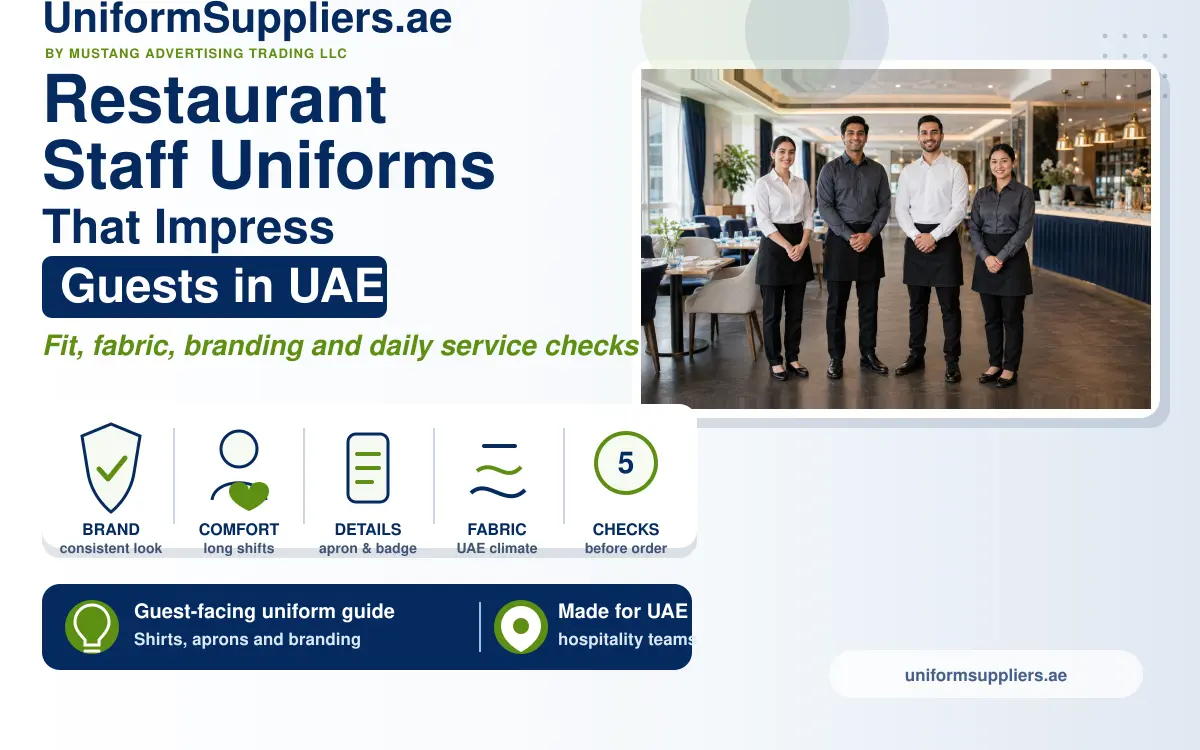
A dining room speaks before anyone in it does. In the UAE, where a booking usually follows a scroll through photographs and reviews, the front-of-house team is part of the visual product the guest has already been sold.
Restaurant staff uniforms carry more weight here than in many markets. Teams move between a chilled dining room and a warm terrace in the same shift, garments are laundered far more often than a European rota would demand, and floor teams are typically multinational.
This guide covers front-of-house garment choice and guest perception only. Wider buying and programme decisions sit in the complete guide to hospitality uniforms in the UAE.
What this guide covers
- Why guests judge front-of-house uniforms in seconds
- The front-of-house role kit, role by role
- Choosing fabric for chilled rooms and hot terraces
- Fit, movement and the long service shift
- Where branding belongs on front-of-house garments
- Modest options and a multinational floor team
- Holding the look together as the team changes
- The guest perception checklist
- Frequently asked questions
- Next step
Why guests judge front-of-house uniforms in seconds
Guests form an impression at the host stand, long before the food arrives. The first thing they read is not the menu but the person holding it: how the collar sits, whether the garment fits, whether it looks laundered.
Dubai and Abu Dhabi dining rooms compete in an unusually dense field. A guest choosing between four comparable venues in the same mall podium uses small visual signals to judge whether a place is worth its price point, and uniform condition is among the most visible. Staff also appear in the background of guest photographs constantly, so a faded polo becomes part of the venue’s public image.
The conclusion is simple: specify front-of-house garments for how they look on their fortieth wash, not their first.
The front-of-house role kit, role by role
A restaurant floor is not one uniform. Each role has a different physical task and a different amount of contact with food, ice, wine and dirty plates. The table below sets out a workable kit for each.
| Role | Core garments | Fit and finish priority | Branding placement | Practical detail that matters |
|---|---|---|---|---|
| Host or hostess | Tailored shirt or blouse, waistcoat or structured jacket, trousers or long skirt, closed shoes | Sharpest silhouette in the venue; collar and shoulder line must hold while standing still | Small chest embroidery or a discreet lapel badge | Stands in the door draught between chilled air and outside heat, so a removable layer matters |
| Server | Shirt or polo, bib or waist apron, tapered trousers, non-slip shoes | Sleeve and shoulder freedom for reaching across a table; no gaping when bending | Chest embroidery plus an apron mark | Deep reinforced apron pockets sized for pen, order pad and card machine |
| Food runner | Short-sleeve shirt or polo, short waist apron, hard-wearing trousers | Roomier through back and arms; hems that will not catch on trolleys | Single chest mark; avoid sleeve branding that rubs carried plates | Fabric tolerant of hot-plate contact and constant washing |
| Bartender | Rolled-sleeve shirt, bib or leather-look apron, dark trousers | Trim through the torso; cuffs that stay secure | Apron chest panel or bib strap, since a bib hides chest embroidery | Water and stain resistance on the apron front; sleeves that stay rolled |
| Sommelier or beverage lead | Long-sleeve shirt, tailored waistcoat or jacket, long apron, neckwear | Most formal fit on the floor; the jacket must allow a full pouring motion | Lapel badge or subtle collar detail; minimal embroidery | Pocket for a waiter’s friend and tasting glass, plus a towel loop |
| Supervisor or manager | Blazer or jacket, contrast shirt, tailored trousers, formal shoes | Distinct from the service team but the same garment family | Chest embroidery plus a name badge showing role | A colour or layer difference guests can spot across a full room |
Mustang recommendation: build the floor around one shirt or polo base in a single colour, then separate roles with aprons, layers and neckwear rather than entirely different garment ranges. It keeps the visual family intact, simplifies replenishment and makes it far easier to dress a new starter.
Choosing fabric for chilled rooms and hot terraces
A UAE restaurant runs two climates at once for much of the year. The dining room may sit at 21 to 23 degrees while the terrace, from May through September, stays hot and humid well past midnight. Staff crossing between them all evening need fabrics that cope with both.
Polyester-rich blends survive the wash cycle and hold colour; cotton content improves comfort against the skin. A poly-cotton blend with a little elastane is the usual compromise for shirts and polos. Weight matters as much as blend: light shirting feels excellent on a terrace but shows perspiration, while a heavier twill looks better indoors and is punishing outside. Our guide to fabric GSM in UAE workwear explains how weight is compared.
Laundering frequency then decides the specification. Gulf venues usually wash front-of-house garments after every shift, so a garment sees several hundred cycles a year. Ask your supplier to confirm colour fastness and shrinkage on the datasheet, and quote the wash temperature your laundry actually uses.
Fit, movement and the long service shift
Front-of-house staff stand for most of a shift and repeat the same movements hundreds of times: reaching across tables, lifting trays, bending to clear low seating. A garment that restricts them gets adjusted, untucked or rolled up, and the look degrades within the hour.
Three fit checks matter most: the shoulder seam sitting on the point of the shoulder, the sleeve staying clear of the plate when the arm is extended, and the hem staying tucked when the arm is raised. Test all three on a real member of staff before approving a sample.
Sizing across a multinational team is rarely straightforward, because one supplier’s chart may fit one group well and another poorly. Try a size set across body types before committing to bulk. Onsite measurement is available free of charge in the UAE for qualifying company uniform orders, and a size record should then be kept for every employee so replacements repeat the original fit.
Where branding belongs on front-of-house garments
Restaurant branding should be legible at conversational distance and never a distraction. In practice that means one primary mark, usually on the left chest, sized so a seated guest can read it without staring.
Embroidery suits collared shirts, waistcoats and jackets because it survives repeated washing and reads as more considered. Printing suits aprons, service bags and lighter tees, and handles fine detail that embroidery cannot reproduce. The trade-offs are set out in our embroidery versus printing guide.
Aprons deserve separate thought: they are the most photographed and most frequently replaced garment on the floor, so a simple mark that reproduces consistently across repeat orders beats an intricate one. A free digital logo mock-up is provided before production so placement can be approved on screen. Name badges then complete the picture, and engraved badges carry a one-year no-fading warranty where eligible.
Modest options and a multinational floor team
UAE restaurant teams are drawn from many countries and many personal dress preferences. A programme offering only one cut will quietly exclude part of the team or produce visible workarounds on the floor.
Build modest alternatives into the specification from the start: a long-sleeve version of every short-sleeve garment, a longer tunic length, trousers wherever a skirt is offered, and a headscarf in matching fabric where staff wish to wear one. These should look like planned parts of the range, not substitutions.
Ramadan adds a further consideration. Service shifts to late iftar and suhoor sittings, terrace use rises at night, and many venues take on temporary staff. A ready-stock layer in the core colours lets you dress seasonal staff without a custom production run.
Holding the look together as the team changes
Restaurant floors turn over, and the uniform that looked immaculate at opening drifts as replacements are bought piecemeal, dye lots shift and staff substitute their own trousers or shoes.
Three controls prevent most of that drift: a written specification for every garment covering fabric, colour reference, branding position and size scale; artwork and size records held by your supplier so repeat orders reproduce the original; and a written shoe policy, because footwear is what staff most often supply themselves.
A structured employee uniform programme handles the rest: stored repeat-order specifications, employee-by-employee packing, and ready-stock supply for urgent gaps while custom production completes. If your supplier cannot do that, our questions to ask a uniform supplier will help you test the next one.
The guest perception checklist
These are the details guests register without mentioning them. Walk the floor before service and check each one.
- Collar shape after washing — does the collar still stand, or has it curled at the points?
- Apron length and ties — consistent length, ties not frayed, knots tied the same way.
- Pocket function — pen and order pad inside the pocket, not clipped to a waistband.
- Shoe policy — one agreed colour and style, closed, clean and non-slip.
- Name badge legibility — readable at a seated guest’s eye level, straight, same side for everyone.
- Sleeve length when carrying — clear of the plate rim when the arm is extended, and rolled to the same point.
- Colour match — no visible difference between older and newer garments of the same style.
Frequently asked questions
How many sets of uniform should each employee have?
Most UAE venues work on a minimum of three sets per person, because garments are laundered after every shift and turnaround is not always same-day. Roles with heavy soiling, such as runners and bartenders, need more aprons than shirts. Set the ratio against your laundry cycle rather than a general rule.
Should servers wear polos or shirts?
It depends on the price point and the room. Collared shirts read as more formal and photograph better in fine dining, while a good polo suits casual dining, terraces and high-volume service. Many venues use both, with shirts indoors and polos for terrace or daytime shifts.
What colour works best for front-of-house uniforms?
Darker mid-tones hide stains and hold colour best through heavy laundering, but can look heavy on a bright terrace. Very light colours photograph well and show every mark. A practical approach is a darker base garment with a lighter apron or accent that is replaced more often.
How do we keep colour consistent on repeat orders?
Ask your supplier to hold a reference sample and colour reference for each garment, and to confirm repeat production is matched against it. Order in fewer, larger batches where practical, since a single dye lot is more consistent than several small ones. Final specification will be confirmed during quotation.
Do we need different uniforms for terrace and indoor service?
Between May and September, usually yes, at least as a layer difference. A common solution is a shared base garment with a lighter short-sleeve option for terrace shifts and a jacket or waistcoat layer indoors. That keeps one identity while making the summer shift bearable outside.
Next step
If your front-of-house kit has drifted, or you are dressing a new floor team, start with a specification review against the role table above, then sample the garments you are considering. Free samples are available against a confirmed LPO, and free onsite measurement is offered in the UAE for qualifying company uniform orders.
Uniform Suppliers UAE, the uniform division of Mustang Advertising Trading LLC, has supplied hospitality and restaurant and catering teams from Dubai since October 2007, combining ready-stock supply with custom manufacturing, embroidery and printing in one programme. See the range of hospitality uniforms in the UAE or request a quote with your role list, headcount and logo, and a digital mock-up will be prepared free of charge.