Special offers: free digital logo mock-up and free samples against a confirmed LPO. View offers


Branded Workwear: Turning Uniforms Into Marketing

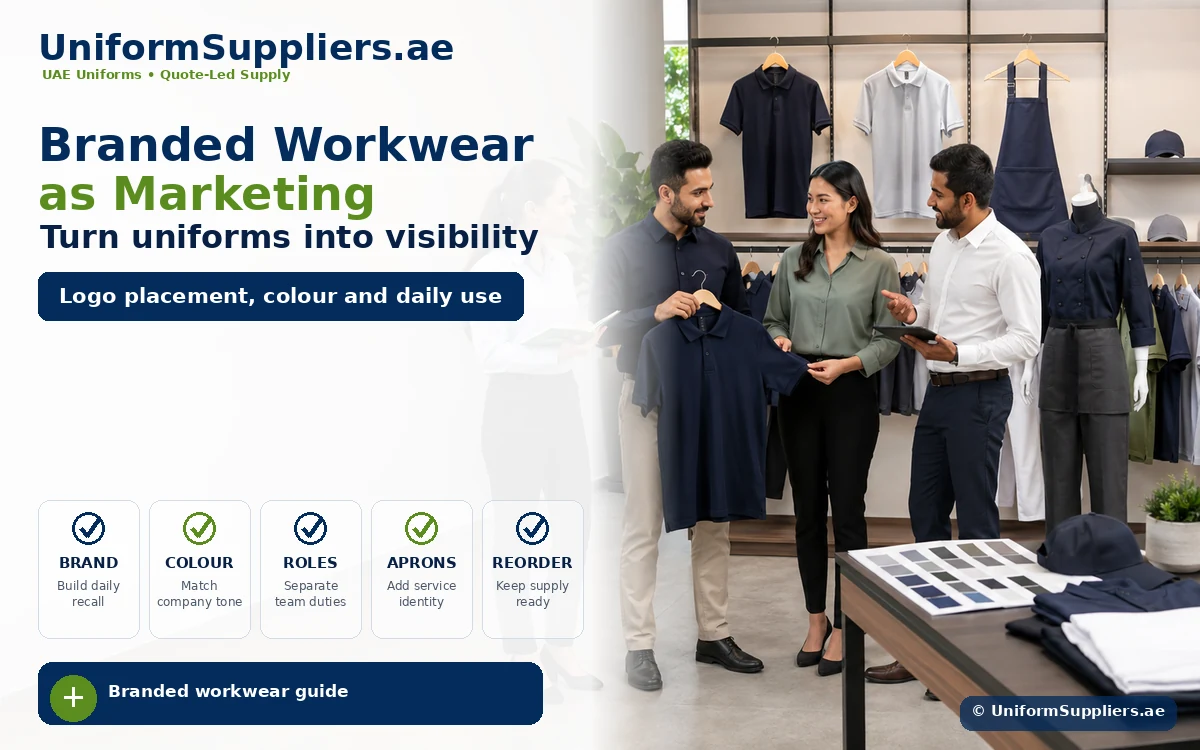
A uniform does more than dress a team — worn consistently, in public-facing and client-facing settings, it becomes one of the most repeated brand touchpoints a company has. A delivery driver, a technician on a client site, or a retail team member interacting with dozens of customers a day each carry the brand further, and more often, than most marketing spend does.
This guide takes the strategic view of branded workwear as a marketing asset, distinct from our practical guide on choosing corporate uniforms to reflect your brand, which covers the selection process itself. Here we look at why uniforms function as marketing, how to think about that value, and how to keep the effect working as your team and locations grow.
What this guide covers
- The repeated-exposure effect of a uniform
- Uniforms as a trust and credibility signal
- The mobile-billboard effect for field and delivery teams
- Consistency as the actual marketing lever
- How branded uniforms affect employee perception
- A practical way to think about the value
- Keeping the effect consistent as you grow
- Colour and design choices in a marketing context
- Uniforms as part of the brand experience for new hires
- Marketing-value checklist for a uniform programme
- Frequently asked questions
The repeated-exposure effect of a uniform
Marketing generally works through repeated exposure — a customer or member of the public seeing a brand’s name, colours and logo consistently over time builds recognition in a way a single interaction rarely does. A uniform delivers this automatically: every shift, every client visit, every delivery is another repetition of the same consistent brand presentation, at effectively no additional cost once the uniform programme is in place.
This is meaningfully different from a one-off marketing placement. A billboard or an online ad is seen once or occasionally by any given viewer; a branded uniform worn by the same technician visiting the same client site monthly builds recognition through a genuinely repeated relationship, not a series of disconnected impressions.
Uniforms as a trust and credibility signal
Beyond recognition, a well-presented, consistently branded uniform signals something about the organisation behind it — that the company takes its presentation seriously, invests in its team, and operates with a level of professionalism that carries through to the work itself. Customers and clients often form an impression of service quality before any actual service is delivered, based partly on how a team member presents.
This trust signal works in both directions: a scruffy, inconsistent or unbranded uniform can undermine confidence even when the underlying service is excellent, while a smart, consistent uniform can support confidence even in a first interaction with a new client.
The mobile-billboard effect for field and delivery teams
Field service technicians, delivery drivers and any role that moves through public or semi-public spaces during a shift extend brand visibility well beyond a fixed location. A branded vehicle and uniform combination, seen repeatedly across a neighbourhood or business district, builds a form of local brand presence that a fixed shopfront alone cannot achieve.
This effect compounds with team size and route frequency — a larger field team covering the same territory repeatedly creates more brand touchpoints than a single fixed location could generate on its own, effectively turning routine operational activity into ongoing local marketing exposure.
Consistency as the actual marketing lever
The marketing value of a uniform comes specifically from consistency, not from any single garment being particularly striking. A uniform that varies noticeably between branches, between shifts, or simply fades and wears differently across a team dilutes the recognition effect that consistency is meant to build. A slightly less elaborate uniform, worn identically and consistently across every team member and location, generally builds stronger brand recognition than a more elaborate design applied inconsistently.
This is why a single approved specification, kept on file as a stored repeat-order record and reordered identically over time, matters as much for marketing purposes as it does for operational efficiency — every reorder that matches the original specification protects the consistency the marketing effect depends on.
How branded uniforms affect employee perception
The marketing effect of a uniform is not limited to how customers perceive the brand — it also shapes how staff perceive their own role within it. A well-designed, comfortable, properly fitted uniform that staff are genuinely willing to wear with a degree of pride tends to translate into how they represent the brand in client interactions, which is a harder-to-measure but real extension of the same marketing effect.
Conversely, a uniform staff actively dislike wearing — due to poor comfort, poor fit, or a design that feels dated or unflattering — can undermine the intended brand impression regardless of how well-designed the logo or colour scheme is on paper. Comfort and fit are not purely operational concerns in this context; they directly affect how consistently and confidently the uniform is worn.
A practical way to think about the value
Uniform branding value is genuinely difficult to measure with the same precision as a digital marketing campaign, since there is no click-through rate for a delivery driver seen by a neighbourhood over a year. A more useful framing is to think of the uniform programme as a fixed, low-cost baseline of brand exposure that runs continuously alongside any other marketing activity, rather than trying to attribute a specific return figure to it.
Viewed this way, uniform spend competes less directly with paid marketing budget and more with the cost of achieving equivalent repeated local exposure through other channels, which is often considerably higher once the comparison is made explicit.
Keeping the effect consistent as you grow
As a business adds branches, expands a field team, or grows headcount generally, the marketing value of a uniform programme depends on that consistency holding at scale rather than drifting as new locations or hires are added. This is the same underlying discipline covered in our guides on choosing uniforms for multi-branch retail and rolling out uniforms across multiple branches — a single specification, referenced consistently, is what protects the brand-recognition value as the team grows.
Treating each new branch or hire as an opportunity to reference the stored specification, rather than a chance to introduce small unapproved variations, is what keeps the cumulative brand-exposure effect intact rather than gradually eroding it one inconsistent reorder at a time.
Colour and design choices in a marketing context
Colour is one of the most immediate brand-recognition triggers a uniform carries, often registering with a viewer before a logo is consciously read. Using your brand’s core colours consistently across the uniform — rather than a generic hospitality or corporate colour scheme that could belong to any company — strengthens the connection between the uniform and the specific brand it represents, particularly useful for teams operating in crowded public environments where many uniformed staff from different organisations may be visible at once.
Logo placement and sizing also affect how readable the brand is at a glance and at a distance. A logo sized and placed to be legible from a normal social distance — not just up close — matters more for roles seen briefly in passing, such as a delivery driver at a doorstep, than for roles in extended close-contact interactions where a smaller, more discreet placement may suit the brand better.
Uniforms as part of the brand experience for new hires
The first uniform issue is often a new hire’s first tangible experience of joining the brand, and how that moment is handled — a well-fitted, properly presented uniform issued promptly, rather than an ill-fitting item pulled from general stock — sets an early impression of how seriously the organisation treats its own presentation. This is a small detail operationally but a meaningful one for a new team member’s early sense of the brand they now represent.
Free onsite individual measurement, where used at onboarding, also reinforces this impression directly, giving a new hire a properly fitted uniform from their first shift rather than a generic size that may not represent the brand as well until a correction is made later.
Marketing-value checklist for a uniform programme
| Factor | Why it matters for brand exposure |
|---|---|
| Consistency across team and locations | Recognition builds through repetition of the same presentation, not variation |
| Colour matched to brand identity | Colour registers before a logo is consciously read |
| Logo size and placement | Legible at the distance the role is typically viewed from |
| Fit and comfort | Affects how confidently and consistently staff actually wear it |
| Stored specification for reorders | Protects consistency as the team grows or turns over |
Mustang recommendation: treat your approved uniform specification as a protected brand asset, not just an operational purchase — every reorder that matches it exactly preserves the recognition value the programme has already built, while every small unapproved variation quietly erodes it.
Frequently asked questions
How does a uniform actually function as marketing?
Through repeated exposure — every shift, delivery or client visit is another consistent presentation of the brand’s name and colours, building recognition over time in a way similar to repeated advertising exposure, at effectively no additional cost once the programme is in place.
Does uniform branding matter more for some roles than others?
Field service, delivery and any public-facing role that moves through the community during a shift extends this effect furthest, since they generate repeated brand touchpoints across a wider area than a fixed location alone.
What matters more for marketing value — an elaborate design or consistency?
Consistency. A simpler uniform applied identically across every team member and location generally builds stronger recognition than a more elaborate design applied inconsistently.
Does employee comfort actually affect the marketing value of a uniform?
Yes, indirectly. Staff who are genuinely comfortable in their uniform tend to wear it with more confidence and consistency, which affects how the brand comes across in real interactions, while a disliked uniform can undermine the intended impression.
How should we think about the return on uniform branding spend?
As a continuous, low-cost baseline of brand exposure running alongside other marketing activity, rather than a campaign with a directly measurable return — comparable to the cost of achieving equivalent repeated local exposure through other channels.
How do we keep the marketing effect consistent as we open new branches?
Reference the same stored, approved specification for every new branch or hire rather than introducing small variations, since consistency across the whole team is what protects the recognition effect at scale.
Should uniform design decisions involve marketing or brand teams, not just operations?
It is worth including a brand or marketing perspective in the initial specification, given the genuine brand-exposure value involved, alongside the practical fit, fabric and durability considerations operations teams typically lead on.
Ready to treat your uniform programme as a brand asset? Request a quote from Uniform Suppliers UAE.