Special offers: free digital logo mock-up and free samples against a confirmed LPO. View offers

Choosing the Right Branding Method for Your Fabric

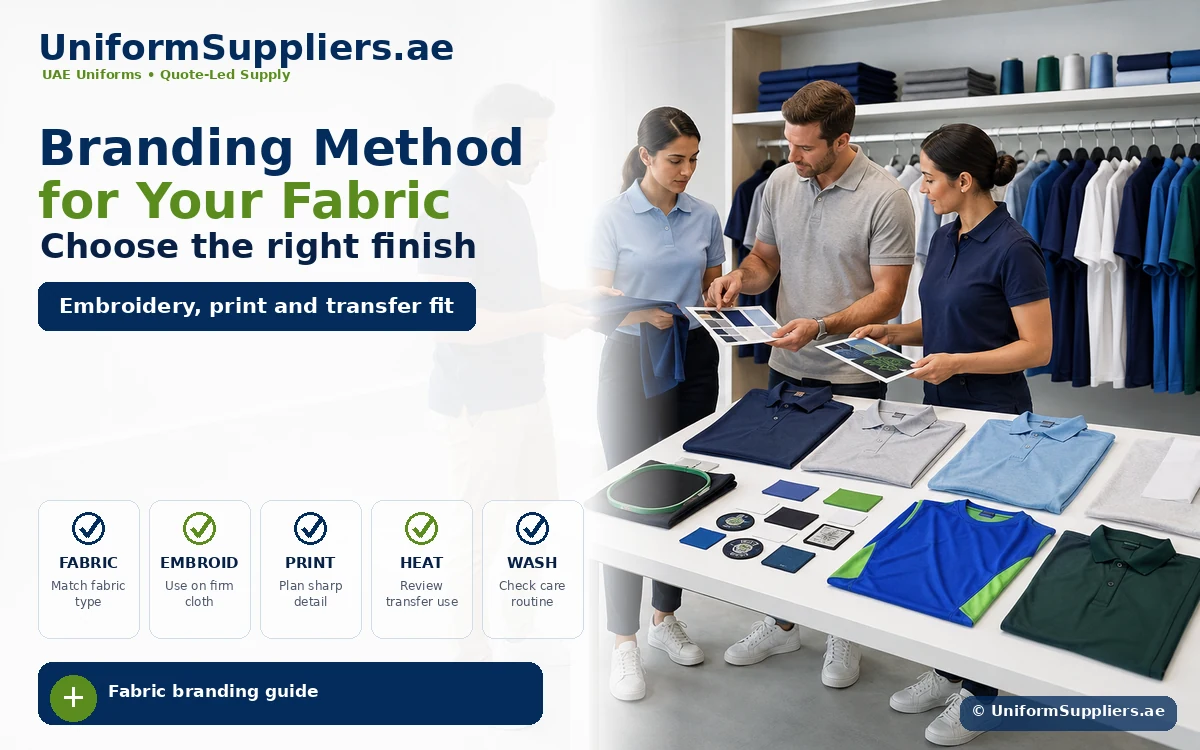
Embroidery, screen printing, heat transfer and sublimation are not interchangeable — each performs differently depending on the fabric it is applied to, and choosing the wrong pairing shows up as cracked print, loose stitching, or a design that simply will not hold through repeated laundering. This guide works from the fabric outward: what branding method actually suits cotton, polyester, technical performance fabric, and the trickier surfaces like caps and bags.
This is a companion to our broader embroidery vs printing comparison guide, which explains how the methods differ in general. Here we focus specifically on matching method to fabric type — a decision that should come before, or alongside, choosing between embroidery and printing on style grounds alone.
What this guide covers
- Cotton and cotton-blend fabrics
- Polyester and polyester-blend fabrics
- Technical and performance fabrics
- Delicate and lightweight fabrics
- Structured surfaces: caps, bags and heavy canvas
- Leather, vinyl and non-fabric surfaces
- When an order mixes fabric types
- Durability through laundering, by fabric and method
- Colour matching across branding methods
- Fabric-to-method matching table
- Frequently asked questions
Cotton and cotton-blend fabrics
Cotton and cotton-poly blends are among the most forgiving fabrics for branding, which is why they suit the widest range of methods. Screen printing performs well on cotton for bold, larger designs and flat colour areas, while embroidery suits cotton polos, shirts and jackets where a raised, premium logo finish is wanted. Heat transfer works on cotton too, particularly for detailed or small-run designs where screen printing setup would not be cost-effective for the quantity involved.
The main consideration on cotton is weave tightness — a looser weave can let embroidery stitches sit slightly proud or let printed ink bleed marginally at the edges, while a tighter weave holds both cleanly. This is worth checking on a sample before a full production run, particularly for a new fabric your supplier has not branded before.
Polyester and polyester-blend fabrics
Sublimation is the standout method for polyester, since the dye bonds directly into the fibre under heat rather than sitting on top of it, producing a permanent, full-colour result that will not crack or peel — this is why sports jerseys and technical polos are almost always sublimated rather than printed. Embroidery also works well on polyester, though screen printing can be less durable on high-polyester-content fabric, where ink adhesion is weaker than on natural fibres.
Where a design needs to cover the entire garment in full colour — an all-over sports jersey pattern, for example — sublimation is generally the only practical method, since screen printing and heat transfer are limited to specific placement areas rather than the whole garment surface.
Technical and performance fabrics
Moisture-wicking and stretch performance fabrics, common in sportswear and some technical workwear, need a branding method that moves with the fabric rather than cracking under stretch. A heat transfer using a stretchable vinyl or a specialist screen-print ink formulated for performance fabric both hold up better than a standard rigid-ink print, which can crack at the edges of the design once the fabric stretches repeatedly.
Embroidery on performance fabric needs a lighter stitch density than on woven cotton, since a dense, heavy embroidery patch can stiffen a stretch fabric at exactly the point it needs to flex, creating discomfort at that spot over a full shift or match.
Delicate and lightweight fabrics
Fine or lightweight fabrics — a thin dress shirt, a delicate blouse fabric, or lightweight scrubs — need a gentler approach than heavier workwear. A smaller, lighter-density embroidery design avoids puckering the fabric around the stitching, which is a common problem when a design intended for heavier cotton is applied directly to a finer weave without adjustment.
Heat transfer is often a better fit than screen printing on genuinely lightweight or delicate fabric, since the transfer process applies less mechanical stress to the fabric than screen printing’s press-and-pull application, though this should be confirmed with a sample given how much fabric weight varies even within a single garment category.
Structured surfaces: caps, bags and heavy canvas
Caps and structured bags present a different challenge to flat garment fabric, since the branding surface is curved, seamed or reinforced rather than flat. Embroidery is the standard method for caps specifically because it holds its shape and definition on a curved surface in a way flat printing methods generally cannot replicate cleanly.
Heavy canvas, as used in some workwear and bags, takes screen printing and embroidery equally well, though very heavy or coated canvas can require adjusted embroidery tension settings to avoid the needle struggling to penetrate the fabric consistently — a detail worth confirming with your supplier rather than assuming standard settings apply.
Leather, vinyl and non-fabric surfaces
Leather and vinyl trims, sometimes used on bag accents or premium workwear details, generally cannot be embroidered or screen printed using standard garment methods. Heat transfer using a vinyl or foil suited to non-porous surfaces, or in some cases direct engraving for a genuinely premium accessory, is the more appropriate approach — this is a specialist requirement worth flagging to your supplier early rather than assuming standard branding methods will transfer directly.
When an order mixes fabric types
A single uniform programme often spans several fabric types — cotton shirts, polyester sportswear, canvas bags, and caps — which means a single branding method rarely suits the entire order. Rather than forcing one method across every item for the sake of simplicity, matching the method to each fabric individually and keeping the logo artwork, colours and proportions consistent across methods generally produces a more professional result than a uniform branding method applied inconsistently well.
Requesting a free digital logo mock-up across each fabric and method combination in your order lets you check that the branding reads consistently before committing to full production, which matters more on a mixed order than a single-fabric one.
Durability through laundering, by fabric and method
How a branded fabric holds up to repeated laundering depends on both the fabric and the method together, not either alone. Sublimated polyester generally shows the least fading over time, since the dye lives inside the fibre rather than sitting on the surface where friction and detergent gradually wear it down. Screen-printed cotton, by contrast, is more exposed to surface wear, and a design printed with a thinner ink layer will show wear noticeably sooner than one applied with a properly cured, adequately thick print.
Embroidery holds its colour well across most fabrics since thread colour is far more wash-stable than most printed inks, though loose or poorly secured stitching can fray with repeated laundering regardless of fabric type — checking stitch density and thread tension on a sample, particularly for a uniform that will be laundered several times a week, is worth doing before a full production run.
Colour matching across branding methods
Where a single brand identity spans several garment types branded with different methods — embroidered polos alongside sublimated sportswear, for example — matching thread colour, print ink and sublimation dye to the same brand reference is worth explicit attention, since each method reproduces colour slightly differently even when targeting the same brand colour code. A colour that looks correct in embroidery thread can read subtly differently once reproduced in screen-print ink or sublimation dye on a different fabric base.
Requesting a physical colour reference check across every method used in a single uniform programme, rather than approving each method’s colour match independently, helps catch this kind of subtle mismatch before garments from different production runs are worn side by side.
Fabric-to-method matching table
| Fabric type | Best-suited method | Why |
|---|---|---|
| Cotton and cotton blends | Embroidery or screen printing | Holds both cleanly on a tight weave; widest method flexibility |
| Polyester and sports fabric | Sublimation | Dye bonds into the fibre; permanent, full-colour, all-over capable |
| Technical/stretch performance fabric | Stretchable heat transfer or specialist ink | Moves with the fabric without cracking |
| Lightweight/delicate fabric | Light-density embroidery or heat transfer | Less mechanical stress than standard screen printing |
| Caps | Embroidery | Holds shape and definition on a curved surface |
| Leather/vinyl trims | Specialist heat transfer or engraving | Standard garment methods do not adhere to non-porous surfaces |
Mustang recommendation: confirm branding method against a physical fabric sample before committing to a full order, particularly for a fabric your supplier has not branded for you before — this is a more reliable check than a general fabric-type rule of thumb alone.
Frequently asked questions
Can any branding method be used on any fabric?
No. Fabric composition and weave affect how well embroidery, screen printing, heat transfer and sublimation each hold and last, so the method should be chosen to match the fabric rather than applied uniformly across every garment type.
Why is sublimation used for sports jerseys specifically?
Sublimation bonds dye directly into polyester fibre, producing a permanent, full-colour result that can cover the entire garment — the standard approach for sports jerseys, which often need all-over patterns rather than a single logo placement.
Is embroidery always better than printing?
Not universally — it depends on the fabric and design. Embroidery suits sturdier fabrics and curved surfaces like caps, while sublimation suits polyester and full-colour designs. See our companion embroidery-vs-printing guide for the broader comparison.
What branding method works on caps?
Embroidery is the standard choice for caps, since it holds shape and definition on a curved surface better than flat printing methods.
Can leather or vinyl trims be branded the same way as fabric?
No, standard embroidery and screen printing generally do not adhere to leather or vinyl. A specialist heat transfer or engraving approach is more appropriate for these surfaces.
What should we do if our uniform order mixes several fabric types?
Match the branding method to each fabric individually rather than forcing one method across the whole order, and request a digital mock-up across each fabric-method combination to check consistency before production.
How do we know which method is right for our fabric before ordering?
Request a sample using your actual fabric and confirm the branding method with your supplier during quotation — this is more reliable than judging from a fabric-type rule of thumb alone.
Not sure which branding method suits your uniform fabric? See our garment printing and branding services or request a quote.