Special offers: free digital logo mock-up and free samples against a confirmed LPO. View offers

Corporate Blazers and Suits: A UAE Sourcing Guide

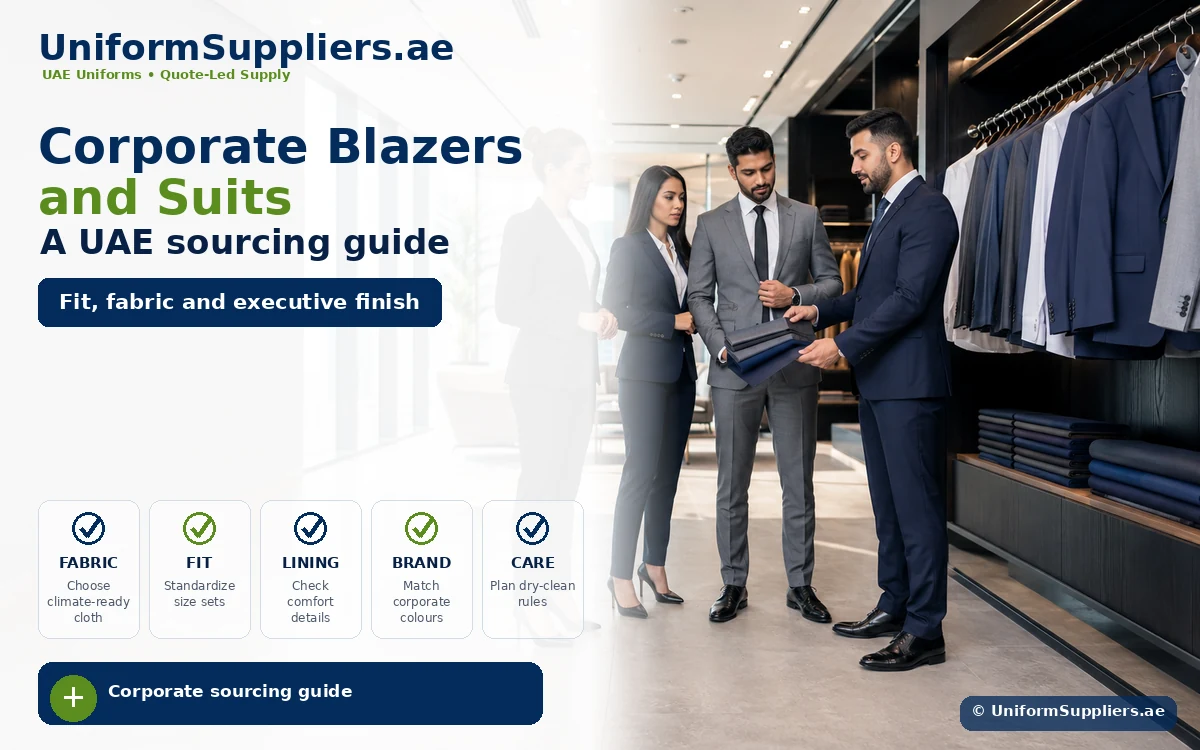
Blazers and suiting sit at the top of most corporate uniform programmes. They are the garments clients read first, the most expensive line on the order, and the items judged on fit rather than fabric — and they are usually bought against a specification written for a different climate.
A suit that works in a northern-European office behaves differently in the UAE, where a front-office team spends the day at twenty-two degrees and the walk to the car park at well over forty. Canvassing, lining, cloth weight and vents look like tailoring detail, but they are comfort and durability decisions.
This guide covers what each choice changes, how to keep a team consistent across several intakes, and what to check at fitting.
What this guide covers
- Why UAE conditions change the specification
- Construction and cut: what each choice changes
- Blazers as a lighter alternative to full suiting
- Matching men’s and women’s ranges, and modest cuts
- Colour consistency across several intakes
- The alteration and fit checklist
- Cleaning cycles and garment life
- Getting the fit right from the start
- Frequently asked questions
Why UAE conditions change the specification
Most corporate wearers in the Gulf are indoor staff who make short, hot transitions. Between May and September, moving from a chilled lobby to a street-level car park can mean a thirty-degree swing several times a day, with high coastal humidity. The jacket must survive that cycle without looking creased or damp at the collar.
Heavy worsted cloth around 300 gsm, standard in cooler markets, holds heat, recovers slowly and traps perspiration against a full lining, which is where odour and lining failure begin.
Dust matters too: airborne sand dulls flat, high-shine navy, so a twill or lightly textured face wears better. Staff who travel between sites also expose one shoulder to strong sun through car glass, a common cause of uneven fading.
Construction and cut: what each choice changes
The table below covers the decisions that most affect how a corporate jacket looks and lasts in the Gulf. Use the final column as wording for your specification sheet or tender.
| Element | Options | What it changes | Best for | What to specify |
|---|---|---|---|---|
| Canvassing | Fully canvassed, half canvassed, fused | How the chest moulds to the wearer and survives dry-cleaning; fused chests can bubble late in life | Half canvassed for client-facing teams; fully canvassed for executives; fused for short-life roles | Name the construction type and require the chest interlining on the datasheet |
| Lining | Full, half (skeleton back), unlined | Warmth, drape and how fast the jacket dries after a hot transition | Half lining for UAE indoor teams; full for banking and legal; unlined for retail blazers | Half lining, breathable body lining, smooth sleeve lining |
| Fabric weight | 200-240, 240-280, 280 gsm and above | Heat retention, crease recovery and how the jacket holds shape on the hanger | 240-280 gsm for most Gulf corporate wear; lighter for hospitality floor teams | Give a gsm range, not one figure, and ask for the mill’s confirmed weight |
| Fabric blend | Pure wool, wool-rich poly-wool, high-polyester, blends with elastane | Crease recovery, shine after pressing, cost, and how forgiving the cloth is in daily use | Poly-wool for large teams; wool-rich for management tiers; light elastane for active roles | State blend percentages; require colourfastness to light and rubbing |
| Button stance and lapel | Two-button, three-button, one-button; notch, peak or shawl | Where the jacket opens on the torso and how formal it reads across mixed body shapes | Two-button notch is the safe default; peak lapel for senior or ceremonial wear | Fix one stance for the programme and record lapel width |
| Vents | Single centre vent, double side vents, ventless | How the back sits when seated, standing, or with hands in pockets | Side vents for staff constantly up and down; single vent as an economical standard | Specify vent type per style and confirm it on the approved sample |
| Trouser or skirt pairing | Matched suit trouser, contrast trouser, straight or A-line skirt | Whether the outfit reads as a suit or a blazer look, and the cost of replacement | Matched for formal roles; contrast where blazers outlive the lower half | Order spare lower garments in the first run and record the ratio |
For most UAE offices a wool-rich poly-wool in the middle weight band is the practical answer: polyester improves crease recovery through frequent cleaning, while wool keeps the matt handle that makes a uniform look tailored. Ask for pilling and colourfastness to be confirmed on the mill datasheet; where a detail cannot be confirmed at enquiry stage, final specification will be confirmed during quotation. Our guide to fabric GSM compares these weight bands.
Blazers as a lighter alternative to full suiting
Not every client-facing role needs a matched suit. For hotel front office, retail management, showroom staff and events teams, a blazer over a contrasting trouser or skirt delivers the same authority with less heat and a lower replacement cost. The jacket carries the branding, so the lower half can be replaced more often without breaking colour matching.
The trade-off is formality: boardroom, legal and banking relationship roles still read better in a full suit. A common structure is a blazer programme for the floor team and a matched suit tier for management, cut from cloth in the same shade family so group photographs stay coherent.
Matching men’s and women’s ranges, and modest cuts
Mixed teams need both ranges cut from the same cloth, ideally the same production lot. Sourcing men’s suits from one supplier and women’s from another almost always produces two slightly different navies, and the difference shows when staff stand together at a reception desk.
Plan modest cut options into the range rather than treating them as exceptions: a longer jacket covering the hip, a higher button stance, full-length sleeves as standard, a roomier armhole, lined skirts cut to mid-calf, and straight trousers that work under an abaya. For hijab wearers, a lower jacket collar and smooth neck lining avoid catching.
Offer a skirt and a trouser option in every size. Label sizes from different countries do not agree, so measured size files beat guesswork across a multinational workforce — the sizing and measurement guide lists what to record.
Colour consistency across several intakes
Corporate teams are rarely dressed all at once. New joiners arrive throughout the year and each top-up risks a slightly different shade. Navy is the worst offender: two dye lots that match under warehouse light can read differently under a lobby’s warm lighting.
Three habits keep a programme consistent. Reserve cloth from a single lot at the start where volume justifies it. Keep a retained swatch and check deliveries against it in daylight. Record the mill reference, shade code, buttons, thread and lining so repeat orders quote the same cloth — a jacket with different buttons looks like a mistake even when the cloth matches.
Mustang recommendation: agree the shade once, sign off a physical sample, and keep the approved specification on file so top-ups are produced against the original record. Uniform Suppliers UAE stores repeat-order specification records, and free samples are available against a confirmed LPO.
The alteration and fit checklist
Tailored garments are signed off at the fitting, not at sample stage. Work through this list on every wearer and record the alterations.
- Shoulder seam: it should end where the shoulder ends. Overhang or digging in cannot be corrected cheaply — change the size instead.
- Sleeve pitch: with arms hanging naturally, the sleeve should fall clean, with no diagonal drag lines at the armhole.
- Jacket length: covering the seat for classic corporate wear, slightly shorter for a modern cut. Fix one rule for the programme.
- Sleeve hem: leave roughly a centimetre of shirt cuff showing with the arm relaxed.
- Waist suppression: the jacket should close without strain and without an X-shaped crease at the button.
- Lapel and collar: the lapel should lie flat, with no gap at the collar when buttoned.
- Trouser hem: agree one break rule for the team and record the finished inside leg per wearer.
- Trouser rise and seat: check seated as well as standing, since office wear is judged sitting down.
- Skirt length and lining: the walking vent must allow a full stride and the lining should not cling.
- Movement test: ask the wearer to reach forward, cross the arms and sit. Anything pulling now will be worse in a month.
Usually alterable afterwards: sleeve length, hems, waist adjustment within the seam allowance, and moderate side-seam shaping. Generally not alterable: shoulder width, armhole height, chest circumference beyond a small margin, and jacket length on garments with patch pockets. Those must be right at selection, which is the argument for measuring every wearer rather than collecting sizes by email.
Cleaning cycles and garment life
Over-cleaning destroys jackets faster than wearing them, because solvent and pressing flatten the cloth and stress fused interlinings. A practical rhythm for indoor UAE wear is to brush and air after each wear, steam out creases, and dry-clean only when genuinely soiled or at season end. Trousers and skirts absorb perspiration and take seat wear, so two lower garments per jacket is sound economics.
Rotation extends life. Store on shaped hangers with breathing room; in humid coastal conditions sealed plastic covers trap moisture and can mark cloth. Build replacement into the budget rather than reacting to complaints: the signs it is time to upgrade company uniforms give a quick assessment, and a planned uniform rebrand checklist is the right tool when the look itself is changing.
Getting the fit right from the start
Tailored corporate wear rewards measurement more than any other uniform category. Guessed sizes cost twice: once in alterations and again in garments nobody wants to wear. Measuring on site, employee by employee, produces a size file that serves every future top-up.
Uniform Suppliers UAE, the uniform division of Mustang Advertising Trading LLC in Dubai, offers free onsite individual measurements in the UAE for qualifying company uniform orders, a fit-correction guarantee for garments measured by our team, employee-by-employee packing and stored specification records. Explore the corporate uniforms UAE range, see how we support corporate office teams, and read about custom uniform manufacturing.
Book an onsite measurement for your team, or request a quote with your style, cloth and quantity requirements.
Frequently asked questions
What fabric weight is right for corporate blazers in the UAE?
For indoor, air-conditioned roles, cloth in roughly the 240-280 gsm band suits most teams. It holds shape, recovers from creasing and is not oppressive during short outdoor transitions. Hospitality floor teams often go lighter, and weights above 280 gsm are rarely necessary in the Gulf.
Is a fused jacket acceptable for a corporate uniform?
Yes, for many roles. Fused construction is economical and presentable, and it suits high-turnover positions or short programme lifespans. The trade-off is longevity, since repeated dry-cleaning can cause bubbling at the chest. Where jackets must last several years, half canvassed construction is better value.
How do we stop new joiners’ suits looking a different shade?
Approve one cloth, keep a retained swatch, and record the mill reference, shade code, buttons, thread and lining. Order top-ups against that record rather than re-selecting cloth, and check deliveries against the swatch in daylight. Reserving a single lot at the outset removes most of the risk.
Can jackets be altered after delivery?
Sleeve length, hems, waist adjustment within the seam allowance and moderate side-seam shaping are routine. Shoulder width, armhole height and chest circumference are not practical to change and must be right when the size is selected. Measuring every wearer first saves cost and rework.
Should we offer skirts, trousers or both for women?
Offer both in every size and let staff choose. In a multinational UAE workforce preference varies by individual and role, and planning both into the range costs nothing at specification stage. Include modest-cut variations as standard: longer jackets, full-length sleeves, lined mid-calf skirts and abaya-friendly trousers.