Special offers: free digital logo mock-up and free samples against a confirmed LPO. View offers


Branded Jackets and Outerwear: A UAE Buyer’s Guide

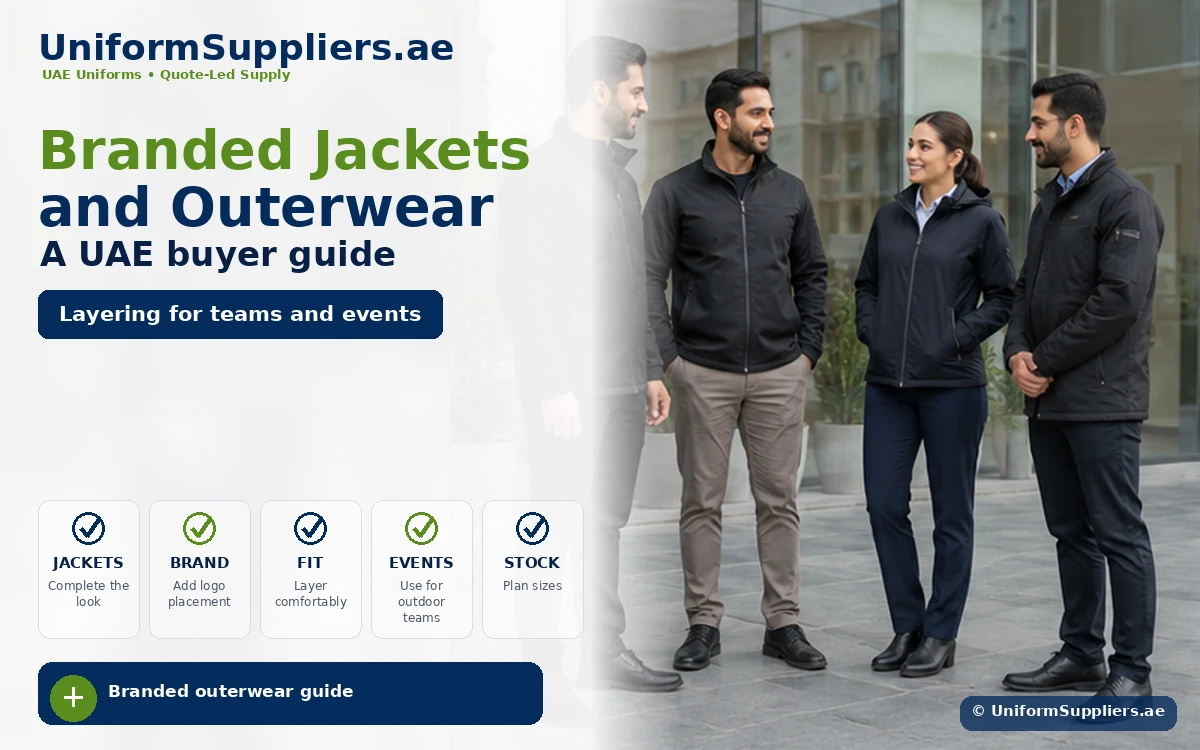
UAE workplaces have a jacket problem that outsiders rarely expect: the climate outside is hot for most of the year, but a growing number of indoor environments – cold storage facilities, refrigerated logistics, aggressively air-conditioned offices and hospital corridors – genuinely require warm outerwear. Add outdoor construction sites on cooler winter mornings and evenings, and a single “one jacket fits all seasons” approach quickly falls apart. This guide covers how to specify branded jackets and outerwear across these different needs – from lightweight corporate softshells to insulated cold-storage jackets – without over-ordering or under-protecting any part of the workforce.
Table of Contents
- Why UAE Companies Need More Than One Jacket Type
- Corporate and Office Outerwear
- Cold-Storage and Refrigerated Logistics Jackets
- Outdoor Site and Winter-Morning Jackets
- Fabric and Insulation Choices
- Comparing Jacket Categories
- Branding Placement on Outerwear
- An Outerwear Planning Checklist
- FAQs
Why UAE Companies Need More Than One Jacket Type
It’s a common assumption that a hot-climate country has little need for branded jackets, which leads many companies to skip outerwear planning entirely – right up until staff start layering personal jumpers and jackets over their uniforms indoors, breaking the consistent look the rest of the programme was designed around. In reality, UAE workplaces need outerwear for several genuinely different reasons: comfort in over-cooled interior spaces, functional cold protection in refrigerated environments, and practical warmth for outdoor work during the cooler months. Each of these calls for a different jacket, not one generic option.
Corporate and Office Outerwear
A lightweight softshell or fleece-lined jacket, cut to the same silhouette and brand colours as the rest of a corporate uniform range, solves the most common UAE office complaint – being cold indoors after being hot outside – without looking like a mismatched personal item thrown over a uniform. This pairs naturally with the knitwear layering approach covered in our corporate accessories guide, and companies building a full corporate wardrobe should plan outerwear alongside blazers and shirts rather than as an afterthought – see our corporate blazers and suits sourcing guide for the wider range.
Cold-Storage and Refrigerated Logistics Jackets
Staff working in or regularly entering cold rooms, refrigerated trucks or chilled warehouse zones need genuinely insulated outerwear, not a fashion-weight jacket rebranded for the purpose. Insulated jackets for this use typically combine a wind- and water-resistant outer shell with a substantial synthetic-fill or quilted lining, rated for sustained cold exposure rather than brief outdoor use. This is a distinct specification from general warehouse uniforms covered in our broader industrial workwear safety guide, and should be treated as PPE-adjacent equipment for any role with regular cold-room exposure rather than a standard uniform add-on.
Outdoor Site and Winter-Morning Jackets
Construction, facilities and logistics teams working outdoors during the UAE’s cooler months – roughly November through February, with noticeably cold early mornings and evenings – benefit from a mid-weight jacket that layers over existing workwear without restricting movement. Hi-vis jackets with reflective elements are worth considering for teams already using hi-vis garments elsewhere; see our hi-vis and reflective workwear guide for the broader visibility standard this should align with.
Fabric and Insulation Choices
- Softshell fabrics suit office and light outdoor use – windproof and water-resistant without the bulk of a fully insulated jacket.
- Fleece linings add warmth for indoor air-conditioned environments without the weight needed for genuine cold-room work.
- Quilted synthetic insulation is the standard choice for cold-storage and refrigerated logistics roles, offering warmth without absorbing moisture the way natural-fill insulation can.
- Waterproof or water-resistant outer shells matter for any outdoor jacket used during the UAE’s occasional winter rain, even if rain is infrequent overall.
Exact insulation rating and fabric weight should be confirmed during quotation against the specific temperature range a role is exposed to, since a jacket over-specified for mild office use adds unnecessary bulk, while one under-specified for a cold room fails at the one task it was bought for.
Comparing Jacket Categories
| Jacket Type | Best For | Insulation Level | Typical Fabric |
|---|---|---|---|
| Corporate softshell/fleece | Office staff, indoor air-conditioning | Light | Softshell or fleece-lined polyester |
| Cold-storage insulated jacket | Cold-room and refrigerated logistics staff | High – rated for sustained cold | Quilted synthetic fill, wind/water-resistant shell |
| Outdoor site/hi-vis jacket | Construction, facilities, early-morning outdoor work | Moderate | Water-resistant shell, reflective elements where relevant |
Branding Placement on Outerwear
Jackets carry branding well at the chest and upper back, and unlike thinner garments, they can usually support a larger embroidered or printed logo without the placement looking oversized. Companies weighing embroidery against printing for heavier outer fabrics can review our guide to matching branding method to fabric type before finalising placement and method for a jacket order specifically, since heavier fabrics and insulated linings behave differently under embroidery needles than a standard shirt fabric.
Sizing Jackets for Layering
A jacket is almost always worn over another uniform layer – a shirt, a fleece, sometimes both – so sizing purely against a person’s normal garment size tends to produce a jacket that fits too tightly once layered. Ordering a size guide specifically for outerwear, rather than reusing the same size chart used for shirts and trousers, avoids the common problem of staff requesting a size up simply to accommodate a layer underneath, which then makes the jacket oversized when worn alone. For teams also working through the general sizing guidance covered in our inclusive and diverse fit sizing guide, outerwear should be planned as part of the same overall sizing exercise rather than ordered separately afterward.
Ownership, Care and Replacement
Jackets are typically issued less frequently than daily-wear garments like shirts or scrubs, which means a single jacket often needs to last several years of use. Two practical points extend that lifespan: briefing staff to store jackets properly between uses rather than balled up in a bag or left in a hot vehicle, which degrades both fabric and any insulation over time, and specifying a genuinely washable construction from the outset, since a jacket that requires specialist cleaning is far less likely to be cleaned regularly in practice. Cold-storage jackets in particular should be checked periodically for compressed or degraded insulation, since insulation performance can decline well before the outer shell shows visible wear – a jacket that still looks intact may no longer be providing adequate warmth for sustained cold-room work.
Who Should Be Issued a Jacket
Not every role needs outerwear, and issuing jackets broadly “just in case” adds unnecessary cost without meaningful benefit. A more practical approach is to base issuance on actual working conditions – staff who regularly enter cold storage, work outdoors during cooler months, or have raised comfort concerns about office air-conditioning are reasonable candidates, while roles that are consistently indoors in a moderate climate zone typically don’t need a dedicated jacket beyond a light knitwear layer. Reviewing actual usage after the first season – are the jackets being worn regularly, or left in lockers – is a useful check before committing to a repeat order at the same scale.
An Outerwear Planning Checklist
- Identify which roles genuinely need outerwear and for which reason – office comfort, cold-room exposure, or outdoor conditions.
- Avoid a single universal jacket across genuinely different exposure levels.
- Confirm insulation rating against actual temperature exposure for cold-storage roles.
- Match jacket colours and cut to the existing uniform range for a consistent look.
- Plan branding placement suited to the heavier fabric and lining of an outer garment.
- Review sizing to allow comfortable layering over existing uniform pieces.
Our team can help match jacket type to your team’s actual working conditions as part of a quote request.
FAQs
Do UAE offices really need branded jackets?
Many do, primarily because of aggressive indoor air-conditioning rather than outdoor cold – a light softshell or fleece layer is one of the most requested comfort items once companies survey their own staff.
Can one jacket cover both cold-storage and outdoor site use?
Generally not well. Cold-storage roles need sustained insulation rated for continuous cold exposure, while outdoor site jackets prioritise wind and water resistance with lighter insulation – the two purposes are usually better served by separate specifications.
How warm does a cold-storage jacket need to be?
This depends on the specific temperature of the cold room or refrigerated vehicle involved and should be confirmed during quotation rather than assumed from a standard jacket rating.
Can jackets be branded the same way as our existing shirts?
Brand colours can stay consistent, but placement and method often need adjusting for a heavier jacket fabric or insulated lining – this can be confirmed during quotation.
Should outdoor jackets include reflective hi-vis elements?
For teams already using hi-vis garments in other parts of their uniform, matching reflective elements on an outer jacket is generally worth including so visibility standards aren’t lost once a jacket is layered on top, and this should be checked against the same visibility standard used for the rest of the hi-vis programme rather than treated as a separate, lower-priority item.
How do we decide which staff actually need a jacket?
Base the decision on real working conditions – cold-room exposure, outdoor work in cooler months, or documented comfort concerns about air-conditioning – rather than issuing jackets broadly across a whole department by default.
Can a single jacket work for both indoor office use and outdoor site work?
Not usually well. Office jackets prioritise a light, smart cut suited to indoor comfort, while outdoor jackets need weather resistance and often reflective elements – the two purposes generally call for separate specifications.
How do we know if a cold-storage jacket’s insulation has degraded?
Insulation performance can decline before the outer shell shows visible wear, so periodic comfort feedback from staff working in cold rooms is a more reliable signal than visual inspection alone.