Special offers: free digital logo mock-up and free samples against a confirmed LPO. View offers


Reordering Team Kit: How Stored Sizes and Artwork Keep Repeat Orders Consistent

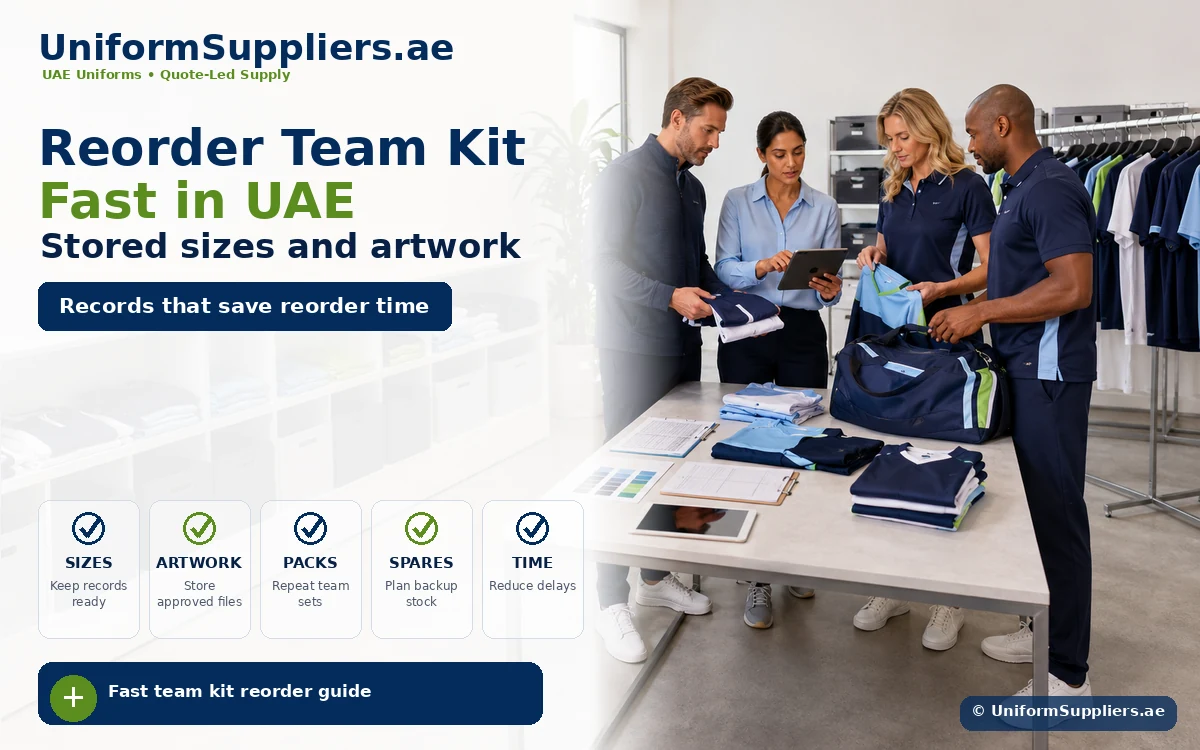
New players join, juniors grow, shirts wear out and sponsors change. A team rarely orders kit once. What matters is whether each top-up starts from a blank page or from a record of what was approved the first time.
This guide explains reordering team kit using stored sizes and artwork: what is kept on file, why it makes repeat orders simpler and more consistent, and what the club or school still needs to confirm each time.
It reflects how we support clubs and academies and school sports departments across the UAE.
What this guide covers
- Why reorders drift without records
- What is kept on record, and why it matters
- Matching colours and numbers for new signings
- Using stored sizes sensibly
- When the record needs updating
- Reorder checklist
- Start your kit with us
- Frequently asked questions
Why reorders drift without records
Most kit problems appear on the second or third order, not the first. The original order had everyone’s attention. The top-up for four new signings is placed by whoever has time, often from a photograph of last season’s shirt.
That is how small differences creep in. A colour is described by name instead of by reference, so the new shirts are a slightly different shade. The numbers are set in a similar typeface, not the same one. The crest sits a little lower. A number already in use is issued twice. None of this is dramatic, but in a team photograph it shows.
A stored record removes the guesswork. The reorder is produced from the approved files and references, so the buyer does not have to re-brief the design or remember what was agreed.
What is kept on record, and why it matters
Once a kit is approved, we keep records of the approved sizing, fabric, colour, logo position and branding for repeat orders. In practical terms, that covers the following.
| What is kept on record | Why it matters at reorder |
|---|---|
| Approved, production-ready artwork | New garments are made from the same file; nothing is re-drawn or re-briefed |
| Colour references | Colours are matched to a reference, not to a description or a photograph |
| Fabric and garment style | The same fabric and cut are specified as on the original order |
| Crest and logo positions and sizes | Branding sits in the same place on every garment, old and new |
| Number and name style | New numbers use the same typeface, size, colour and position |
| Sizes by player or student | Existing members confirm their size; only new members need a try-on |
| Fit chosen for each person | Men’s or unisex, women’s modest and hijab-friendly fits are repeated correctly |
Fabric availability can change between orders. If the original fabric cannot be used, ask to see a swatch of the proposed alternative before you approve. Final specification will be confirmed during quotation.
Matching colours and numbers for new signings
A new signing should walk out in a shirt that looks like everyone else’s. With the artwork and colour references on file, new pieces are made to the same design as the originals, in the same layout.
Numbering is the part the club controls. The supplier’s record holds the number style; the club decides who wears which number. Keep a simple register with three columns: numbers in use, numbers reserved or retired, and numbers free. Send the relevant rows with each reorder so that no number is duplicated within a squad.
The same applies to names. Decide once whether names are printed, how they are spelled and whether initials are used, and apply the rule to every later order. Our comparison of sublimation, printing and embroidery for sports jerseys explains which methods allow numbers and names to be added to a finished garment.
Using stored sizes sensibly
Sizes captured at a try-on stay on file, so topping up a squad or a class means confirming names and quantities instead of collecting every size again. That means less paperwork for a coach or PE head.
Stored sizes are a starting point, not a fixed fact. Use them like this:
- Adults: ask each player to confirm that last season’s size is still right.
- Juniors: re-check at the start of every season. A stored size from a year ago is often out of date.
- New members: arrange a try-on. They can visit our Jebel Ali showroom to try a size set.
Our guide to running a team kit size try-on day explains how to capture sizes for a whole squad in one session, and the size and fit guide helps anyone who has to measure at home.
When the record needs updating
A reorder repeats what was approved. If something has changed, say so at the start, because the record has to change with it.
- New or departing sponsor: the artwork is revised and a new mock-up is issued for approval.
- New crest or colours: treat this as a new design, with a new approval.
- Additional garments: a new item, such as a training top or a goalkeeper set, is designed to match and added to the record.
- New team or age group: the existing design is applied to a new size range.
Where nothing has changed, the buyer has fewer approval rounds to manage: the design was signed off on the original order and does not need to be debated again. Where something has changed, the free design mock-up shows the revision before production.
A reorder is still a production order. Its timing depends on the quantity, the branding method and the production schedule when it is placed. Delivery timelines are confirmed during quotation.
Mustang recommendation: nominate one kit contact at the club or school and route every order through that person. Give them the number register, the list of who holds which size, and the reference of the original order. Records on the supplier’s side only work when the requests coming from the buyer’s side are consistent. Clubs and schools that order regularly can also request a company account.
Reorder checklist
- Team name, season and the reference of the original order.
- Garments needed: home, alternate, goalkeeper, training, warm-up.
- List of players with name, number, size and fit for each.
- Numbers checked against the club register for duplicates.
- Juniors’ sizes re-checked this season.
- Any change to sponsors, crest or colours stated clearly.
- New members booked for a size try-on if needed.
- The date the kit is needed, so that it can be considered in the quotation.
- Name of the person who will approve the order.
For a wider view of what to prepare before any uniform order, see the uniform ordering checklist. Organisations that also dress staff may find our employee uniform programmes useful; they apply the same stored-record approach to new-joiner kits and replacements.
Start your kit with us
Every order begins with a free design mock-up and a free sample against your confirmed order (LPO), and your sizes and artwork are stored for repeat orders. Teams and students can try a size set in person at our Jebel Ali showroom before committing. Delivery timelines are confirmed during quotation.
Browse sports team uniforms, return to the main sports uniforms page, then request a quote or request a sample.
Frequently asked questions
What do you keep on record after the first order?
Records of the approved sizing, fabric, colour, logo position and branding, including the production-ready artwork and the number style, are kept for repeat orders.
Will new shirts match the ones we already have?
They are produced from the same approved artwork and colour references, in the same layout. Fabric availability can change between orders, so confirm at quotation that the original fabric is being used.
Do we need to approve the design again for a reorder?
Not if nothing has changed. If you add a sponsor, alter the crest or add a new garment, a revised mock-up is issued for approval.
Can we rely on last season’s sizes?
For adults, ask each player to confirm. For juniors, re-check every season. New members should try a size set.
How long does a reorder take?
It depends on the quantity, the branding method and the production schedule at the time of ordering. Delivery timelines are confirmed during quotation.