Special offers: free digital logo mock-up and free samples against a confirmed LPO. View offers

Uniform Care and Laundering: How to Extend the Life of Workwear in the UAE

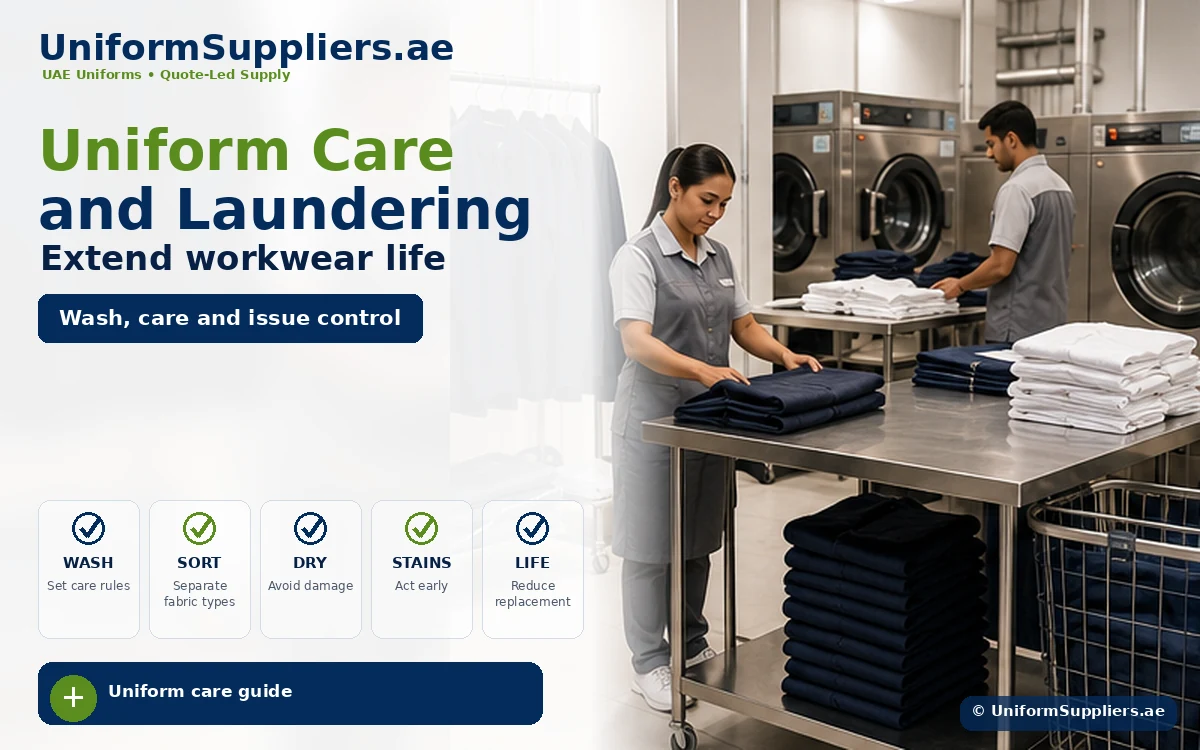
A well-made uniform can look sharp for years — or fade, shrink and fray within months. The difference usually has nothing to do with the garment itself and everything to do with how it is washed, dried and stored. In the UAE, where high heat, strong sun, air conditioning and heavy-duty commercial laundering all take a toll on fabric, a clear care routine is one of the cheapest ways to protect a uniform investment and keep a workforce looking consistent.
This guide sets out practical, UAE-relevant care and laundering guidance for corporate, hospitality, healthcare and industrial uniforms, so procurement and HR teams can build simple washing standards their staff — or their laundry contractor — can actually follow.
In this guide
- Why uniform care matters more in the UAE
- Reading the care label before you wash anything
- Care guidance by fabric type
- Washing embroidered and printed uniforms safely
- Drying, ironing and storage in a hot climate
- In-house washing vs a commercial laundry contract
- Quick uniform care checklist
- FAQ
Why uniform care matters more in the UAE
Three local conditions make uniform care a bigger factor here than in milder climates. First, sun exposure — UV levels are intense for most of the year, and direct sunlight during outdoor drying accelerates colour fade, particularly on darker corporate shades and printed logos. Second, indoor-outdoor temperature swings — staff moving between air-conditioned interiors and outdoor heat sweat more, which means uniforms are washed more frequently than in cooler markets, so fabrics and stitching need to tolerate a higher wash count. Third, water hardness varies by emirate and building supply, and hard water combined with strong detergents can dull colours and stiffen fabric over time if not managed.
None of this means uniforms wear out faster by design. It means the care routine has to be matched to the climate, not copied from a generic label written for a temperate market.
Reading the care label before you wash anything
Every uniform we supply carries a care label with wash temperature, drying and ironing guidance specific to that garment’s fabric and finish. Before setting a standard wash routine for a department, the simplest first step is to check the label of the actual garment being issued — recommendations vary between a 100% cotton chef jacket, a poly-cotton corporate shirt and a technical polyester polo, and treating them the same is the most common cause of early wear.
Where a garment carries branding — embroidery, heat transfer or screen print — the label will usually also flag a lower wash temperature or a reverse-wash instruction to protect the decoration, covered in more detail below.
Care guidance by fabric type
Cotton and cotton-rich blends
Common in chef wear, corporate shirts and healthcare garments. Cotton handles regular washing well but can shrink if washed too hot or over-dried, and white cotton (common in hospitality and healthcare) shows staining if not washed promptly. A moderate wash temperature with a lower-heat tumble dry, or line drying in shade, generally protects both size and colour.
Polyester and performance polyester
Used widely in corporate polos, sportswear-style pieces and technical workwear because it resists shrinking and dries quickly — useful in a laundering-heavy environment. Polyester holds colour well but can retain body odour if washed at too low a temperature, and it is more prone to static and pilling if tumble-dried on high heat repeatedly.
Poly-cotton blends
The most common fabric across UAE corporate and hospitality uniforms because it balances durability, comfort and easy care. Poly-cotton tolerates standard commercial laundering well, making it a practical default for high-turnover departments like housekeeping and F&B.
Technical and flame-resistant fabrics
Industrial and FR fabrics often have specific laundering requirements to preserve their protective properties — certain detergents, fabric softeners or bleach can degrade FR treatments over repeated washes. For any flame-resistant or high-visibility garment, follow the manufacturer’s care label exactly rather than a general workwear routine, and flag this requirement to any external laundry contractor in writing.
Wool and wool-blend (blazers, formal wear)
Corporate blazers and formal trousers are usually dry-clean only. Frequent home or commercial washing of wool-blend tailoring will distort the shape and shorten its life — dry cleaning at a sensible interval, with spot-cleaning in between, is the standard approach.
Washing embroidered and printed uniforms safely
Decoration is usually the first thing to show wear, not the base fabric. A few habits protect it significantly:
- Turn garments inside out before washing to reduce direct friction on embroidery or printed logos.
- Wash at the temperature specified for the decoration, not just the fabric — printed logos in particular often need a cooler wash than the garment fabric would otherwise tolerate.
- Avoid direct ironing over embroidery or prints; iron from the reverse side, or use a pressing cloth over the design.
- Skip fabric softener on printed areas where possible, as it can affect adhesion over repeated washes.
These same habits apply to name badges, patches and heat-sealed ID elements — anything applied to the surface of the garment benefits from being protected during the wash cycle rather than left exposed to direct agitation.
Drying, ironing and storage in a hot climate
Line drying in direct UAE sun is one of the fastest ways to fade colour and weaken elastic — where possible, dry in shade or use a tumble dryer on a moderate setting instead of full sun exposure. For departments issuing multiple sets per employee (the usual approach for daily-wear roles), rotating sets reduces wash frequency per garment and extends the working life of the full uniform issue.
Storage matters too: uniforms stored in humid back-of-house areas without airflow are prone to mildew and odour retention, particularly cotton-rich fabrics. A dry, ventilated storage area — and not leaving damp uniforms in a closed bag or locker overnight — avoids most of these issues.
In-house washing vs a commercial laundry contract
Smaller teams typically manage uniform washing individually or through an internal laundry room, while larger hospitality, healthcare and facilities-management operations often use a commercial laundry contractor for hygiene, consistency and volume reasons. If a commercial laundry is used, it’s worth sharing the care label requirements for each garment type directly with the contractor — commercial laundries often run a single hot-wash, high-heat-dry cycle across mixed loads by default, which is efficient for heavily soiled kitchen or housekeeping linens but can be too aggressive for lighter corporate shirts or branded polos processed in the same batch.
For teams issuing new uniforms, this is also a good moment to confirm with the supplier which garments in the order are commercial-wash tolerant and which need gentler handling — request a quote and we can flag any garments in your order that need special care instructions passed to your laundry provider.
Common care mistakes that shorten uniform life
Most premature uniform wear traces back to a handful of repeated mistakes rather than genuine fabric failure. Overloading the washing machine is one of the most common — packing too many garments into a single cycle means detergent doesn’t rinse out evenly and friction between garments increases, which accelerates fading and pilling. Using a higher wash temperature than the label recommends “to be sure it’s clean” is another frequent cause of shrinkage, particularly on cotton-rich corporate shirts and chef wear.
Mixing dark and light garments in the same wash is a simple one that still causes avoidable damage, especially with new uniform stock in the first few washes, when dye is most likely to bleed. And skipping the label entirely — treating every uniform the same regardless of fabric — is probably the single biggest contributor to inconsistent uniform condition across a workforce, since different fabrics in the same order can have meaningfully different care needs even when they look similar on the rail.
None of these mistakes require expensive fixes. A short one-page care guide handed to new staff, or shared with a laundry contractor, resolves most of them at no additional cost.
Quick uniform care checklist
| Step | What to do |
|---|---|
| 1. Check the label | Confirm wash temperature and drying method for the specific fabric before setting a department-wide routine. |
| 2. Sort by fabric and colour | Keep FR, technical and dark corporate garments separate from general cotton-rich items. |
| 3. Protect decoration | Turn garments inside out; avoid direct high heat over embroidery or prints. |
| 4. Dry in shade or moderate heat | Avoid full direct sun drying for branded or dark-coloured uniforms. |
| 5. Iron from the reverse | Protect printed and embroidered areas during pressing. |
| 6. Store dry and ventilated | Avoid closed, humid storage that encourages mildew and odour. |
| 7. Brief your laundry contractor | Share fabric-specific care notes if uniforms go through a commercial laundry. |
FAQ
How often should uniforms be replaced in the UAE?
It depends on fabric, role and wash frequency rather than a fixed timeline — a front-desk shirt washed a few times a week will wear differently to a kitchen uniform washed daily. Watching for fading, thinning fabric at stress points (collars, cuffs, seams) and loosening decoration is a more reliable signal than a calendar date. Final replacement guidance for a specific fabric and role is confirmed during quotation.
Can hard water damage uniforms?
Over time, hard water combined with strong detergent can leave mineral residue that dulls colour and stiffens fabric. Where hard water is a known issue, a water softener in the wash cycle or a lower detergent dose can help preserve both colour and hand-feel.
Is dry cleaning necessary for all corporate uniforms?
No — most corporate shirts, polos and poly-cotton garments are machine washable. Dry cleaning is generally reserved for tailored pieces like blazers, suits and some wool-blend garments where the structure and shape need to be preserved.
Can uniforms be treated for stain resistance?
Some fabrics can be finished for improved stain and soil resistance at the manufacturing stage. If this is a priority for a particular role — kitchen or maintenance staff, for example — raise it during quotation so it can be factored into fabric selection.
Who should we ask about care instructions for a specific garment?
Your account contact can confirm care requirements for anything supplied as part of your order, and pass on any special instructions your laundry contractor needs.
Does uniform colour affect how it should be washed in the UAE?
Yes — darker corporate shades are more prone to visible fading from sun exposure and high-heat drying than lighter colours, so they generally benefit from shade drying and a slightly cooler wash where the fabric allows it.
Should new uniforms be washed before first wear?
Many employers do wash new uniforms once before issuing them, which can help settle any initial dye and reduce the risk of colour transfer during the first few wears. Follow the care label for that first wash the same as any other.
Get uniforms built to hold up to UAE conditions
Fabric choice and construction make the biggest difference to how well a uniform survives regular UAE laundering. If you’re planning a new uniform rollout or replacing worn-out stock, our team can recommend fabrics suited to your wash frequency and climate exposure. See our guide to corporate uniforms in the UAE or read more on choosing fabrics for the UAE climate. Request a quote or request a sample to see fabric options in person before you order.