Special offers: free digital logo mock-up and free samples against a confirmed LPO. View offers


Taekwondo Dobok: Styles, Belts and Club Branding

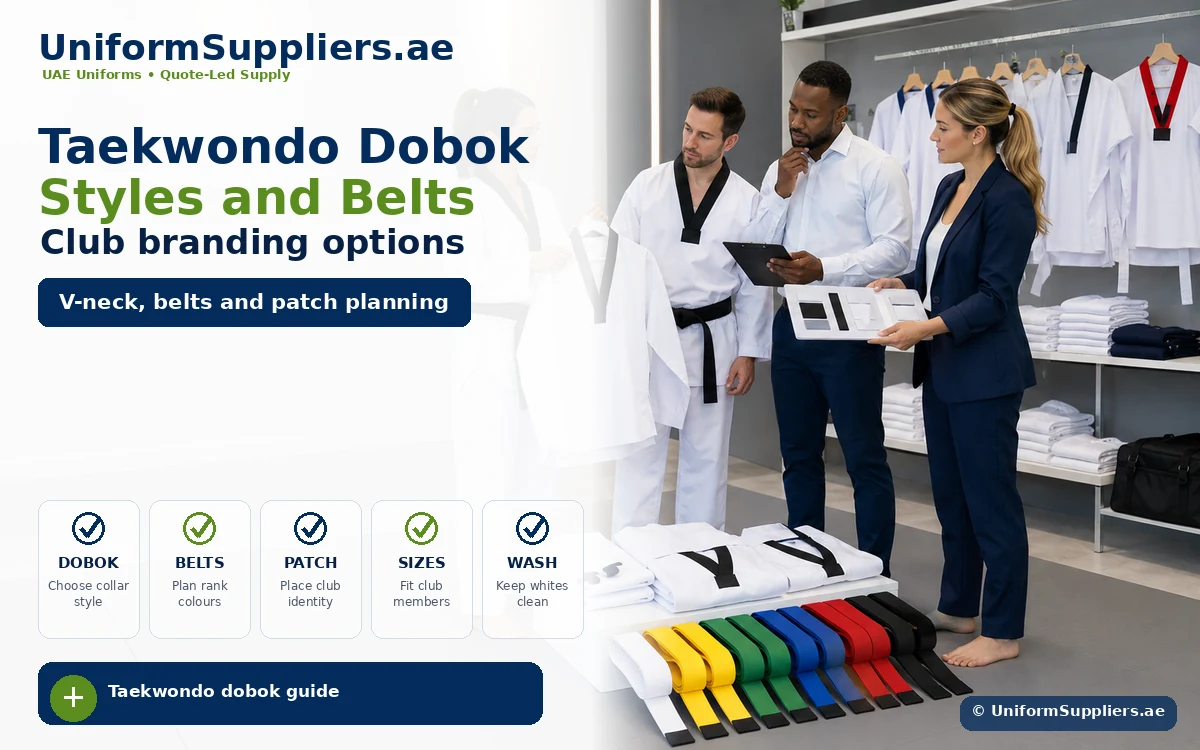
A taekwondo dobok has two jobs. It has to be light and roomy enough for high kicks, and neat enough to represent the club at gradings, demonstrations and competitions. Getting both right across a membership of small children, teenagers and adult black belts takes more planning than choosing a size.
This guide is for UAE club owners, academy managers, head instructors and school PE departments. It covers jacket styles, collar conventions, fabrics, junior sizing, belt and grading stock, club branding and the differences between sparring, poomsae and demonstration uniforms.
See our custom taekwondo dobok range, or the wider sports uniforms hub.
What this guide covers
- What makes up a dobok
- Jacket styles and collar colours
- Fabric choices and care
- Junior sizing and growth
- Belts and grading stock planning
- Club branding: back print, chest embroidery and sleeve
- Sparring, poomsae and demonstration teams
- Planning table, recommendation and checklist
- Start your kit with us
- Frequently asked questions
What makes up a dobok
A dobok is a three-part uniform: jacket, trousers and belt. Compared with the uniforms used in grappling arts, it is lighter and cut with more room through the hips and legs, because the art is built around kicking rather than gripping.
- Jacket: hip length, with side vents so it does not ride up during kicks. The neckline and collar are where most of the style differences sit.
- Trousers: wide through the thigh with an elasticated or drawstring waist. The hem should clear the floor so the student does not stand on it when pivoting.
- Belt: shows the student’s grade and is ordered by colour and length.
Clubs that teach more than one martial art should not assume one uniform works for all of them. Our guides to karate gi weights and the judo gi explain how those garments differ.
Jacket styles and collar colours
V-neck pullover
The V-neck jacket is closed at the front and pulled on over the head. There is nothing to come untied during training, which makes it popular for children’s classes and for sparring. It is the style many sport-oriented clubs use as their everyday uniform.
Cross-over jacket
The cross-over or wrap jacket overlaps at the front and is held closed by ties and the belt. It has a more traditional appearance. Some associations use it as their standard uniform, and it is also seen on poomsae and demonstration uniforms.
Which should a club choose?
Follow your association first. If you have a free choice, the pullover is the simpler garment for young beginners to manage on their own, while the cross-over allows more adjustment across the chest and gives a formal look for senior grades. Many clubs keep one style for the whole membership so that the line-up looks consistent.
Collar colours
Collar trim is commonly used to show seniority. A widely seen convention is a white collar for colour-belt students and a black collar for black belts, with a two-colour collar used for junior black belts in some systems. Other organisations use black piping along the jacket edge, or coloured trim, to mark grade or instructor status.
These conventions differ between organisations, and they are revised from time to time, so check your own association’s current rules before ordering. Tell us the requirement and we match it and keep it consistent across the club.
Fabric choices and care
Most doboks are polyester-cotton blends, which hold their shape, crease less than pure cotton and stand up to frequent washing. Within that, three broad fabric types are common. Exact weights and names vary by maker.
- Lightweight plain fabric: thin and soft. The usual choice for beginners and small children, and comfortable in halls with limited cooling.
- Ribbed fabric: a textured, slightly heavier cloth with fine raised lines. It hangs cleanly, looks sharper in a line-up and is the common step up for regular students and black belts.
- Textured lightweight sparring fabric: a light, often patterned or perforated weave intended to feel airy under protective equipment.
In the UAE the venue matters as much as the season. A ribbed dobok is usually comfortable in an air-conditioned studio; a lighter fabric is the more practical option for a school hall, an outdoor demonstration or a summer camp. These are recommendations, not performance promises. Final specification will be confirmed during quotation.
Care
White doboks are washed after almost every session. Follow the care label; as general practice, wash cool with similar colours, turn printed jackets inside out, avoid bleach on printed or embroidered areas and dry in the shade. Wash coloured belts separately, because dye can transfer onto white fabric. The fabric care guide has more detail.
Junior sizing and growth
Doboks are generally sized by height, and children make up a large share of most club memberships. That makes sizing the part of the order most likely to go wrong.
- Measure height on the day, without shoes, rather than relying on a figure a parent remembers.
- Allow growth room, within reason. One size up is common for a child who is growing; more than that leaves sleeves over the hands and hems under the heels.
- Check the trousers in a deep stance and a high knee lift. The seat and thigh should not pull.
- Check the sleeve with the arm extended in a punch. It should finish around the wrist.
- Prefer elasticated waists for young children, who need to dress themselves.
- Record the size against the student’s name, so the next order starts from a known point.
Students can try sizes at our Jebel Ali showroom, and stored sizes make re-kitting new intakes each term consistent. The size and fit guide explains how to take and record measurements.
Belts and grading stock planning
Belts are the item clubs most often run short of, because demand arrives in bursts. A whole group moves up on the same grading day and every student expects to leave with the new belt.
Map your own belt sequence
The order of colours, and whether striped or tagged belts are used between full colours, differs between associations and sometimes between clubs. Write down your own sequence before ordering and use it as the reference.
Plan from the grading calendar
- List the students at each grade who are expected to test at the next grading.
- Note the belt length each student needs. Length follows waist size and whether the belt is wrapped once or twice, not age.
- Add a sensible allowance for students who join the grading late and for lost belts.
- Carry forward unused belts as stock for the following grading.
Black belts
Black belts are often embroidered with the student’s name, the club name or grade bars. Each one is individual, so the spelling and script need approval from the instructor before production. Collect these details well ahead of the grading. Delivery timelines are confirmed during quotation.
We supply matching belts alongside the dobok order, so colours, lengths and embroidery can be planned on one list.
Club branding: back print, chest embroidery and sleeve
We add club names, logos and sponsor branding by print or embroidery. The dobok has several established positions, and each suits a different method.
- Back print: the largest and most visible position, typically the club or academy name in a single colour. Printing keeps the jacket light and flexible; see garment printing.
- Chest embroidery: a club badge on the left chest gives a durable, formal finish. On very light fabric, keep the badge small so that dense stitching does not pull the cloth; see our embroidery service.
- Sleeve: often used for a flag, a sponsor mark or an association badge.
- Trouser leg: a vertical club name or stripe is common on demonstration and sparring uniforms.
Remember that a chest protector covers the chest and most of the back in sparring, so branding meant to be seen in a match needs to sit on the sleeve, shoulder or trouser leg. Our guide to embroidery versus printing compares the methods in detail.
Some competitions restrict the size, number and position of logos. Check your own association’s or competition’s current rules before branding uniforms that will be worn in competition.
Sparring, poomsae and demonstration teams
Sparring
Sparring uniforms are usually the lightest in the club. The cut needs room for forearm and shin guards under the sleeves and trousers and for a chest protector over the jacket. A V-neck pullover is the common choice because it stays closed.
Poomsae
Poomsae is judged on precision, so competitors tend to prefer a fabric with enough body to keep clean lines and a fit that shows the technique clearly. Some organisations specify a particular jacket style and trouser colours for poomsae by age and grade. Check the rules of the event before ordering.
Demonstration teams
Demonstration teams have the most freedom. Clubs often choose a distinctive colour, larger branding and a cut that allows jumps and acrobatic techniques. Because the same uniform is used for repeated performances, choose fabric and print that stand up to regular washing, and order all team uniforms together so that colour and print match.
We do not make claims about competition approval for any uniform. Students who wear a sports hijab can pair it with the dobok; our guide to building a Muslim women’s team kit covers hijab options, and competition rules on head coverings should be checked with the organiser.
Planning table, recommendation and checklist
| Member group | Style and fabric to consider | Branding | Planning note |
|---|---|---|---|
| Young beginners | V-neck pullover in lightweight fabric with an elastic waist | Back print and small chest badge | Size by measured height with modest growth room; expect regular replacement |
| Regular colour-belt students | Club standard style in lightweight or ribbed fabric | Back print, chest embroidery | Record sizes each term; plan belts from the grading calendar |
| Black belts and instructors | Ribbed fabric with the collar or trim your association specifies | Chest embroidery; embroidered belt | Collect name spellings and approvals ahead of the grading |
| Sparring squad | Lightweight or textured sparring fabric; room for protective equipment | Sleeve and trouser leg, where rules allow | Check competition rules on uniform and logos |
| Poomsae and demonstration teams | Fabric with more body; style and colours as the event or club requires | Larger back and leg branding for demonstrations | Order the whole team together for a consistent match |
Mustang recommendation: fix three things in writing before you request a quotation: your association’s collar and style rules, your belt sequence, and one approved set of artwork with positions. Then order doboks and belts from the same list. Clubs that do this once find every later intake and grading far easier to manage.
- Jacket style and collar convention confirmed with your association.
- Fabric chosen for each member group and venue.
- Heights measured and sizes recorded by name.
- Belt sequence, colours and lengths listed against the grading calendar.
- Black-belt embroidery details signed off by the instructor.
- Back print, chest, sleeve and leg positions shown on a mock-up.
- Competition rules on uniform and logos checked where relevant.
Start your kit with us
Every order begins with a free design mock-up and a free sample against your confirmed order (LPO), and your sizes and artwork are stored for repeat orders. Teams and students can try sizes in person at our Jebel Ali showroom before committing. Delivery timelines are confirmed during quotation.
Request a quote or request a sample to get started, or view the taekwondo dobok category.
Frequently asked questions
What is the difference between a V-neck and a cross-over dobok?
A V-neck dobok is pulled on over the head and has no front opening. A cross-over dobok wraps across the chest and is tied closed. Which one a club uses normally follows its association.
What do the collar colours on a dobok mean?
Collar trim often indicates grade, for example white for colour belts and black for black belts, but conventions differ between organisations. Check your own association’s current rules.
Which dobok fabric suits training in the UAE?
Lightweight fabric is a common choice for beginners and for halls with limited cooling, while ribbed fabric is popular for regular students in air-conditioned studios. This is advice, and the right choice depends on your venue.
Can you supply belts with the doboks?
Yes. We supply matching belts, and colours, lengths and any embroidery can be planned on the same list as the uniforms.
Where can club branding go on a dobok?
Common positions are the back, the left chest, the sleeve and the trouser leg, by print or embroidery. A free design mock-up shows the positions before production.
How do we handle new students each term?
Your sizes and artwork are stored for repeat orders, so new intakes can be kitted to match the existing club uniform. Send the new students’ heights or sizes and belt requirements with the request.