Special offers: free digital logo mock-up and free samples against a confirmed LPO. View offers


Uniforms for Government and Public-Sector Projects

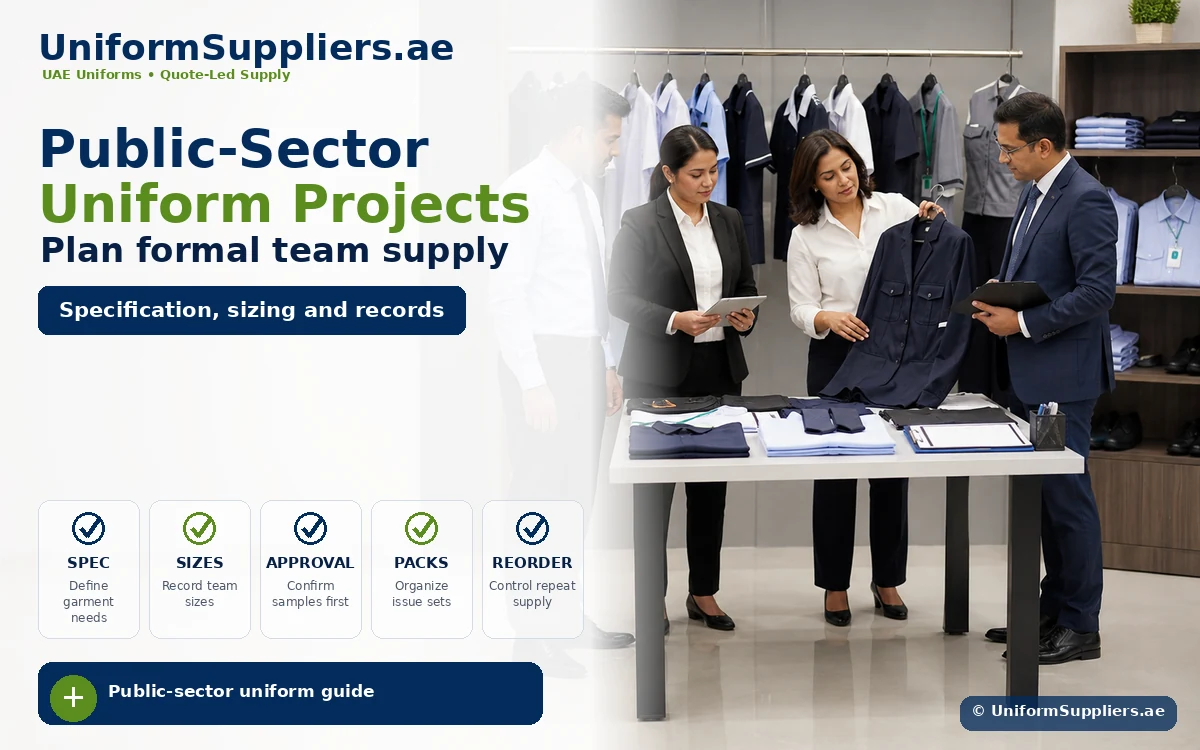
Government and public-sector projects have a different procurement rhythm to most private-sector uniform orders — larger headcounts, formal documentation, phased delivery across departments or sites, and purchasing that runs through structured tender or LPO processes rather than an informal reorder. A uniform supplier working with this kind of project needs to fit that process, not the other way around.
This guide sets out what a public-sector-style uniform project typically needs from a supplier: standardised specification, quality and durability expectations, coordinated supply at scale, and clear documentation. It describes our standard process and how it supports that kind of project — it does not claim any specific prior government contract, client, or formal approved-vendor status, and any organisation should confirm current tender or panel requirements directly with the relevant authority.
What this guide covers
- Why public-sector procurement runs differently
- Consistent standards across departments and sites
- Quality and durability for long-serving public-facing roles
- Coordinated supply for large or phased headcounts
- Documentation and audit-style record-keeping
- Working within formal tender and LPO purchasing
- A realistic specification and sampling process
- Planning for scale without overcommitting early
- What a project like this typically needs from a supplier
- Frequently asked questions
Why public-sector procurement runs differently
A private company can often finalise a uniform specification, sample it, and place an order within a few conversations. A government or public-sector project usually moves through additional steps — formal specification documents, multiple sign-off levels, and procurement processes designed for accountability and auditability rather than speed. Any supplier working on this kind of project needs to be comfortable operating inside that structure rather than expecting the faster pace of a typical private-sector order.
This also means the relationship is often less about a single transaction and more about a supplier’s ability to sustain consistent quality and documentation across what can be a long-running, multi-phase engagement.
Consistent standards across departments and sites
Public-sector organisations frequently span multiple departments, sites or facilities, each potentially procuring or reordering uniforms at different times. Standardised garments, fabrics and branding — agreed once and issued as a fixed reference — keep a consistent appearance across the whole organisation rather than letting each department or site interpret the specification independently.
This is the same underlying discipline used in any large multi-branch or multi-site rollout: one specification, centrally controlled, referenced consistently by every part of the organisation. See our guide on rolling out uniforms across multiple branches for the operational mechanics that apply equally here.
Quality and durability for long-serving public-facing roles
Public-sector and government-adjacent roles are often long-serving and public-facing, which raises the bar on durability and consistent appearance compared with a short-term or high-turnover role. A uniform that fades, thins or loses shape well before a natural replacement cycle reflects poorly on the organisation it represents, so fabric weight, colour-fastness and construction quality typically need to be specified to a higher standard than a minimum-cost option.
Final fabric specification, weight and any relevant durability testing are confirmed during quotation against the specific role and expected wear pattern — no fixed durability figure applies universally across every garment type.
Colour-fastness deserves particular attention for public-facing roles, since a uniform that visibly fades unevenly across a team looks inconsistent even where every garment is technically still serviceable. Requesting a sample and checking it after a hot wash cycle before committing to full production quantities helps confirm colour stability against your organisation’s actual laundering method.
Coordinated supply for large or phased headcounts
Public-sector headcounts are frequently larger than a typical private-sector order, and rollout is often phased across departments, sites or budget cycles rather than delivered in a single batch. A supplier able to combine ready-stock supply for urgent or interim needs with custom manufacturing for the full specification supports this kind of phased delivery without leaving any group of staff waiting on the slowest part of the order.
GCC project coordination and delivery is relevant where a public-sector project spans more than one Emirate or country, using the same coordination principles covered in our guide to GCC uniform supply and multi-country rollouts.
Documentation and audit-style record-keeping
Formal procurement processes typically expect clear documentation at every stage: a written specification, sample approval records, sizing and quantity breakdowns, and delivery confirmation. Keeping this documentation organised and available — rather than relying on informal email threads — supports the kind of audit trail public-sector purchasing often requires.
Stored repeat-order specification records serve this purpose well beyond the initial order too: a documented, unchanged specification referenced for every subsequent phase or reorder gives a clear paper trail showing consistency over time, which is often exactly what an audit-style review is looking for.
Working within formal tender and LPO purchasing
Public-sector purchasing generally runs through a structured LPO or tender process rather than an ad hoc order, with defined specification documents, formal quotations, and purchase orders that reference agreed line items precisely. A supplier experienced in this kind of purchasing structures its quotations and documentation to match — itemised specification, clear quantities, and a quotation that can be referenced directly in a formal purchase order — rather than an informal price list.
See our guide on reading a uniform quotation for what a well-structured quotation should include, which applies equally to a formal public-sector purchasing process.
Where a project requires quotations broken down by department, phase or cost centre rather than one consolidated total, it is worth confirming this need at the outset so quotations can be structured accordingly from the first phase, rather than reformatted retroactively partway through the project.
A realistic specification and sampling process
Public-sector uniform specifications often need to satisfy more than one stakeholder — an operations lead who cares about durability, a procurement officer who cares about documentation and pricing structure, and sometimes a communications or branding function concerned with how the organisation presents itself. Building sampling and approval time into the project timeline for this multi-stakeholder review, rather than assuming a single quick sign-off, avoids the specification stalling midway through a formal purchasing cycle.
A sample garment against a confirmed LPO, reviewed by the relevant stakeholders together where possible, tends to surface concerns earlier than sequential single-person reviews, and keeps the eventual bulk order aligned with what every stakeholder actually expects.
Planning for scale without overcommitting early
Large public-sector headcounts do not need to be committed to a full uniform order in one step. A pilot batch for one department or site, reviewed against real wear and feedback before the wider rollout is confirmed, reduces the risk of a specification issue only being discovered after a very large quantity has already been produced.
This staged approach also fits naturally with phased budget cycles, which are common in public-sector planning, allowing an organisation to commit to each phase as budget and approval allow rather than requiring the entire programme to be funded and approved upfront.
What a project like this typically needs from a supplier
| Requirement | What this typically means |
|---|---|
| Standardised specification | One fixed reference for fabric, colour, branding, sizing across departments/sites |
| Durability | Fabric and construction suited to long-serving, public-facing wear |
| Phased supply | Combined ready-stock and custom manufacturing for large or staged headcounts |
| Documentation | Written specification, sample approval, sizing records, delivery confirmation |
| Formal purchasing | Itemised quotations and documentation matched to LPO or tender processes |
| Consistency over time | Stored specification records for accurate, auditable reorders |
Mustang recommendation: confirm your organisation’s specific tender, documentation and approved-vendor requirements directly with your own procurement authority before beginning a project of this kind — our role is to support the specification, supply and documentation once those requirements are known, not to determine them on your behalf.
Frequently asked questions
Is Uniform Suppliers UAE a registered government vendor?
Vendor registration and approval requirements vary by organisation and authority. Confirm your specific procurement panel or vendor registration requirements directly with your own procurement authority; we support the specification, quality and documentation side of a project once those requirements are established.
Can uniforms be supplied for a large, multi-department organisation?
Yes, this is the kind of coordinated, phased supply a standardised specification and a combined ready-stock and custom manufacturing programme are designed to support.
What documentation should we expect from a supplier on a formal project?
A written specification, sample approval records, sizing and quantity breakdowns, and delivery confirmation are standard, along with an itemised quotation that can be referenced directly in a formal purchase order.
How is durability handled for long-serving public-facing roles?
Fabric weight, colour-fastness and construction are specified to suit the expected wear pattern and role, confirmed during quotation rather than following one fixed figure across every garment type.
Can a project like this span multiple sites or Emirates?
Yes, using the same coordination approach as any multi-site or multi-country rollout. See our GCC uniform supply guide where a project spans more than one country.
How does reordering work for an ongoing public-sector contract?
Once a specification is confirmed, it is kept on file as a stored repeat-order record, so later phases or reorders reference the same documented specification rather than restarting the process.
Should we run a pilot batch before a full public-sector rollout?
It is a reasonable approach for a large headcount. A pilot for one department or site, reviewed against real wear and feedback, reduces the risk of discovering a specification issue only after a very large quantity has been produced.
How long should we allow for specification approval on a formal project?
Allow time for review by every relevant stakeholder — operations, procurement and any branding or communications function — rather than assuming a single quick sign-off, particularly where the project moves through a multi-stage formal purchasing cycle.
To discuss a public-sector or government-linked uniform project, request a quote outlining your organisation’s structure and procurement process.