Special offers: free digital logo mock-up and free samples against a confirmed LPO. View offers


Coveralls and Boilersuits: The Complete UAE Buyer’s Guide

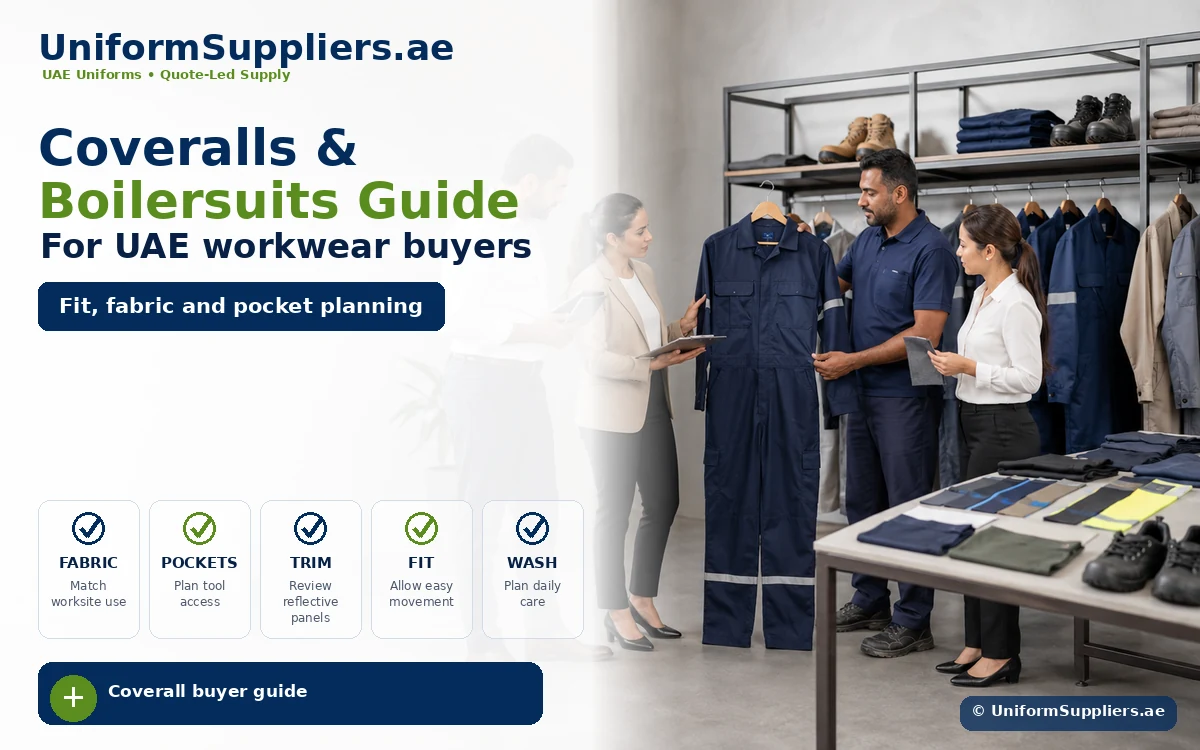
Coveralls and boilersuits are often used interchangeably in everyday conversation, but the terms cover genuinely different garments with different closures, fit and best-use cases. Choosing the wrong one for a role — or specifying “coveralls” when what a team actually needs is a boilersuit with a specific closure system — leads to a garment that looks right on paper but frustrates workers on site.
This guide focuses specifically on the construction, closure and use-case differences between coveralls and boilersuits, and how to choose between them for a UAE workforce. It covers general specification and fit — not the general hazard-mapping process across an entire industrial site, which our industrial workwear safety guide covers, and not flame-resistant technical detail, which our flame-resistant workwear guide covers in depth. Both are referenced here rather than repeated.
What this guide covers
- Coverall versus boilersuit: what’s the difference
- Closure systems: zip, popper and combination
- Fabric weight and weave for UAE conditions
- Fit for movement, bending and equipment
- Pockets and tool storage
- When to choose which garment
- Branding and hi-vis integration
- Sizing and reorder consistency
- Coverall vs boilersuit comparison table
- Frequently asked questions
Coverall versus boilersuit: what’s the difference
In UAE and broader GCC usage, “boilersuit” typically refers to a one-piece garment with a looser, more utilitarian cut, historically associated with heavy mechanical and engineering work, often with a simple front closure running the full length of the garment. “Coverall” is used more broadly and can describe a similar one-piece garment but often implies a more tailored fit, additional design features like elasticated cuffs or waist adjustment, and use across a wider range of industrial and light-industrial roles.
In practice, the two terms overlap heavily in supplier catalogues and the distinction matters less than the specific features of the garment being ordered. Rather than relying on the name alone, specify by closure type, fabric weight, pocket configuration and fit — the features that actually determine how the garment performs on the job.
Closure systems: zip, popper and combination
A full-length zip closure, often with a storm flap or popper overlay for added security, is the most common closure for both coveralls and boilersuits, offering quick on-and-off access. A popper-only closure is less common but sometimes preferred for roles where a metal zip near certain equipment or processes could pose a snagging or contact risk — this should be confirmed against your specific site’s safety requirements rather than assumed.
Some garments use a combination closure — a zip for the main length with poppers at the collar and cuffs for a more adjustable fit and better seal against dust or debris. This adds cost but is worth considering for roles with meaningful dust, spray or particulate exposure where a snug closure genuinely matters.
Fabric weight and weave for UAE conditions
A one-piece garment worn over a full shift in UAE heat needs to balance durability against a workday spent largely outdoors or in a non-air-conditioned facility. A lighter-weight, breathable cotton or cotton-poly blend suits general light-industrial and workshop use, while a heavier, more abrasion-resistant weave suits roles with more physical contact with rough surfaces, machinery or materials.
Ripstop weave construction — a reinforcing grid woven into the fabric — resists tearing better than a plain weave and is worth specifying for roles involving contact with sharp edges, though it is not a substitute for flame-resistant or chemical-resistant fabric where those specific hazards apply. Final fabric weight and weave are confirmed during quotation to match your team’s actual working conditions.
Fit for movement, bending and equipment
A one-piece garment lives or dies on fit, since a poor fit affects nearly every movement a wearer makes through a shift — bending, reaching overhead, crouching to work under equipment. Articulated knees and elbows, where the fabric is pre-shaped to allow bending without pulling tight across the joint, make a genuine practical difference for roles involving repeated crouching or kneeling.
An elasticated waist or adjustable waist tabs allow the garment to be cinched for a better fit across a range of body types without requiring multiple fitted sizes, and are a worthwhile feature for teams with a wide range of builds. A gusseted crotch — an extra fabric panel allowing greater range of motion — reduces strain on seams for roles involving frequent crouching, climbing or reaching.
Pockets and tool storage
Pocket configuration should be specified around what a role actually carries during a shift, not a generic industrial layout. A chest pocket for a phone or small notebook, a hip pocket for hand tools, and a dedicated pen or tool loop cover most general industrial roles without excessive bulk. Roles carrying more specialised tools benefit from a purpose-built tool pocket layout, agreed with your supplier before production rather than adjusted afterward.
Reinforced pocket corners and bar-tacked stress points — extra stitching at points of repeated strain — extend the usable life of pockets carrying tools or equipment daily, and are worth the modest additional specification cost for teams using their pockets heavily.
When to choose which garment
Rather than choosing based on terminology alone, match the garment to the role. A workshop, warehouse or light-maintenance role generally suits a lighter-weight coverall with a tailored, mobile fit. A heavier engineering, mechanical or vehicle-maintenance role, particularly one involving contact with grease, oil or rougher surfaces, generally suits a heavier boilersuit-style garment built for durability over a close fit.
Where a role involves specific hazards — flame exposure, chemical contact, high-visibility requirements near vehicle movement — these considerations sit above the coverall-versus-boilersuit choice and should be resolved first, using our dedicated guides on flame-resistant workwear and industrial safety for that assessment.
Branding and hi-vis integration
Embroidered or printed branding on a one-piece garment is usually placed on the chest and sometimes the back, sized and positioned to remain visible whether the garment is worn open or fully closed. Reflective trim can be integrated into the garment design for roles needing partial hi-vis, though a role requiring full compliance with a specific hi-vis classification should be specified against that standard directly rather than assuming trim alone is sufficient — see our hi-vis and reflective workwear guide for that detail.
Laundering and replacement for heavy-use garments
Coveralls and boilersuits used in genuinely dirty or oily work are laundered more frequently and harder than most other uniform categories, which affects both fabric choice and expected service life. A fabric and colour that hides staining reasonably well between washes, combined with reinforced stitching at high-stress points, extends usable life meaningfully compared with a lightly constructed garment in the same fabric weight.
There is no universal replacement schedule for this category — check regularly for thinning fabric at the knees and seat, seam or closure failure, and fading that makes branding or reflective trim less visible, and replace individual garments as they show genuine wear rather than on a fixed calendar.
Sizing and reorder consistency
One-piece garments are less forgiving of a poor size match than separate top-and-trouser workwear, since excess fabric in one area cannot be adjusted independently of the rest of the garment. Free onsite individual measurement is available in the UAE for qualifying company uniform orders, which is particularly useful for this garment category given how much fit affects comfort and freedom of movement across a full shift.
Keeping confirmed sizing on file as a stored repeat-order record means replacement garments and new-hire orders can be placed against the same specification without re-measuring each time, which matters for this category more than most given how frequently heavy-use coveralls and boilersuits need replacing compared with lighter uniform items.
Coverall vs boilersuit comparison table
| Feature | Lighter coverall | Heavier boilersuit |
|---|---|---|
| Typical use | Workshop, warehouse, light maintenance | Engineering, mechanical, vehicle maintenance |
| Fabric weight | Lighter, more breathable | Heavier, more abrasion-resistant |
| Fit | More tailored, mobile | Looser, built for durability |
| Closure | Zip, often with popper overlay | Zip or combination, sized for quick access |
Mustang recommendation: specify by closure type, fabric weight and pocket configuration rather than by the name “coverall” or “boilersuit” alone, and confirm any flame-resistant or hi-vis requirements separately against the specific hazard involved.
Frequently asked questions
Is there a real difference between a coverall and a boilersuit?
The terms overlap heavily in practice. “Boilersuit” often implies a looser, heavy-duty engineering-style garment, while “coverall” is used more broadly and can include a more tailored fit. Specifying by closure, fabric and fit matters more than the name used.
What closure type is best for industrial use?
A full-length zip with a storm flap or popper overlay is the most common and offers quick access. A combination zip-and-popper closure at the collar and cuffs suits roles with dust or particulate exposure where a snug seal matters.
Do coveralls need articulated knees and elbows?
For roles involving repeated bending, crouching or kneeling, articulated joints make a genuine practical difference to comfort and range of motion compared with a flat-cut garment.
Are coveralls and boilersuits flame-resistant by default?
No, standard fabric is not inherently flame-resistant. Where flame exposure is a genuine hazard, this must be specified explicitly — see our dedicated flame-resistant workwear guide for that requirement.
How should pockets be specified for a coverall?
Around what the role actually carries during a shift, rather than a generic layout. Confirm any specialised tool storage needs with your supplier before production.
Can hi-vis trim be added to a coverall or boilersuit?
Reflective trim can be integrated into the design for partial visibility, but a role requiring full hi-vis classification compliance should be specified against that standard directly rather than relying on trim alone.
How often should coveralls be replaced?
There is no fixed schedule — check regularly for fabric thinning at high-wear points, seam or closure failure, and fading, and replace individual garments as they show genuine wear.
Which is better for vehicle maintenance work — a coverall or a boilersuit?
A heavier, boilersuit-style garment built for durability generally suits vehicle maintenance better than a lighter, more tailored coverall, given the grease, oil and rougher surface contact typical of that role.
Ready to specify coveralls or boilersuits for your team? Request a quote from Uniform Suppliers UAE.