


Blog
Hospitality Uniform Buying Guide for UAE Hotels, Restaurants and Venues

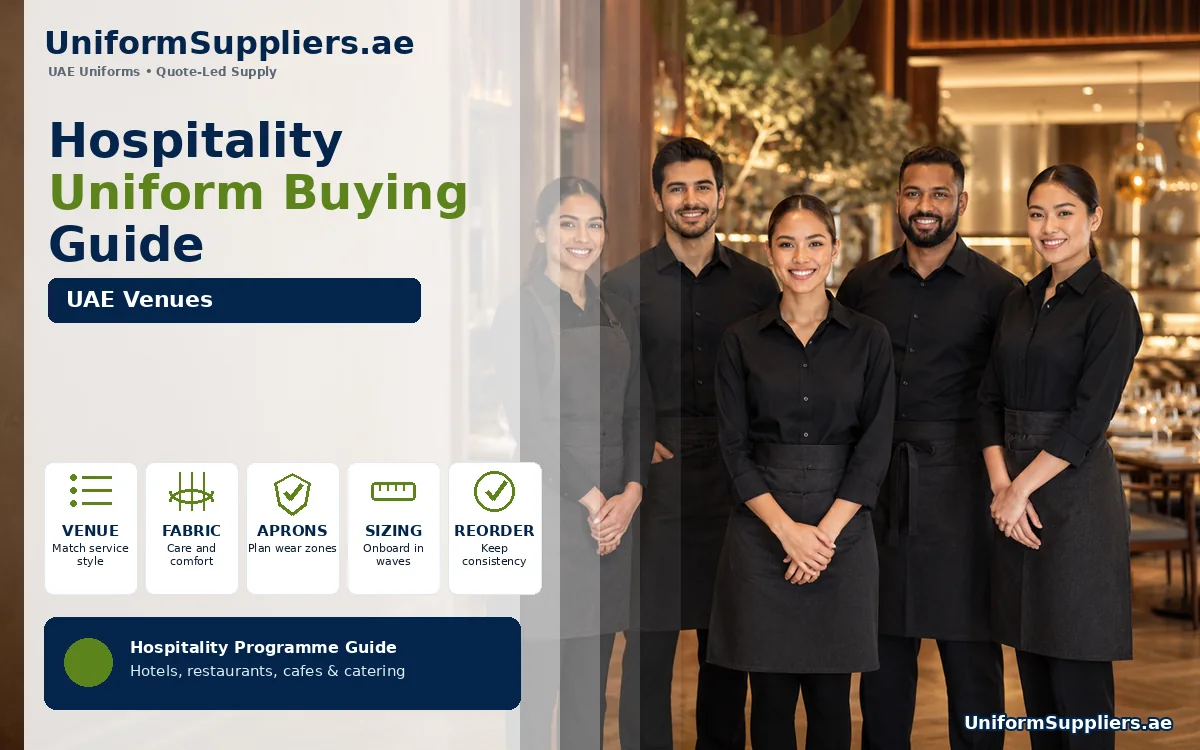
Hospitality uniforms in the UAE are rarely a single purchase. They are a programme — multiple venues, several service styles, constant staff movement, a commercial laundry cycle that never stops, and a summer that punishes careless fabric choices.
The buying decision therefore has less to do with picking a nice waistcoat than with matching garment specification to venue type, service style and replenishment rhythm. Get that structure right and the rest becomes routine ordering.
This guide sets out how to plan and buy a hospitality uniform programme across UAE hotels, restaurants, cafés, catering operations and leisure venues, including the fabric and care decisions that determine how long the programme actually lasts.
What this guide covers
- What a hospitality uniform programme actually includes
- Venue-type programme table
- Hospitality fabric and care guide
- Pre-opening timelines and the UAE buying process
- Turnover, new-joiner kits and replenishment
- Multi-outlet consistency
- Budgeting and procurement practice
- Mustang recommendation
- Frequently asked questions
What a hospitality uniform programme actually includes
Most buyers underestimate the item count. A single restaurant typically needs front-of-house service wear, host attire, bar wear, chef jackets, aprons in two or three lengths, headwear and name badges — before anyone counts stewarding and back-of-house.
A programme therefore has three moving parts. The core specification defines fabric, colour, cut and branding per role. The issue standard defines how many pieces each person receives. The replenishment rule defines when items are replaced and who authorises it.
Written down, those three decisions remove most of the friction from later ordering. Without them, every new outlet reopens the same debate. For the overview of ranges and roles, see the hospitality uniforms UAE pillar page.
This article stays at programme level. For the department-by-department breakdown of a hotel property, see hotel uniforms: dressing every department.
Venue-type programme table
Service style drives the uniform far more than the category label does. A beach club and a fine-dining room may both be described as hospitality, but almost nothing about their programmes overlaps.
| Venue type | Service style | Uniform direction | Fabric priority | Branding | Replenishment rhythm |
|---|---|---|---|---|---|
| Five-star hotel F&B | Structured, multi-outlet, brand-standard led | Tailored separates, distinct outlet identities | Colour-hold and shape retention in commercial laundering | Discreet embroidery, engraved name badges | Quarterly audit and top-up |
| Standalone fine dining | Formal, small team, chef-driven | Considered tailoring, aprons as the signature piece | Premium hand feel and crease resistance | Minimal, or none at all | Low volume, high specification |
| Casual dining chains | High volume, standardised | Polos or shirts with bib aprons; hard-wearing | Stain release and wash durability | Bold, visible logo placement | Rolling monthly replenishment |
| Speciality coffee and cafés | Counter service, visible craft | T-shirts or shirts with barista aprons | Apron stain resistance; comfort on standing shifts | Apron-led; embroidered or woven labels | Aprons replaced far more often than garments |
| Cloud kitchens and catering | Production-led, off-site, mobile | Chef wear, tunics, event-ready outer layers | Heat comfort, breathability, hygiene | Identification over decoration | Tied to event calendar and peaks |
| Leisure and beach clubs | Outdoor, seasonal, high sun exposure | Lightweight polos and resort-style pieces | UV colour-hold, moisture management | Sublimation or embroidery on performance fabric | Heavy pre-season intake, seasonal replacement |
Where a specification cannot be confirmed from a catalogue image, request the datasheet. Final specification will be confirmed during quotation.
Hospitality fabric and care guide
Hospitality garments fail for four reasons: staining, colour loss, heat discomfort and seam failure. Each has a specification answer.
Stain resistance
Front-of-house garments meet oil, wine, coffee and turmeric daily. Polyester-rich blends release oil-based stains more readily than pure cotton, and a soil-release finish helps further — ask the supplier to confirm it on the datasheet. Darker tones and small patterns disguise marks that survive washing.
Colour-hold through commercial laundering
UAE hotel and restaurant garments are typically laundered daily at high temperature with strong detergents. That regime fades cotton quickly and can grey whites within months. Specify colour fastness to washing when tendering, order outlets from the same dye lot where possible, and keep an approved colour reference on file.
Chef wear and heat comfort
Kitchen temperatures in Dubai rise well above the dining room, particularly in summer when air-conditioning plant is already loaded. Chef jackets in breathable cotton-rich blends with mesh venting under the arms and across the back are far more tolerable across a double shift. Long sleeves remain the safer choice around hot surfaces.
Apron durability
Aprons take the heaviest wear in any venue and are usually the first item to look shabby. Look for heavier canvas or twill, bar-tacked stress points, metal rather than plastic hardware, reinforced neck straps and stitched-through pockets. Treat aprons as a consumable budget line, not part of the garment set.
The temperature swing
Staff move between a 22°C dining room, a hot kitchen pass and a 42°C terrace within one shift, and a single fabric weight cannot serve all three. Terrace and pool teams need lighter, moisture-managing cloth; indoor service teams can carry heavier, more structured fabric. The business polo shirt guide compares the relevant knits.
Pre-opening timelines and the UAE buying process
Pre-opening is where these programmes most often go wrong, because uniform decisions sit downstream of concept design, which is itself frequently late.
A workable sequence runs: agree concept and colour direction, confirm roles and headcount, approve samples, measure once onboarding is underway, then place the bulk order with a buffer for late joiners. Measurement is the usual bottleneck, since staff arrive in waves during the final weeks.
Two mitigations work well in this market. First, split the order — commit the core specification early and hold a percentage for late headcount. Second, use ready-stock items for roles where a bespoke garment adds no guest-facing value, keeping bespoke manufacturing for signature front-of-house pieces.
Free onsite individual measurements are available in the UAE for qualifying company uniform orders, with a fit-correction guarantee on garments measured by Mustang. See onsite measurement for how sessions are organised across outlets.
Turnover, new-joiner kits and replenishment
Hospitality turnover in the UAE is high, and the consequence is a constant trickle of new joiners who must be presentable on day one. A programme that can only reorder in bulk will always have someone in an ill-fitting borrowed jacket.
Define a standard new-joiner kit per role — item list, quantity and size logic — and hold buffer stock in the three or four most common sizes. Employee-by-employee packing makes distribution straightforward when a batch arrives for several outlets.
- Agree an issue standard per role, including how many aprons and shirts each person receives.
- Hold buffer stock in high-frequency sizes rather than across the full size range.
- Record every employee’s measurements so replacements do not need a new fitting.
- Set a replacement trigger — visible fading, fraying, missing buttons or stained aprons.
Stored specification records mean a repeat order can be placed against a previous approval rather than rebuilt each time — the practical value of a managed employee uniform programme.
Multi-outlet consistency
Groups running several venues face a different problem: drift. Each outlet orders separately, sizes and shades diverge, and within two years the group looks like six unrelated businesses.
The fix is a written uniform standard held centrally — approved fabrics, colour references, branding artwork and placement, supplier contact and the issue standard per role. Outlets order against that document rather than reinterpreting it.
Consistency does not mean uniformity across concepts. A group can dress its trattoria differently from its lobby lounge. What must stay consistent is quality tier, branding treatment and standard of fit. Operators managing both rooms and restaurants should read this alongside the hotels and hospitality and restaurants and catering pages.
Budgeting and procurement practice
UAE hospitality procurement generally runs on quotations and LPOs, often with two or three suppliers compared on a written specification. That process only produces a fair comparison if the specification is genuinely equivalent.
Build a tender document that states fabric composition, weight, colour reference, construction requirements, branding method and placement, size range and packing instructions. Without those, the lowest quotation usually reflects a lighter fabric rather than better value.
Budget in two lines rather than one: initial fit-out and annual replenishment. Aprons, shirts and polos consume the replenishment line quickly; tailored jackets and waistcoats last far longer. Splitting the budget makes the second year predictable instead of surprising.
Mustang recommendation
Start with the service style, not the catalogue. Decide how the venue serves guests, then specify garments that survive that pattern of movement, heat and laundering.
Treat aprons and shirts as consumables and tailored pieces as assets. Budget and reorder them on different cycles.
Sample before you commit. One wash cycle through your own commercial laundry tells you more about colour-hold than any specification sheet. Free samples are available against a confirmed LPO.
Ready-stock supply and custom manufacturing can run inside a single programme, so urgent needs can be covered from stock while signature pieces are produced. Ready-stock options are outlined under ready-stock uniforms.
Frequently asked questions
How far in advance should a new UAE venue order uniforms?
Start the specification and sampling conversation as soon as concept and colour direction are settled, well before staff arrive. The measurement stage is the constraint, because hospitality teams onboard in waves during the final weeks. Splitting the order into a core commitment plus a late-joiner allocation is the most reliable way to protect an opening date.
Should restaurant uniforms be cotton or polyester blends?
Polyester-rich blends suit high-volume service better because they release oil-based stains, hold colour through commercial laundering and resist creasing. Cotton-rich fabrics feel better against the skin and suit chef wear and premium front-of-house pieces where comfort outranks wash frequency. Most UAE venues use both, specified role by role.
How many uniform sets should each hospitality employee receive?
Three sets is the common working standard for daily service roles: one worn, one in the wash and one spare. Kitchen teams and outdoor terrace staff often need more because garments are laundered after every shift in summer. Aprons should be issued at a higher ratio than garments, as they absorb the majority of daily staining.
What is the difference between this and a hotel department uniform plan?
A hotel department plan works role by role across housekeeping, front office, concierge, spa and engineering. This guide works at programme level across venue types, focusing on the buying decision, fabric specification and replenishment rhythm for food and beverage. Larger properties need both views before finalising a specification.
Can uniforms be supplied consistently across GCC outlets?
Yes, provided the specification is documented and held centrally, including fabric, colour reference, branding artwork and placement. GCC project coordination and delivery can be arranged so multiple outlets receive matched stock from one approved specification. Ordering separately in each market is the fastest route to visible inconsistency.
How should aprons be specified for heavy service use?
Choose a heavier canvas or twill, check for bar tacking at stress points, adjustable metal hardware, reinforced neck straps and stitched-through pockets. Confirm colour fastness, since aprons are washed at higher temperatures than most garments. Treat them as a recurring budget line rather than a one-off purchase, and audit their condition quarterly.
Next step
A hospitality uniform programme is easiest to fix at specification stage and hardest once it is in service. Document the roles, decide fabric priorities for each venue type, and test garments through your own laundry before a full rollout.
Send your outlet list, roles and headcount and a written specification can be prepared for comparison. Request a quote to start, and a free digital logo mock-up can be produced so branding placement is agreed before production begins.