Special offers: free digital logo mock-up and free samples against a confirmed LPO. View offers

Housekeeping Uniforms Built for Long Shifts

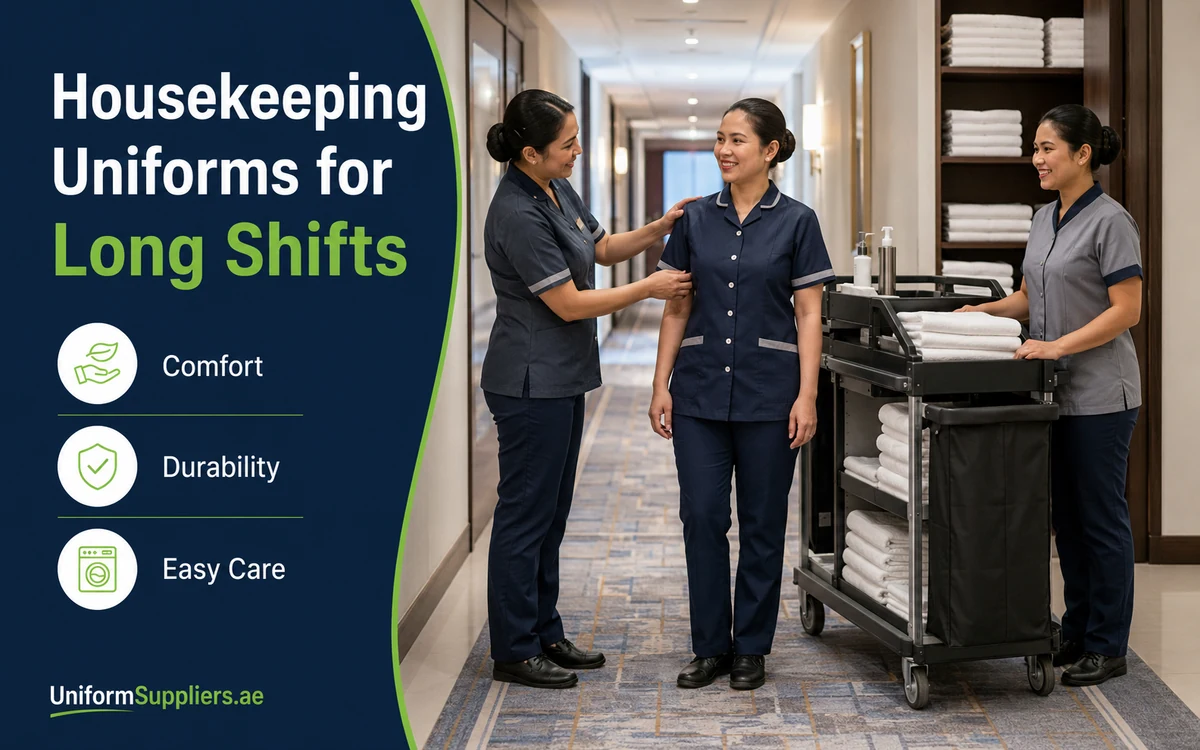
Housekeeping uniforms face a working day no other hotel garment matches. A room attendant in a UAE hotel pushes a loaded trolley along hundreds of metres of corridor, bends and kneels dozens of times, remakes beds, reaches into high shower recesses and low bed frames, and handles cleaning chemicals for a full shift.
The garment then goes into a high-temperature industrial wash, often daily. Across a year that is several hundred cycles on a garment also being stretched, abraded and splashed.
This guide sets out how to specify housekeeping uniforms for that reality: what to write into the specification, what to test on the sample, and what to build into the issue rule. For the whole property rather than one department, see our guide to hotel uniforms department by department.
What this guide covers
- What a housekeeping shift does to a garment
- Movement and durability specification table
- Shift-comfort checklist
- Fabric for daily high-temperature laundering
- Size spread, women’s fit and modest-dress options
- Presentation: housekeepers are guest-facing
- Rotation, records and replacement rules
- Frequently asked questions
- Next step
What a housekeeping shift does to a garment
Most housekeeping uniform failures are predictable from the job description alone.
Repetitive full-range movement. Bed making is a bend-and-reach cycle repeated many times per room, and bathrooms add kneeling and overhead reaching. A garment that fits while standing still can be unwearable after twenty rooms.
Temperature swings. Guest corridors sit near 21 to 23 degrees with strong airflow, while linen rooms and back-of-house lifts run hotter and more humid, and outdoor routes between blocks are punishing from May to September. Staff cross that boundary several times an hour, so the uniform must work as a layered system rather than one garment.
Chemical contact and daily hot laundering. Cleaners and descalers land on cuffs and the garment front, and chlorine strips dye. A daily industrial cycle then drives most shrinkage, colour loss and hem failure.
Guest visibility. Attendants are seen in corridors, lifts and guest rooms, so the garment must still look presentable at hour nine.
Movement and durability specification table
Use the table below as the technical section of your specification.
| Garment element | What the job demands | What to specify | Why it fails when ignored |
|---|---|---|---|
| Tunic cut and armhole | Overhead reaching while the hem stays put | A higher, closer armhole with a fuller sleeve head, a raglan sleeve or an action back | A wide armhole drags the garment up on every lift, so the hem rides above the waistband |
| Stretch content | Bending, kneeling and lifting mattresses | Around two to five per cent elastane, with recovery after repeated washing confirmed on the datasheet | Rigid fabric tears at stress points; poor-recovery stretch bags at knees and seat |
| Side vents | Squatting without the tunic binding across the hips | Vents of about ten to fifteen centimetres on a hip-length tunic, bar-tacked at the top | An unvented tunic rides up on crouching; an unreinforced vent tears from the top |
| Pocket depth and placement | Carrying key card, phone, pen and cloths while bending forward | Deep, angled pockets above the bend line, one with a secure closure, mouths bar-tacked | Shallow patch pockets empty themselves during bed making, and corners fail first |
| Trouser rise and knee ease | Squatting below basin level and kneeling on hard floors | Mid to high rise, gusseted crotch, generous seat and eased knees; check the fit squatting, not standing | A low rise gapes on every bend and a tight seat blows out at the crotch |
| Fastenings | Daily hot wash and tumble cycles | Sewn-through buttons with reinforced stitching or a concealed placket, rated for your laundry temperature | Buttons crack in industrial cages and trims discolour; the garment leaves service |
| Hem and seam construction | Abrasion against trolleys, door frames and bed bases | Twin-needle or topstitched main seams, bar-tacks at pockets and vents, and a deep hem allowance | Single-row seams unravel where load is highest, and a shallow hem cannot be let down |
| Colour and soil concealment | Chemical splash, dust, make-up transfer and limescale | Mid-tone colours, subtle texture, contrast trim on high-contact panels, colourfastness on the datasheet | Dark shades show lint and bleaching; pale ones show every mark by mid-shift |
Shift-comfort checklist
Specification keeps the garment alive. This checklist keeps the wearer comfortable, which determines whether the uniform is worn correctly.
- Layering for chilled corridors and hot linen rooms. Issue a lightweight base garment plus an optional overlayer, such as a knitted waistcoat in the same colour family, so staff can adjust without breaking the look.
- Breathability where it matters. Prioritise airflow at the underarm, centre back and behind the knee; zoned breathability does more than simply dropping the fabric weight.
- Chemical splash tolerance. Cuffs, forearms and the lower front take the most spray, so have colourfastness to washing and to chlorine confirmed on the datasheet.
- Kneeling and reaching. Test the sample by kneeling, squatting and making a bed. Check whether the tunic rides up, the waistband gapes, or the knee fabric goes tight.
- Badge fixing that does not tear fabric. Pin badges leave a hole pattern and eventually a tear on lightweight tunics. Specify a magnetic fixing, a badge tab or a reinforced patch behind the badge position; see our guide to name badges, ID cards and lanyards.
- Spare-set rotation. Plan enough sets that nobody waits on the laundry, and hold a buffer in common sizes for new joiners and same-day replacement.
- Footwear compatibility. Specify trouser length against the shoe the team wears; hems that drag are a slip risk on wet floors.
Mustang recommendation
Put the approved sample through your own laundry at your own wash temperature at least five times before committing to the order. Colour loss, shrinkage and fastening failure all show up in the first few industrial cycles. Free samples are available against a confirmed LPO.
Fabric for daily high-temperature laundering
Housekeeping is one of the few uniform categories where fabric should be chosen around the laundry first, because the laundry is what destroys the garment.
Polyester-rich blends hold colour, shape and crease recovery better through repeated hot washing, which is why most housekeeping ranges sit in the polyester-cotton family with a small elastane addition. Cotton-rich cloth feels cooler but shrinks and fades faster on a daily cycle.
Weight matters as much as blend. Too light and the garment turns semi-transparent after washing; too heavy and it is unwearable in a hot linen room. Our explainer on fabric GSM in UAE workwear shows how to compare quotations like for like.
Confirm three figures on the datasheet: maximum wash temperature, expected shrinkage after first wash, and colourfastness rating. Where a detail is not yet fixed, note that final specification will be confirmed during quotation.
Size spread, women’s fit and modest-dress options
UAE housekeeping teams are usually large, predominantly female and drawn from several countries across South and Southeast Asia, producing a far wider size spread than other hotel departments. A single unisex block fits a minority well and everyone else approximately.
Specify a genuine women’s block for the majority of the team with a unisex block alongside it. The difference appears in bust and hip shaping, shoulder width, sleeve length and rise, and it separates a uniform worn properly from one quietly adapted.
Build modest-dress preferences into the range rather than treating them as exceptions: a longer tunic length, a full-length sleeve, a higher neckline, a looser body and a matching headscarf for staff who wear one.
Capture sizes properly, because self-declared sizes across a large multinational team produce a re-order rate costing more than the measurement exercise. Free onsite individual measurement is available in the UAE for qualifying company uniform orders, and garments measured by Mustang carry a fit-correction guarantee. See measuring a team and keeping size records.
Presentation: housekeepers are guest-facing
Guests judge cleanliness partly through the people delivering it, so a tidy housekeeping uniform supports the room product itself. That means considered colour and clean finishing, not decoration.
Keep housekeeping inside the property’s colour story but distinct enough that a guest knows who to ask for towels. Contrast trim or a consistent apron style achieves that without a second uniform. The wider logic sits in our hospitality uniforms guide, and the multi-building version for cleaning contractors under facilities management.
Choose logo application for laundry endurance: embroidery generally outlasts printing through daily hot washing, but a badge placed where a trolley handle rubs will abrade whatever the process.
Rotation, records and replacement rules
Set the issue quantity around the laundry cycle. Daily in-house laundering needs fewer sets per person than a weekly external cycle. Whatever the number, it must allow one set in wear, one clean and ready, and enough slack for a spill.
Hold a buffer in common sizes. Housekeeping turnover runs higher than most departments, and a new joiner in the wrong garment is visible to guests immediately. Combining ready-stock supply with custom manufacture in one programme covers that gap.
Write down the replacement trigger. Replace on a defined condition rather than on complaint: colour loss, hem or seam failure, a torn pocket or vent, persistent staining, or a size change at fit review. Apply it consistently across the department.
Keep records. Sizes, garment codes, issue dates and per-employee packing make each later order faster to run. See employee uniform programmes, and use request a quote once quantities are ready.
Frequently asked questions
How many housekeeping uniform sets should each attendant have?
Base the number on the laundry cycle rather than a fixed rule. A property laundering in-house daily needs fewer sets per person than one on a weekly external service. Whatever you choose, the wearer should always have one set in use and one clean and ready, plus a departmental buffer.
Should housekeeping tops be tunics or polo shirts?
Tunics present better in guest areas and give more coverage for kneeling, while polos are cooler and simpler to launder. Many UAE properties use a tunic for room attendants seen by guests and a polo for night cleaning teams. Either way, the armhole, side vents and hem length matter more than the garment name.
What colour works best for housekeeping uniforms in the UAE?
Mid-tone and muted colours perform best. Very pale garments show marks by mid-shift, and very dark ones show lint, dust and chemical bleaching from bathroom cleaners. A mid tone with subtle texture conceals soiling between launderings, and contrast trim keeps the garment looking deliberate as it ages.
How do we handle a wide size range and modest-dress requests?
Build both into the range rather than treating them as exceptions. Offer a women’s block alongside a unisex block, extend the size run at both ends, and make longer tunic lengths, full-length sleeves and a matching headscarf standard options. Then capture sizes by individual measurement rather than self-declaration.
Should the hotel or the employee launder housekeeping uniforms?
Most UAE hotels launder in-house because the garments face chemical and soil contact and consistency of appearance matters. If laundering is in-house, specify the maximum wash temperature and confirm the garment tolerates it. If employees launder their own, the care label must be simple and the fabric forgiving.
Next step
Housekeeping uniforms fail for reasons visible on a sample and predictable from a shift description. Specify the armhole, stretch, vents, pockets, rise, fastenings, seams and colour deliberately, then test the sample as the garment will be used.
The most reliable starting point is accurate sizing across the department. Book onsite measurement and our team will measure your housekeeping team individually in the UAE for qualifying company uniform orders, record the sizes for future re-orders, and pack the finished uniforms employee by employee.