Special offers: free digital logo mock-up and free samples against a confirmed LPO. View offers
Ready-Stock vs Custom: Quick Decision Checklist

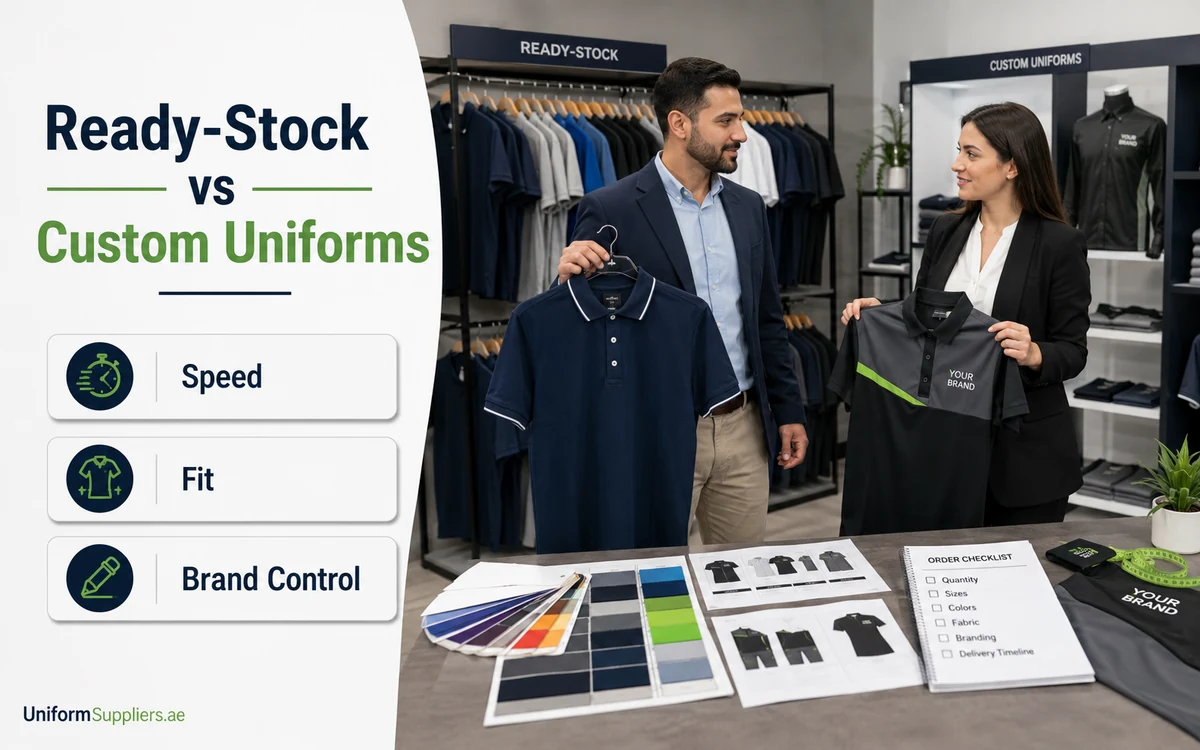
Many uniform briefs stall on one early question: should the garments come from ready stock, or be manufactured to your own specification? The answer shapes everything that follows, from colour choice to how new joiners are equipped.
This checklist turns that decision into twelve A-or-B questions you can answer in a few minutes with HR, procurement and operations in the room. Score it, read the result, and you will know which route to brief.
If you want the reasoning behind each route first, our full comparison of ready stock vs custom uniforms explains it in detail. This page is the short working version.
What this guide covers
- How to use the checklist
- The ready-stock vs custom uniforms checklist
- How to read your result
- Outcome one: ready stock
- Outcome two: custom manufacturing
- Outcome three: a combined programme
- What the checklist cannot decide
- Turn your result into a quotation
- Frequently asked questions
How to use the checklist
Answer each question with A or B, choosing the statement that is closer to your situation. Do not look for a perfect match; pick the nearer one and move on.
Score one role or department at a time. A receptionist, a housekeeper and a maintenance technician in the same company often produce three different results, and that is useful information, not a problem.
Keep a tally of As and Bs for each role. You will also need to note your answers to questions 1, 2 and 12, because those three can override the total.
The ready-stock vs custom uniforms checklist
| No. | Question | Answer A | Answer B |
|---|---|---|---|
| 1 | When must staff be in uniform? | The start date is close and cannot move | There is time for sampling and production |
| 2 | How specific is the colour? | A standard colour such as white, black, navy or grey works | The garment must match an exact brand shade |
| 3 | How distinctive must the design be? | A standard cut with our logo is enough | We need our own collar, panels, trims or cut |
| 4 | How many people wear each style? | A small team, or few wearers per style | A large group wears the same style |
| 5 | What fabric does the role need? | A general-purpose fabric suits the work | A particular weight, blend or finish is required |
| 6 | How wide is the size range? | Standard sizes cover almost everyone | We need extended sizes, modest cuts or individual adjustments |
| 7 | How long will this uniform stay in use? | It may change after a season, campaign or event | It should stay the same for years |
| 8 | How will you reorder? | Occasional small top-ups | A planned cycle for new joiners and replenishment |
| 9 | How many sites must match? | One site, or teams that need not match exactly | Several branches must look identical |
| 10 | Who approves the design? | One manager can decide | Brand, HR and operations all sign off |
| 11 | How visible is the role? | Back-of-house, temporary or support staff | Customer-facing and part of the brand identity |
| 12 | Does the job need specific garment features? | No, a standard garment does the job | Yes: particular pockets, closures, reinforcement or protective features |
How to read your result
Count the As and Bs for the role you scored.
- Nine or more As: ready stock is the likely route.
- Nine or more Bs: custom manufacturing is the likely route.
- Anything in between: a combined programme is the likely route.
Then apply two override checks. If you answered A to question 1 but B to most of the others, you have a custom brief with an urgent start date, which is a combined programme, not a ready-stock one. If you answered B to question 2 or question 12, that garment almost certainly has to be custom whatever the total says, because an exact shade or a specific functional feature cannot be added to a standard garment afterwards.
Outcome one: ready stock
A ready-stock result means your priorities are a close start date, standard colours and a straightforward design. Garments are supplied from existing ranges and branded with your logo using in-house embroidery or printing, with a free digital logo mock-up before production.
This route suits small teams, event and promotional crews, seasonal staff and support roles. Polo shirts, T-shirts, caps and basic workwear are typical examples; see promotional polo shirts and our article on polo shirts for business. Selected international garment brands are also available through Mustang.
The trade-off is control. Colours, cuts and sizes are limited to what the range offers, and a style can be changed or withdrawn by its maker. Ask about range continuity before you standardise on a garment. Details are on the ready-stock uniforms page.
Outcome two: custom manufacturing
A custom result means the uniform is part of how your organisation is recognised, and you need it to stay consistent across sites and years. The garment is specified for you: fabric, shade, cut, trims and branding.
The process has more steps, and each one protects the result. You approve a free digital logo mock-up, then a sample, which Mustang provides free against a confirmed Local Purchase Order (LPO). Staff can be measured individually through free onsite measurement in the UAE for qualifying company orders. After delivery, the approved sizing, fabric, colour, logo position and branding are kept on record for repeat orders.
Read the custom uniform manufacturing page for the service itself and the custom uniform manufacturing guide for the UAE for the full sequence.
Outcome three: a combined programme
A mixed score is a normal result for employers with several departments, and it is not a compromise. Mustang combines ready-stock garments with custom manufacturing in one programme, under one set of records.
Combined programmes usually take one of three shapes:
- By time: urgent staff are supplied from ready stock while the custom order is completed, so nobody starts work without a uniform.
- By role: customer-facing roles wear custom garments, while back-of-house, temporary or support roles wear branded ready-stock items.
- By garment: the core garment is custom, and layers such as polos, T-shirts, jackets or caps come from ready stock.
Many businesses also begin with ready stock at opening and move to custom garments at the first replenishment. If that is your plan, say so in the brief so the interim garments are chosen with the later custom design in mind. The employee uniform programmes page explains how rollout, new-joiner kits and replenishment are organised.
What the checklist cannot decide
The checklist tells you which route to brief. It does not tell you the fabric, the workable quantity for each style, the cost or the timing. Those depend on the garments, the branding method and the size breakdown. Final specification will be confirmed during quotation.
The same applies to dates. A ready-stock order avoids the sampling and production stages, but branding, packing and distribution still take time. Delivery timelines are confirmed during quotation.
Mustang recommendation: never score the whole company as one line. Score each role, then group the roles by result. Buyers often find they have one or two custom garments that carry the brand and a larger set of standard items around them, and briefing them that way produces a clearer quotation.
- Score every role separately and record the A and B totals.
- Mark any role where question 2 or question 12 was answered B.
- Write down the date each group of staff must be in uniform.
- List headcount per role and per branch.
- Note which staff need interim uniforms.
- Attach logo files and brand colour references.
For the wider buying process, the uniform ordering checklist for the UAE picks up where this one ends.
Turn your result into a quotation
Send your scored roles, headcount and logo through Request a Quote and tell us which outcome you reached. If you would like to see and handle a garment first, use Request a Sample. You can also read more about how we work as a uniform supplier in Dubai.
Frequently asked questions
Is ready stock lower in quality than custom?
No. They are two supply routes, not two quality grades. Quality depends on the fabric and construction of the specific garment, so judge it by handling a sample.
Can ready-stock garments carry our logo?
Yes. Ready-stock garments are branded with in-house embroidery or printing, and you receive a free digital logo mock-up before production.
Can we move from ready stock to custom later?
Yes, and many employers do. Plan the change one role or department at a time, so that colleagues working side by side are not left in two different uniforms.
Is there a minimum quantity for the custom route?
It varies by product and branding, and it is confirmed during quotation. If a role has only a few wearers, the checklist will usually point that role towards ready stock anyway.
What if two departments get different results?
That is expected. Brief them as one combined programme so that branding, records and packing stay consistent across both.