


Blog
Name Badges, ID Cards and Lanyards: Small Details, Big Impact

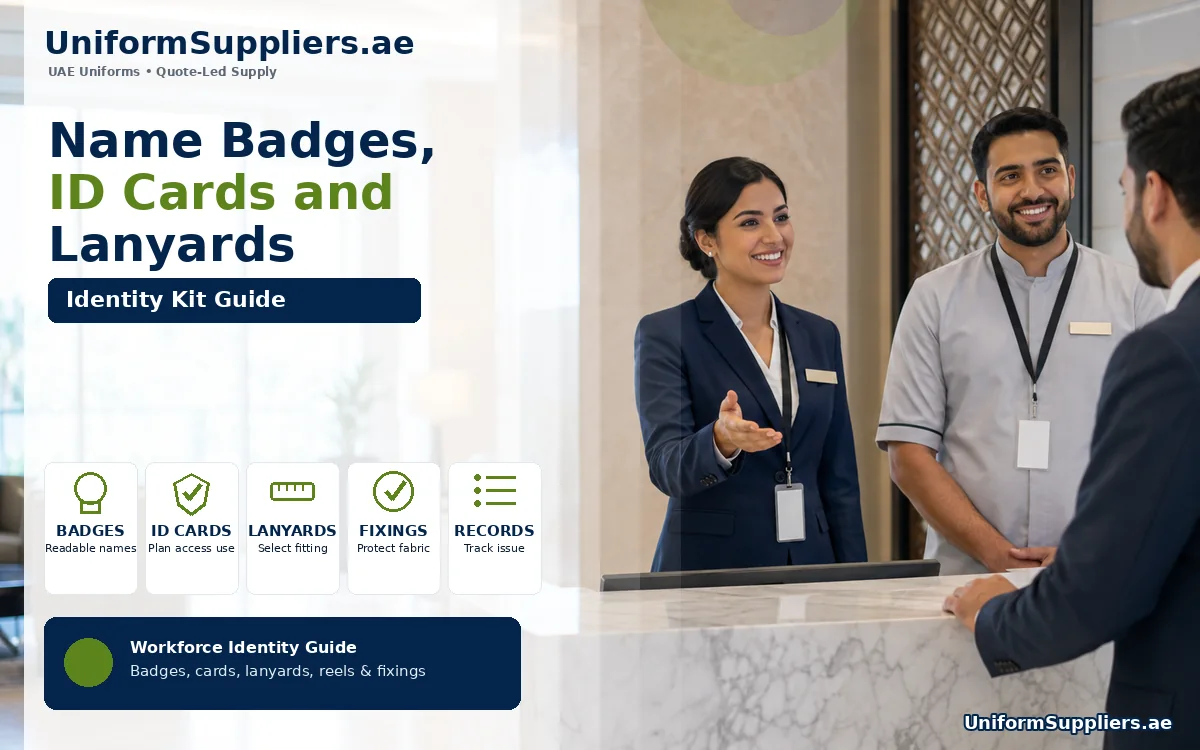
In most UAE workplaces the badge is read before the face is recognised. A guest at a hotel reception, a patient in a clinic waiting room or a contractor signing in at a facilities desk glances at a badge in the first few seconds, and that glance sets the tone.
Name badges, ID cards and lanyards are usually the last line on a uniform purchase order and the first items to fail. Badges fade, lanyards fray by August, pins tear delicate fabrics, and new joiners spend a fortnight with a handwritten sticker on the chest.
This guide treats workforce identity as a complete kit: what each item is made from, how it attaches, how long it survives Gulf conditions, and what to specify.
What this guide covers
- Why identity items carry extra weight in UAE workplaces
- Identity item comparison table
- Choosing between badge types
- ID cards and access control
- Lanyards, reels and fixings
- Badge legibility and layout checklist
- Treating badges as a rolling consumable
- Writing the specification
- Next step
- Frequently asked questions
Why identity items carry extra weight in UAE workplaces
UAE teams are unusually multinational. A single hotel floor or clinic department may carry names from a dozen language backgrounds, so a guest often cannot repeat a name they have only heard once. A clear, correctly spelled badge does the work that pronunciation cannot.
Access control adds a second layer. Many organisations run several sites across Dubai, Sharjah and Abu Dhabi and staff move between them, which turns the ID card into a security asset with its own lifecycle, separate from the name badge.
Then there is the climate. From May to September staff move constantly between air-conditioned interiors and outdoor humidity. Lanyards absorb sweat, low-grade dye transfers onto light collars, and badge surfaces that were never UV stable go chalky near glazing. Identity items are consumables here, and planning them as such is what separates a tidy team from a scruffy one.
Identity item comparison table
Match each item to the role and environment rather than buying one badge type for the whole organisation. Most companies settle on two or three formats: a permanent badge for customer-facing staff, a reusable one for temporary staff, and an access card for all.
| Item | Typical construction | Attachment method | Best suited to | Durability consideration | What to specify |
|---|---|---|---|---|---|
| Engraved metal badge | Brass, stainless or anodised aluminium, laser engraved, colour filled | Pin, magnet or clip | Front office, management, fine dining | Highest fade resistance; dents if dropped | Metal, finish, engraving depth, fill colour |
| Printed or domed badge | Printed plastic base under a clear resin dome | Pin, magnet or clip | Multi-colour logos and gradients | Dome protects print; resin yellows in direct sun | Base material, dome thickness, colour references |
| Reusable window badge | Rigid frame with replaceable printed insert | Pin, magnet or clip | Trainees, seasonal and agency staff | Frame outlasts many names; thin inserts curl | Frame size, insert weight, printed or blank |
| PVC ID card | Laminated PVC, digitally printed, photo optional | Lanyard, strap clip or reel | Site access and visitor control | Edges delaminate if punched badly; print scratches | Thickness, sides printed, punch position, laminate |
| Contactless access card | PVC card with embedded chip and antenna | Lanyard, reel or wallet | Door access, lift control, attendance | Chip fails if bent or punched through the antenna | Chip technology matched to existing readers |
| Printed polyester lanyard | Smooth polyester webbing with surface print | Trigger hook or bulldog clip | General staff and visitors | Print abrades at the neck; dye marks collars | Width in millimetres, print method, breakaway |
| Woven lanyard | Design woven into the webbing, not printed | Trigger hook or swivel clip | Long-life daily wear, security, facilities | Best abrasion life; fine detail limited | One or two colour artwork, thread colours |
| Tubular lanyard | Soft tubular polyester, screen printed | Trigger hook or split ring | Events and high-volume handouts | Softest on the neck, shortest working life | Print colours, hook type, breakaway |
| Retractable badge reel | Housing with retracting cord and belt clip | Belt clip, strap clip or pin backing | Healthcare, warehousing, frequent reader taps | Spring and cord fail before the card | Housing material, cord length, clip type |
| Clips, pins and magnets | Steel pin, crocodile clip or two-part magnet | Fitted to the badge itself | Any badge; driven by the fabric | Pins hole fine fabrics; magnets need care | Fixing per garment, magnet strength |
Choosing between badge types
Engraved badges suit roles where the badge is part of the uniform’s finish: front office, restaurant management, clinic reception, premium retail. The engraving is cut into the metal, so no printed layer can lift. Eligible engraved badges supplied by Uniform Suppliers UAE carry a one-year no-fading warranty under normal use and care conditions, with full terms on the warranty terms page.
Printed and domed badges earn their place when the brand mark is multi-colour or contains a gradient. Reusable window badges answer departments where names change every few weeks: the frame is bought once and only the insert is replaced.
Mixing formats is sensible provided shape, size and colour stay constant. Where badges sit beside embroidered branding, align badge colour with the thread palette, as covered in the uniform branding guide.
ID cards and access control
An ID card authenticates rather than introduces, and it usually has to work with door readers, lift controllers or a time-and-attendance system already in the building.
Confirm the chip technology your readers accept before ordering. Cards are often chosen on appearance and then fail at the door because the frequency does not match. If the card carries a chip, the slot punch must clear the antenna, so specify its position.
Photo cards need one capture standard or the set looks chaotic: same background, same crop, same shoulder line. Where the card also identifies staff to the public, keep the name readable at conversational distance.
Lanyards, reels and fixings
Lanyards take the most punishment in the kit. They sit against the neck, absorb sweat through the summer, and get pulled, twisted and caught on trolleys and door handles.
Woven lanyards last longest because the design is part of the webbing. Printed polyester gives sharper artwork but wears at the neck first. Tubular lanyards are the most comfortable and least durable: fine for events, poor for daily wear.
Specify a safety breakaway on any lanyard worn near machinery, kitchen equipment, patients or moving vehicles. For staff tapping a reader dozens of times a day, a belt reel removes the repeated stretch that destroys cord. On fine hospitality and healthcare fabrics choose magnets: a pin leaves a permanent hole in a satin lapel or a lightweight scrub top.
Badge legibility and layout checklist
Most badge complaints are layout problems, not manufacturing problems. Work through this list before artwork is approved.
- Name size: the given name should be the largest element and legible at about two metres. If the logo is bigger than the name, the priorities are reversed.
- Role line: one short role descriptor under the name. Long official job titles rarely fit and rarely help a guest.
- Department or location: add it only where it changes how someone is approached, such as a large hospital or a multi-tower facilities contract.
- Language pairing: for bilingual badges, fix the order of Arabic and English across the organisation and give each language its own line. Have the Arabic checked by a native reader before the first run, and nominate one HR field as the authoritative spelling.
- Contrast: gold on silver and dark grey on navy look elegant on a proof and vanish in a dim restaurant. Aim for strong tonal difference.
- Fixing per garment: record the fixing against each uniform item, not each person. Magnets for jackets and fine blouses, clips for lanyard wearers, pins only on robust fabrics.
- Spare stock policy: hold blank frames and unengraved blanks so a new joiner is badged in week one, and agree a replacement route for lost or damaged badges.
- Reorder record: keep approved artwork, font, size, fill colour and fixing on file so the fiftieth badge matches the first.
Treating badges as a rolling consumable
Turnover in UAE hospitality, retail and facilities management means badge demand never stops. Treating identity items as a one-off purchase guarantees a gap: the first order covers day one, then nothing until half the floor is unbadged.
A standing programme works better. Hold a buffer of blank frames, lanyards and reels, batch engraving requests on a regular cycle, and record every issued item against the employee so exit returns are enforceable. Access cards should be deactivated the day someone leaves. The uniform ordering checklist sets out how to structure the LPO and approval trail so identity items are not left off the requisition.
Writing the specification
Mustang recommendation. Write the badge and lanyard specification as its own annex to the uniform tender rather than a single line item. State badge type and dimensions in millimetres; material and finish; fixing per garment; vector artwork; text hierarchy and character limits; language order; lanyard width, attachment and breakaway; card thickness, chip compatibility and punch position; and a buffer quantity for new joiners.
Where a detail depends on a decision not yet taken, mark it open rather than guessing. Final specification will be confirmed during quotation. Physical samples are worth the short delay, because fill colour, engraving depth and lanyard hand-feel are hard to judge on screen.
Specify badges alongside the garments they attach to. See the guidance on corporate uniforms in the UAE, department detail for hotels and hospitality, and fixing considerations for healthcare teams. The embroidery service page explains how badge colour and thread colour are matched.
Next step
Identity items are easy to approve on screen and easy to regret in a lobby. Handling a badge and seeing how a lanyard sits against a collar answers questions no proof can.
Request a Sample to see badge, card and lanyard options in person, or Request a Quote once your specification is settled.
Frequently asked questions
Should badges be magnetic or pinned?
Magnetic fixings are the safer default for fine hospitality fabrics, lightweight blouses, satin lapels and healthcare tops, because pins leave permanent holes that show once the badge is removed. Pins remain fine on heavier woven shirts, aprons and industrial workwear. Magnets should be avoided by anyone with an implanted cardiac device, so keep a clipped alternative.
How long does a printed lanyard last in UAE conditions?
Wear pattern matters more than calendar age. Daily wear through the humid months, with sweat and repeated laundering, wears surface printing at the neck line first. Woven lanyards hold their appearance longer because the design is part of the webbing. Plan them as a recurring replacement item.
Can one badge design work across several brands or sites?
Yes, and usually it should. Keep badge shape, size, typeface and text hierarchy constant, then vary only the logo and fill colour by brand or site. That keeps reorders simple and prevents the drift that happens when each location commissions its own design.
What file format is needed for badge artwork?
A vector file such as AI, EPS, PDF or SVG reproduces cleanly at badge scale. A low-resolution image taken from a website looks soft at a few centimetres and cannot be engraved accurately. Supply named colour references and a single-colour version for engraved or woven applications.
Do engraved badges carry any warranty?
Eligible engraved badges carry a one-year no-fading warranty under normal use and care conditions, with full terms published on the warranty terms page. That warranty covers engraved badges only and does not extend to printed badges, ID cards, lanyards or reels, which are wearing items with a shorter life.