Special offers: free digital logo mock-up and free samples against a confirmed LPO. View offers

Facilities Management Uniforms for Multi-Site Teams

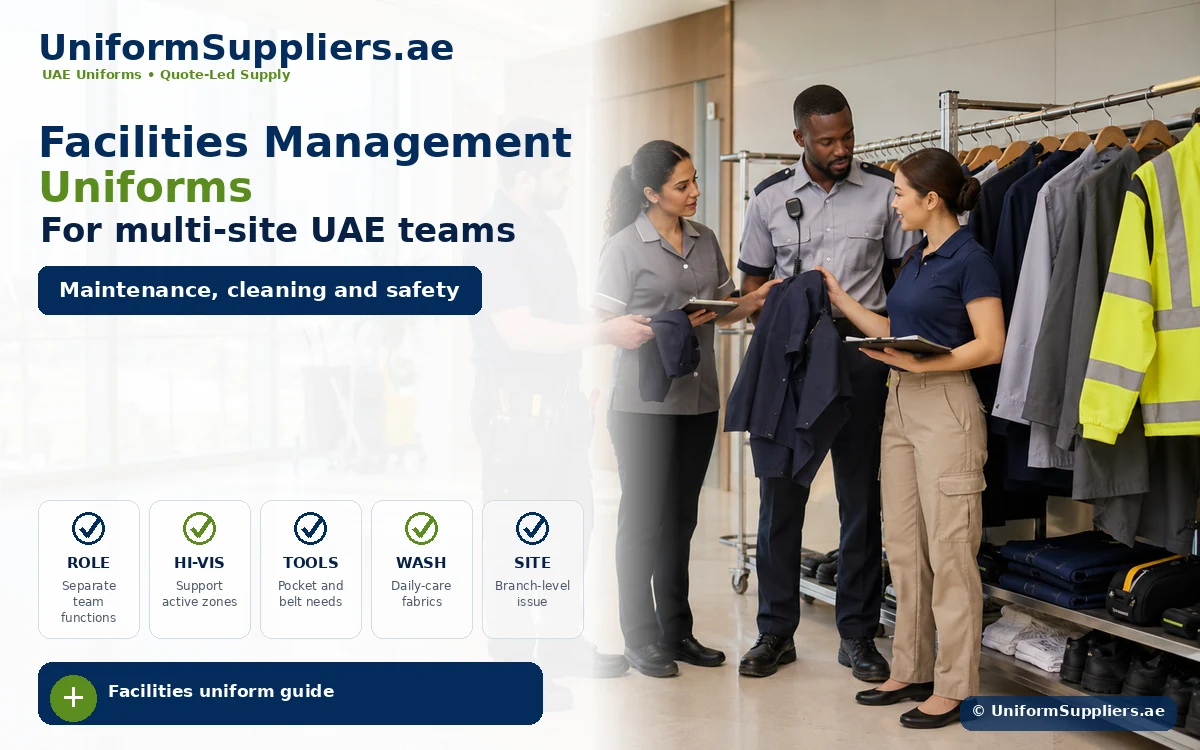
Facilities management is one of the few sectors where one uniform programme has to work in a dozen environments at once. The same contractor can have a cleaning team in a Grade A office tower, a landscaping crew on an open compound, an MEP technician in a hotel plant room and a supervisor who visits all three before lunch.
That mix makes specification harder than buyers expect. A garment that looks correct in a marble lobby is useless in a chiller room, and a garment built for external work in July looks wrong at a client reception desk.
This guide sets out how to specify facilities management uniforms UAE contractors can deploy across multiple sites and multiple clients without ending up with forty unmanageable garment lines.
What this guide covers
- Why FM uniforms are a harder brief than most
- The UAE conditions your kit has to survive
- Uniform requirements by trade and site type
- Working inside somebody else’s building
- Fabric, construction and colour decisions
- Mobilisation, sizing and headcount churn
- Laundering, replacement and lifecycle control
- Frequently asked questions
- Getting your FM uniform specification priced
Why FM uniforms are a harder brief than most
Most uniform briefs describe one workplace. An FM brief describes a portfolio. Soft services, hard services, landscaping, pest control and concierge support sit under one contract manager, each with a different soiling profile, guest visibility and safety exposure.
The second complication is ownership of the space. An FM workforce rarely works in its own building. Staff are guests in someone else’s asset, subject to that client’s access rules and appearance standards.
The third is churn. Headcount is high, turnover is steady, and a new contract can need full kit for a large intake quickly. Good specification therefore groups trades into a few garment families, separates identity from the garment, and plans for continuous replenishment. The facilities management industry page summarises how those pieces fit together.
The UAE conditions your kit has to survive
From May to September, external teams work in sustained heat and high coastal humidity. Landscaping, external cleaning and waste handling happen in direct sun, and midday breaks push work into early starts and late finishes, so long-sleeve sun cover and breathable weaves matter.
Indoors, the swing is severe. A cleaner may move from a loading bay at ambient temperature to a heavily chilled mall interior several times a shift. A light over-layer staff can add or remove beats a heavier base garment.
Dust, fine sand and chemical contact are constant. Dust greys pale fabrics and loads hems; dilute detergents and disinfectants attack colour. Mid-tone colours and tighter weaves hold appearance far longer, and frequent laundering should be assumed.
Uniform requirements by trade and site type
Use the table below as a starting specification for a mixed FM contract. Most trades share one garment platform, with differences carried by colour, trim and identification.
| Trade or service line | Typical environment | Core garments | Identification requirement | Practical detail |
|---|---|---|---|---|
| Soft-services cleaning | Chilled interiors, guest-visible corridors | Polo or tunic, straight-leg trouser, light over-layer | Chest logo, role title, photo ID | Mid-tone colour hides splash marks; pockets for cloths and radio |
| Washroom and waste | Enclosed, wet, high soiling and odour | Tunic or coverall, waterproof apron, rubber boots | Discreet role marking; no client branding on soiled layers | Wipe-clean outer layer, removed before guest areas |
| Landscaping and external | Open sun, irrigation water, sand | Long-sleeve shirt, cargo trouser, legionnaire cap | Back logo for distance; hi-vis vest near traffic | Sleeves for sun cover; darker legs hide soil staining |
| MEP and technical | Risers, roofs, pump rooms, occupied plant | Two-piece work suit or coverall, tool-friendly trouser | Trade marking plus permit or card holder | Reinforced knee and seat; nothing loose near rotating equipment |
| HVAC and plant room | Hot, oily, confined, noisy | Coverall or work shirt and trouser, robust weight | Name and trade visible from the front | Tolerates hot wash and grease; avoid pale colours |
| Pest control | Kitchens, back of house, ducts, perimeters | Distinct-coloured coverall, removable outer layer | Visibly separated from cleaning teams | Launders separately; smooth surfaces, few external seams |
| Security-adjacent concierge | Lobbies, reception desks, entry points | Formal shirt, tailored trouser, blazer or waistcoat | Highest appearance standard; badge plus pass | Crease-recovering fabric; extra shirts in summer |
| Mobile supervisors | Several buildings per shift, vehicle time | Smart polo or shirt, chino, light softshell | Contractor branding, title, multi-site passes | Layers that read as management in a lobby and site staff on a roof |
Where a fabric weight, finish or trim is not yet settled, leave it open in the tender. Final specification will be confirmed during quotation.
Working inside somebody else’s building
This is the problem unique to FM, and it is usually solved badly. One workforce operates inside several client buildings, each with its own access control, appearance standard and sometimes its own branding expectation. Get identification wrong and staff are turned away at a service lift, or look like they belong to the wrong organisation.
Client-branded versus contractor-branded garments
The default should be contractor branding, with client identity carried by a removable element. A client-branded garment is dedicated stock: it cannot be redeployed if the contract moves, and every staff transfer triggers a re-issue.
Where a client insists on their mark, keep it on a tabard, badge, patch or lanyard card and leave the base garment neutral.
Multi-client identification checklist
- Confirm each client’s appearance standard in writing before mobilisation: colour restrictions, footwear rules and whether short sleeves are permitted in guest areas.
- Choose one base garment that satisfies the strictest client on the portfolio, then dress down for the rest.
- Keep client identity on removable items only: tabards, patches, badge inserts or lanyard cards.
- Match pass carriage to the site — retractable reel for technical trades, clip for offices, breakaway lanyard near machinery.
- Issue one holder that fits both your ID and the client access pass.
- Record which staff hold which client passes, and tie pass return to uniform return in one checklist.
- Standardise role colour coding contract-wide so a client’s team can identify a cleaner, a technician and a supervisor at a glance.
- Plan handover: neutral garments stay in your programme; client-branded items are returned or destroyed under a documented process.
- Hold a buffer of unbranded stock so a new site is covered while site-specific items are produced.
The article on name badges, ID cards and lanyards covers those carriage options.
Fabric, construction and colour decisions
Most FM garments sit in a polyester-cotton blend for good reason: it holds colour under repeated washing, dries quickly and resists creasing between sites. Higher cotton content feels better in heat but fades faster and needs pressing.
Weight often matters more than fibre. A light fabric suits interior cleaning but will not survive tool contact in a plant room, while a heavy twill punishes a landscaper in August. Two weights usually cost less over a year than one compromise fabric. The guide to fabric GSM for UAE workwear explains how those numbers translate into garments.
Colour is a maintenance decision as much as a brand one. Keep the brand colour as a contrast panel, collar tip or trim rather than the full garment body.
Mustang recommendation: build the contract around one base garment family in two weights, add high-visibility and technical layers only where the risk assessment requires them, and carry client identity on removable items. That keeps SKU count low and means a new contract can be mobilised largely from existing stock. Where site hazards apply, specify the protective layer separately using the industrial uniforms and safety workwear guidance, and ask your supplier to confirm protective performance on the product datasheet.
Mobilisation, sizing and headcount churn
FM contracts mobilise fast and staff numbers move constantly. The programmes that work are those where sizing is captured properly once and reused for every later issue.
Free onsite individual measurements are available in the UAE for qualifying company uniform orders, which is the practical way to size a large multi-nationality workforce spread across accommodation locations and shift patterns. Those measurements become a stored specification record, so replacement issues need no new fitting session.
Measure by site or accommodation block rather than by trade, group the results into a size curve, and use that curve to set buffer stock for the next intake. The sizing and measurement guide explains the process.
Combining ready-stock supply with custom manufacturing keeps new teams presentable from day one, with urgent ready-stock garments covering the opening period while custom items complete. Employee-by-employee packing then makes site distribution a handover rather than a sorting exercise.
Laundering, replacement and lifecycle control
Most FM staff launder at home, often daily and usually with more detergent than needed. That, not a controlled commercial cycle, is the real test. Specify colourfastness and shrinkage expectations in the tender and ask for wash-care instructions in the languages your workforce reads.
Issue enough sets that garments are never worn damp. Three sets per person is a common baseline for soft services and technical trades.
Track replacement by trade rather than as one blended number, because washroom, waste and landscaping garments wear out far faster than concierge kit. A structured employee uniform programme keeps size records, issue history and replenishment triggers in one place, and the annual replenishment checklist helps at contract review.
Frequently asked questions
Should FM uniforms carry the client’s logo or ours?
Contractor branding should be the default, with client identity on a removable tabard, patch, badge insert or lanyard card. That keeps stock interchangeable between sites and avoids re-issuing garments whenever staff transfer. Where a client requires a fully branded garment, treat it as a separate stock line rather than changing the base uniform for everyone.
How many uniform sets should each FM employee receive?
Three sets per person is a common baseline for cleaning and technical trades, because daily home laundering in UAE conditions leaves little drying time. Concierge and supervisory roles usually need extra shirts to hold appearance standards through the week. Set quantities per service line rather than across the whole contract.
What colour works best across multiple client buildings?
Mid-tone colours perform best. Greys, navies, teals and olives conceal dust, detergent splash and general soiling, and read as professional in both a premium lobby and a plant room. Pale garments look excellent at issue but grey quickly under Gulf dust and frequent washing, which raises replacement frequency.
How do we handle uniforms when a contract changes hands?
Agree the process before mobilisation. Neutral and contractor-branded garments stay in your programme and move with the staff or return to stock, while client-branded items are returned or destroyed under a documented process. Tying access pass recovery to uniform return in one checklist prevents garments coming back while building passes do not.
Do landscaping and external teams need different garments?
Yes. External teams need long-sleeve sun cover, headwear suited to sustained exposure, and darker leg fabric to disguise soil and irrigation staining. High-visibility layers apply wherever staff work near vehicle movement. Interior cleaning garments are lighter and more guest-facing, so specify them separately even if they share a base garment family.
Can one supplier cover a GCC-wide FM contract?
Yes, where the supplier coordinates production and delivery across the region. Uniform Suppliers UAE handles GCC project coordination and delivery, with production and warehouse operations in Dubai and additional storage in Sharjah. The practical requirement is consistency: the same size records, fabric specification and branding method applied at every location.
Getting your FM uniform specification priced
Bring your trade list, headcount by service line, client appearance requirements and site safety rules, and the specification can be built around one garment platform with only the variations you need.
Request a Quote for your facilities management uniform programme, and include your site list so mobilisation and replenishment are planned together.