Special offers: free digital logo mock-up and free samples against a confirmed LPO. View offers
Fabric Comparison: Polyester, Cotton and Blends

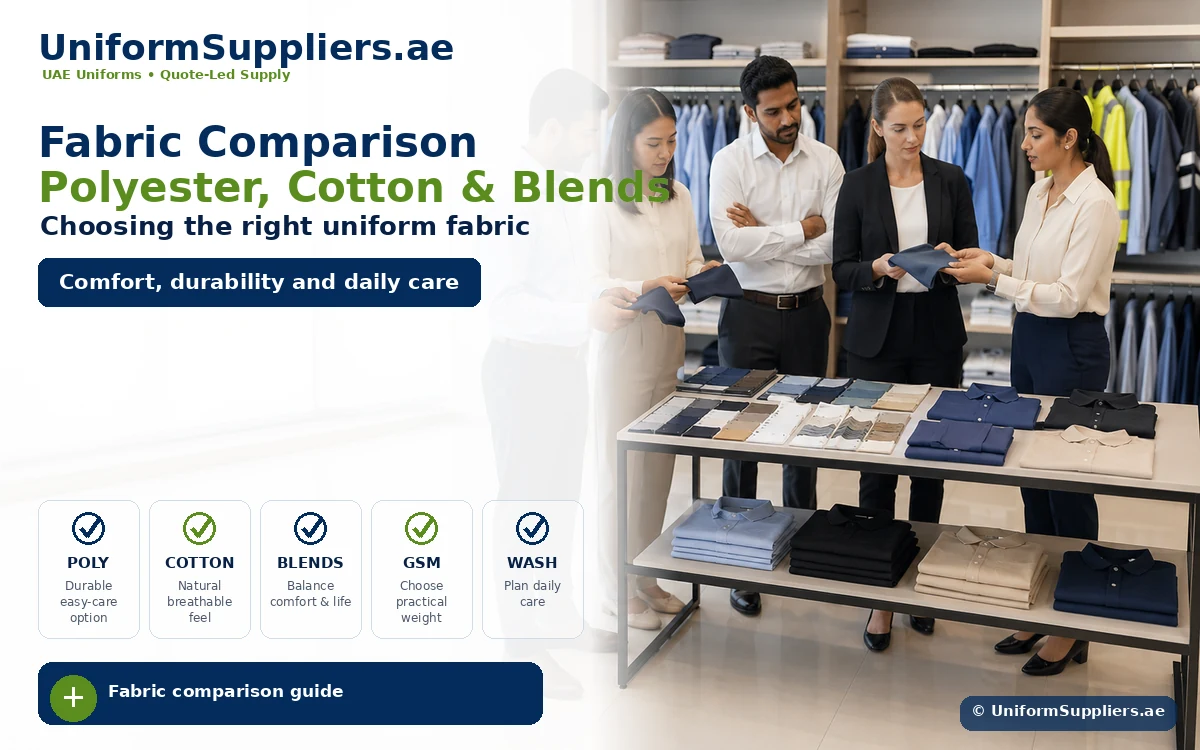
Polyester, cotton and blends of the two make up most uniforms worn in the UAE, yet the fibre is often chosen once for the whole company and applied to every garment. That is where problems start: the fabric that suits a receptionist’s shirt is rarely right for a chef jacket or a site coverall.
This comparison looks at polyester vs cotton uniforms by role and garment type, so procurement, HR and operations teams can specify fibre garment by garment. For weave, finish and fabric weight, see our separate guides on fabrics for the UAE climate and fabric GSM for workwear.
What this guide covers
- How each fibre behaves in daily wear
- Side-by-side comparison table
- Shirts, polos and trousers
- Chef wear and scrubs
- Coveralls and site workwear
- Quick decision matrix by garment
- How laundering changes the answer
- Buyer checklist
- Frequently asked questions
How each fibre behaves in daily wear
Cotton
Cotton is a natural fibre that absorbs moisture and feels soft against the skin, which is why staff usually prefer it in hot conditions. The trade-offs are practical: it creases, stays damp for longer once wet, can shrink if it has not been pre-treated, and dark colours tend to lose depth sooner under frequent washing.
Polyester
Polyester is a synthetic fibre that is durable, colour-stable and quick-drying. It holds its shape and resists wrinkles. It absorbs very little moisture, so comfort depends heavily on how the fabric is constructed. A poorly chosen polyester can feel warm and clingy outdoors, and the fibre can soften or melt when exposed to high heat or sparks.
Polyester-cotton blends
Blends combine comfort and durability: cotton for absorbency and feel, polyester for strength, colour retention and easier care. A blend is described by its ratio, so a polyester-rich blend behaves more like polyester and a cotton-rich blend more like cotton.
Polyester vs cotton uniforms: side-by-side comparison
The table summarises general fibre behaviour. Individual fabrics vary with construction and finishing, so treat it as a starting point for discussion with your supplier.
| Factor | Cotton | Polyester | Polyester-cotton blend |
|---|---|---|---|
| Feel on the skin | Soft and natural | Smooth; depends on construction | Between the two, depending on ratio |
| Moisture | Absorbs sweat, slower to dry | Absorbs little, dries quickly | Moderate absorbency, reasonable drying |
| Creasing | Creases easily | Resists creasing | Fewer creases than cotton |
| Colour after repeated washing | Fades sooner, especially dark shades | Holds colour well | Generally good |
| Shrinkage risk | Higher unless pre-treated | Low | Low to moderate |
| Abrasion and tear strength | Moderate | High | Good |
| Near heat, sparks or flame | Chars and burns; not flame-resistant | Can melt; not flame-resistant | Depends on ratio; not flame-resistant |
| Branding | Embroidery, screen print, heat transfer | Embroidery, print and sublimation | Embroidery, screen print, heat transfer |
Shirts, polos and trousers for office and customer-facing roles
Corporate roles spend most of the day in strong air-conditioning, with short walks through heat between car parks, buildings and client sites.
- Corporate shirts: cotton-rich or balanced blends give a natural handle while staying presentable after a commute. Pure cotton looks sharp only if it is ironed properly. See corporate shirts.
- Polo shirts: cotton or cotton-rich knits feel familiar and suit retail and office teams. Polyester performance knits suit outdoor, delivery and event roles where quick drying matters.
- Trousers: polyester-rich fabrics, often blended with viscose, hold a crease line and resist bagging at the knee better than cotton.
Our corporate uniforms page shows how these garments fit together in one programme.
Chef wear and scrubs: heat, stains and hot washes
Kitchen and clinical garments are washed more often and more aggressively than most other uniforms, so fibre choice here is largely a laundering decision.
Chef wear
Chefs work beside radiant heat, so cotton and cotton-rich fabrics remain popular for jackets: they absorb sweat and do not melt on contact with a hot surface. Polyester-cotton blends are widely used where jackets go through a commercial laundry and need to keep their whiteness and shape. Compare options in chef wear.
Scrubs
Scrubs need to move with the wearer, release stains and survive repeated washing. Polyester-rich blends, sometimes with a little stretch, are common for that reason, while cotton-rich options suit wearers who prioritise a natural feel. Confirm the wash temperature your facility or laundry uses before choosing. Browse medical scrubs.
Coveralls and site workwear
Outdoor crews face direct sun, dust and abrasion. Cotton and cotton-rich coveralls are often chosen for comfort in heat and for general tasks near hot surfaces, because cotton does not melt onto the skin. Polyester-rich blends offer better tear strength and colour retention for logistics, maintenance and facilities teams who are not exposed to sparks.
Neither ordinary cotton nor ordinary polyester is flame-resistant. Where a risk assessment identifies flash fire, arc or molten-metal hazards, the HSE team should specify purpose-made flame-resistant garments and check the documentation supplied with the actual product. General-duty options are listed under coveralls.
Quick decision matrix by garment
| Garment | Common starting point | Consider the alternative when |
|---|---|---|
| Corporate shirt | Cotton-rich or balanced blend | Staff cannot iron daily: move towards more polyester |
| Polo shirt | Cotton or cotton-rich knit | Roles are outdoors or active: consider a polyester performance knit |
| Formal trousers | Polyester-rich, often with viscose | A softer, more natural handle is the priority |
| Chef jacket | Cotton or cotton-rich | Commercial laundering is harsh: consider a blend |
| Scrubs | Polyester-rich blend | Wearers prefer natural fibre: consider cotton-rich |
| Coverall | Cotton or cotton-rich | No hot work and high abrasion: consider polyester-rich |
Final specification will be confirmed during quotation.
How laundering changes the answer
A fabric that feels right on day one can look tired within months if it does not match the wash routine. Ask who launders each garment: the employee at home, an in-house laundry or a commercial contractor. Home washing favours easy-care blends. Commercial laundering favours fabrics that tolerate higher temperatures and tumble drying without shrinking or greying.
Share the routine with your supplier and issue care instructions to staff. Our fabric care guide covers the basics.
Mustang recommendation: do not choose one fibre for the whole company. List each garment, the role wearing it and how it will be washed, then choose the fibre for that combination. Where opinions are split, wear-trial two options with a few employees before committing. Under our uniform sampling service, free samples are provided against a confirmed Local Purchase Order (LPO). Our fabric suggestions for UAE and GCC conditions are advice, not a performance guarantee.
Buyer checklist
- List every garment and the roles that wear it.
- Note where each role works: outdoors, air-conditioned interiors, kitchens or clinical areas.
- Record who launders each garment and at what temperature.
- Flag any role exposed to heat, sparks or chemicals for HSE review.
- Decide the branding method early, since sublimation needs polyester.
- Ask for the fabric composition in writing and compare swatches side by side.
- Wear-trial before approving bulk production.
Get a fabric recommendation for your roles
Send us your garment list, roles and laundering routine and we will suggest suitable fibre options for each line. Request a quote, request a sample or read more about custom uniform manufacturing.
Frequently asked questions
Is cotton or polyester better for uniforms in the UAE?
Neither is better for every role. Cotton and cotton-rich fabrics tend to feel more comfortable in heat, while polyester and polyester-rich fabrics keep their colour and shape for longer and are easier to care for. The right answer depends on the garment, the working environment and how it is washed.
Which fabric keeps its colour longest?
Polyester generally holds colour better than cotton under repeated washing, which is why polyester-rich blends are common for dark or strongly branded colours.
Can polyester uniforms be worn near heat or sparks?
Ordinary polyester can melt when exposed to high heat or sparks, and ordinary cotton will burn. Where such hazards exist, the employer’s HSE team should specify purpose-made protective garments and confirm current requirements with the relevant authority.
Does fibre choice affect logo branding?
Yes. Embroidery works on most uniform fabrics, while sublimation printing needs polyester. Our branding methods page explains the main techniques.
Can one uniform programme use different fabrics for different roles?
Yes, and it usually should. We keep stored records of the approved fabric, colour, sizing, logo position and branding for each garment, so repeat orders match what was approved.