Special offers: free digital logo mock-up and free samples against a confirmed LPO. View offers

Chef Wear and Kitchen Uniforms: The Complete UAE Guide

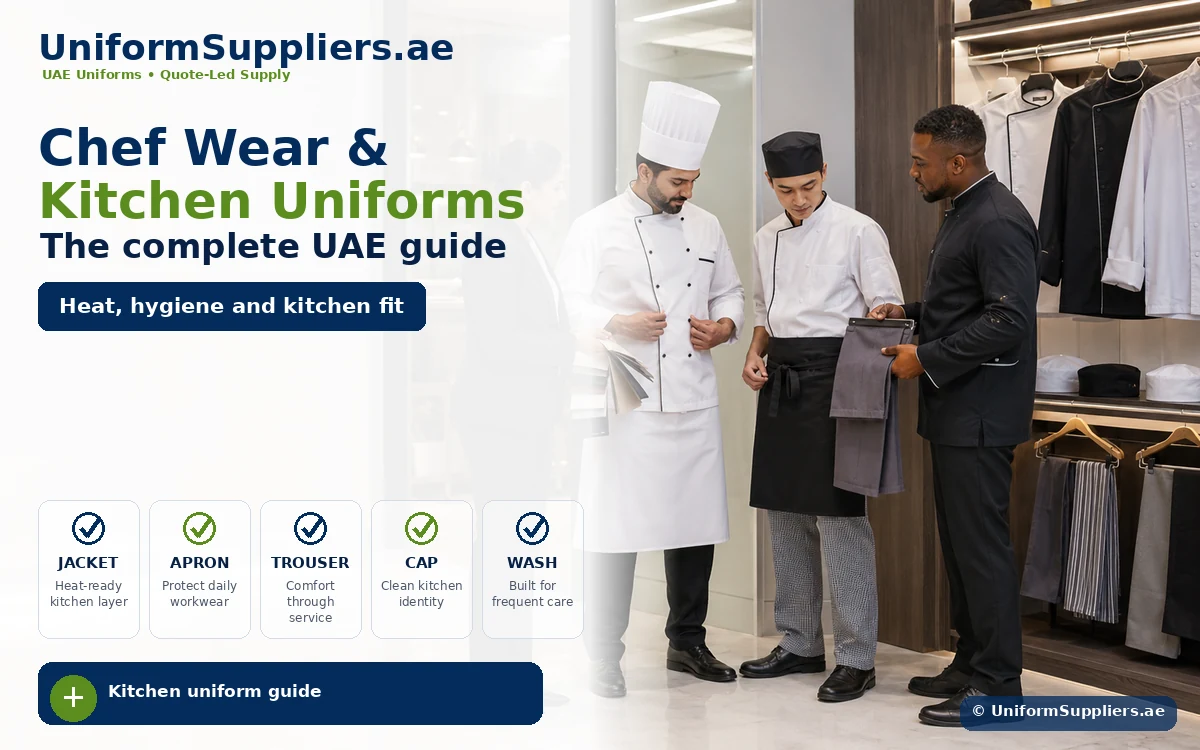
A chef’s jacket has to work as protective clothing, as a hygiene control and as a visible rank marker at the same time. In a UAE kitchen it does all of that at high ambient temperature, through a service period that can run for hours without a break.
Most kitchen uniform problems come from treating the jacket as a single item rather than a specification. Fabric weight, closure type, sleeve policy, vent placement and laundry method all change how it performs on the line.
This guide covers chef uniforms UAE kitchens actually use, role by role, with a jacket specification checklist and an honest note on how fibres behave near heat.
What this guide covers
- What kitchen uniforms have to do
- UAE kitchen conditions that change the specification
- Kitchen brigade kit, role by role
- Chef jacket specification guide
- Fabric, fibre and heat risk
- Rank distinction and branding across outlets
- Sizing, sets and laundry load
- Frequently asked questions
- Specifying your kitchen uniform programme
What kitchen uniforms have to do
Kitchen garments carry three jobs. They put a barrier between the body and splash, steam and hot surfaces. They support food safety through clean, coverable, hair-restraining kit. And they signal rank, so a floor manager or a visiting guest can read the brigade at a glance.
Those jobs pull against each other. Maximum coverage is hot; minimum coverage is cooler but exposes forearms. The right answer is set per station, not across the whole kitchen.
Front-of-house service uniforms follow a different brief and are covered in the guide to restaurant staff uniforms. Aprons have their own detailed guide on choosing the right apron, so this article deals with the garments underneath.
UAE kitchen conditions that change the specification
Even with good extraction and air conditioning, a UAE kitchen runs warm. Make-up air arrives hot, deliveries come through warm loading bays, and the gap between a chilled dining room and the pass is wide. Garments that are merely acceptable in a temperate kitchen become uncomfortable here.
Service patterns add to the load. Ramadan iftar and suhoor service, wedding and conference banqueting and peak-season covers all mean long continuous production rather than two short services, so staff need enough sets to change mid-shift.
Commercial laundering is heavy and frequent. Kitchen whites face oil, protein, turmeric, tomato and coffee staining and are washed hot with strong chemistry. That cycle, not normal wear, destroys most jackets, so colourfastness and seam durability matter more than a soft handle.
Brigades are multinational with a wide size spread, and cloud kitchens compress all of this into tighter, hotter rooms with less circulation.
Kitchen brigade kit, role by role
Use the table as a starting specification. It assumes a hotel or multi-outlet operation; a single restaurant can compress several rows into one garment set.
| Role | Core garments | Fabric and weight priority | Heat and safety consideration | Detail that matters |
|---|---|---|---|---|
| Executive chef | Structured jacket, tailored trouser, bib apron | Finer weave, crisp finish, moderate weight | Guest-facing time in warm dining rooms | Embroidered name and title; spare jacket for table visits |
| Sous chef and chef de partie | Long or short-sleeve jacket, chequered trouser, apron | Durable blend, vented back, mid weight | Sustained work at range, grill and pass | Mesh gussets; pen and thermometer pocket on the sleeve |
| Commis and kitchen porter | Simple jacket or work tunic, trouser, waterproof apron | Hard-wearing, high wash tolerance | Wet floors, lifting, heavy pot wash | Colour that survives hot washing; secure closures |
| Pastry | Lighter jacket, white trouser, waist apron | Lighter weight, smooth surface, low lint | Cooler section but ovens, sugar work, steam | Sleeves that stay clean; few external pockets near dough |
| Butchery and prep | Jacket or tunic, heavy apron, cut-resistant items where assessed | Robust fabric, stain-tolerant colour | Cold rooms and sharp tools rather than flame | Layer for chilled work; protective items specified separately |
| Cold kitchen and garde manger | Jacket, trouser, waist apron | Light to mid weight, breathable | Long standing in chilled prep areas | Extra layer available; presentation-standard whites |
| Stewarding | Coloured tunic or polo, trouser, waterproof apron, boots | Quick-drying, chemical-tolerant, not white | Hot water, steam, detergents, wet floors | Visibly different from the cooking brigade |
| Central production or cloud kitchen | Short-sleeve jacket or tunic, trouser, bib apron | Lightest workable weight, maximum breathability | Tight rooms, limited circulation | Simple kit that scales as headcount moves |
Where a fabric, trim or protective item is not yet decided, leave it open in the brief. Final specification will be confirmed during quotation.
Chef jacket specification guide
The jacket is where most decisions concentrate. Work through these points before requesting a quotation.
- Single versus double breasted. The double breast exists for two practical reasons: the overlapping front can be reversed to hide staining during a long service, and the doubled panel puts two layers of fabric across the chest where splash and radiant heat land. Single breasted is lighter, cooler and increasingly common in open and modern kitchens, but it offers neither of those benefits.
- Closures. Cloth knot buttons are traditional, launder well and have no metal to heat up. Removable studs allow the jacket to be laundered without stud damage but are easily lost across a large brigade. Press studs open fast, which matters if a garment has to come off quickly after a spill.
- Sleeve length policy. Long sleeves cover the forearm against splash and radiant heat at the range; short sleeves are cooler and widely preferred in UAE kitchens. Many groups run long sleeves on hot sections and require sleeves down at the pass in guest view. Decide the policy per section, not per person.
- Collar. A mandarin collar sits neatly under an apron and reads as formal, which suits guest-facing and hotel kitchens. A turned or lapel collar is the classic chef white and gives a slightly more relaxed line.
- Vents and mesh panels. Back yoke vents, underarm mesh gussets and side vents move air without exposing skin. Placement matters more than quantity, and mesh should sit where it will not be splashed directly.
- Cuff finish. A plain hemmed cuff is easiest to launder and roll. Elasticated cuffs keep sleeves out of food but trap heat. Avoid loose, flapping cuffs anywhere near open flame.
- Apron pairing. Confirm bib or waist apron per role and check that the apron neck and tie style works with the collar and closure you have chosen.
- Headwear. Skull caps, beanies, traditional toques, bandanas and disposable options all satisfy hair restraint differently. Pick one that the brigade will actually keep on through a full shift, and confirm it against your food safety requirements.
Fabric, fibre and heat risk
This part deserves plain language. Fibres behave differently near flame and hot surfaces. Natural fibres such as cotton tend to char and burn rather than melt. Common synthetics such as polyester can soften, melt and adhere to skin. Blends behave somewhere in between depending on the ratio and construction.
That is a generic property of the fibres, not a claim about any particular garment. No garment supplied as standard kitchen wear should be assumed to be flame-resistant, heat-rated or certified unless the manufacturer’s datasheet says so. If your risk assessment calls for protective performance, specify it in the tender and ask your supplier to confirm it on the datasheet.
For everyday use, most operators choose either a high-cotton fabric for comfort and fibre behaviour or a poly-cotton blend for colour retention and easier commercial laundering. Higher cotton is cooler but shrinks and creases more; higher polyester holds shape and whiteness longer. The guide to fabrics for the UAE climate covers those trade-offs in Gulf conditions.
Rank distinction and branding across outlets
A multi-outlet hotel kitchen needs visual hierarchy that works instantly. The usual method is to hold the jacket constant and vary the signals: collar or piping colour, button colour, apron style and embroidered title. That keeps the garment range small while making rank obvious.
Outlet identity can be carried on the apron rather than the jacket, so one jacket line serves several restaurants. Embroidery is the normal branding method for chef wear because it survives repeated hot washing better than print; the embroidery service page sets out the options for logos and names.
Where a hotel coordinates kitchen and service uniforms together, the hotel uniforms guide is a useful cross-check.
Sizing, sets and laundry load
Kitchen brigades have an unusually wide size spread, and jacket fit is not forgiving: too tight restricts reach at the pass, too loose is a snag risk near equipment. Free onsite individual measurements are available in the UAE for qualifying company uniform orders, and stored specification records mean later replacements need no new fitting.
Set counts should follow soiling, not headcount convenience. Hot-section and stewarding staff need more sets than pastry or cold kitchen because they change mid-shift.
Agree the laundry route before specifying the fabric. Commercial laundering allows a heavier, hotter-washed garment; home laundering needs easier-care fabric and more forgiving colour. Free samples are available against a confirmed LPO, which is the sensible way to test a jacket through your own wash cycle before committing a whole brigade.
Frequently asked questions
Are double-breasted chef jackets still worth it?
They remain useful where the chef is guest-facing or works long single services, because the front can be reversed to hide staining and the doubled panel adds a fabric layer across the chest. In hot, fast production kitchens many operators now prefer single-breasted jackets for airflow. Deciding by section rather than by tradition gives the best result.
Should UAE kitchens use short or long sleeves?
Both, split by section. Long sleeves cover the forearm against splash and radiant heat at the range and grill, and are often required at the pass in guest view. Short sleeves are noticeably cooler for pastry, cold kitchen and cloud-kitchen production. Set the policy per station and specify both in the same order.
Is cotton or polyester better for chef jackets?
Neither is universally better. Cotton is cooler, more absorbent and chars rather than melts near flame, but it shrinks, creases and greys with repeated hot washing. Polyester blends hold colour and shape far longer and suit heavy commercial laundering. Choose by wash route and section risk, and confirm any protective performance on the datasheet.
What colour should stewarding wear?
Something clearly different from the cooking brigade. Stewarding works with hot water, steam and detergents, so white is impractical and visual separation helps supervisors see who is who. A coloured tunic or polo with a waterproof apron and suitable boots is the common arrangement, with the apron as the wipe-clean outer layer.
How many jackets does each chef need?
It depends on the section and the laundry route rather than a single rule. Hot-section chefs who change mid-shift need more than pastry or cold kitchen staff, and Ramadan or banqueting periods raise the requirement temporarily. Set the ratio per section, keep a buffer for new starters, and review after the first peak season.
Can chef whites carry the outlet logo as well as the hotel brand?
Yes, but keep the jacket simple. The usual approach is a single embroidered brand mark and name on the jacket, with outlet identity carried on the apron. That lets one jacket line serve several restaurants and avoids re-embroidering garments when staff move between outlets.
Specifying your kitchen uniform programme
Bring your brigade structure, section list, laundry route and any protective requirements, and the specification can be built section by section rather than as one compromise jacket. The hospitality uniforms pillar and the restaurants and catering page cover the wider programme.
Request a Quote for your kitchen uniform specification, and include your section headcounts so sets can be planned per station.