Special offers: free digital logo mock-up and free samples against a confirmed LPO. View offers


Work Trousers and Cargo Pants: A Practical Comparison

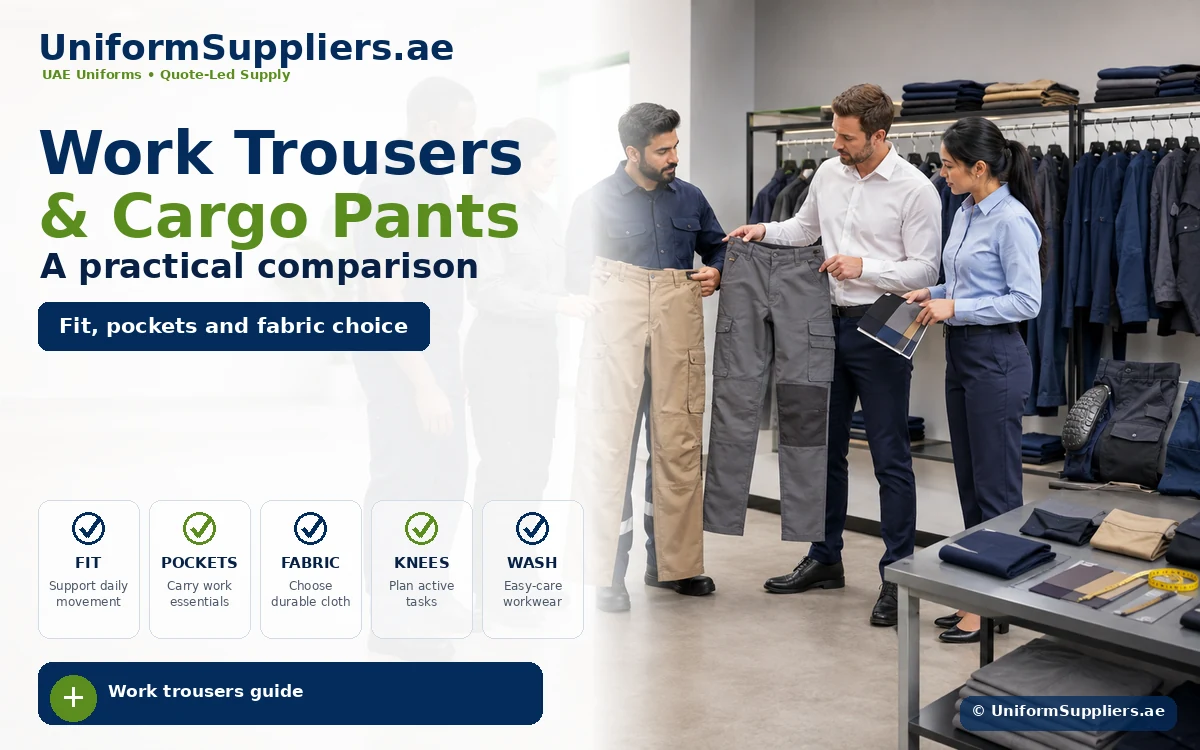
Work trousers and cargo pants both turn up on UAE industrial and trade tenders, often listed as if they were interchangeable. They are not. Each shape trades pocket capacity against a closer, cooler fit, and getting that trade-off wrong shows up as tools dropped on site or trousers that fail at the knee months before the rest of the uniform is due for replacement.
Procurement teams buying for a mixed trade workforce — electricians, riggers, cleaners, drivers, technicians — rarely need one trouser style across the board. The right approach is to match the cut to the role, then specify fabric weight and reinforcement to the actual wear pattern rather than to habit. This guide compares the two styles directly: pockets and tool-carrying, fabric weight, reinforcement, fit against heat, and which roles suit which style.
What this guide covers
- What counts as a standard work trouser
- What counts as a cargo-style trouser
- Comparison table: work trousers vs cargo pants
- Pocket configuration and tool-carrying needs by role
- Fabric weight and durability trade-offs
- Reinforcement points: knees and seat
- Fit for movement vs fit for heat
- Which UAE roles suit which style
- Care and hot-laundering durability
- Mustang recommendation
- Frequently asked questions
- Specifying trousers in your next quotation
What counts as a standard work trouser
A standard work trouser is cut closer to the body than a cargo style, with a conventional front and rear pocket layout plus one or two utility pockets — typically a rule pocket on the thigh and a phone pocket on the hip. It suits roles where a clean line matters, where the wearer moves in and out of vehicles or client-facing areas, or where loose fabric near moving machinery is itself a hazard, and it generally uses less fabric, which improves how the garment breathes.
What counts as a cargo-style trouser
A cargo trouser adds bellowed patch pockets on the outer thigh, usually with a flap and a hook-and-loop or button closure, on top of the standard front and rear pockets. Some styles add a secondary tool loop or a smaller utility pocket set into the main cargo pocket. The extra pockets carry real weight and bulk, which is exactly the point for a role that needs tools, fixings or a handheld device on the body rather than in a bag — at the cost of a looser leg, more fabric surface, and more places for dust and heat to sit against the skin.
Comparison table: work trousers vs cargo pants
The table below sets out the practical differences to weigh before specifying a style for a given role.
| Criterion | Standard work trousers | Cargo-style trousers |
|---|---|---|
| Pocket count | Front and rear pockets plus one or two utility pockets | Front and rear pockets plus two large thigh cargo pockets and often extra tool loops |
| Typical fabric weight | Lighter to mid-weight, closer to shirt-adjacent workwear ranges | Mid to heavier weight, since bellowed pockets need body to hold shape when loaded |
| Mobility | Closer fit; less fabric to catch on ladders, machinery or vehicle door frames | Looser through the leg; more fabric movement, more surface to snag on projections |
| Heat and airflow | Generally cooler; less fabric layering against the leg, especially at the thigh | Warmer at the thigh where cargo pockets sit; airflow reduced where pockets are loaded |
| Tool-carrying capacity | Limited; suited to a phone, a small rule or a notepad | High; suited to hand tools, fixings, a two-way radio, gloves or a tablet |
| Best-suited roles | Drivers, front-of-house facilities staff, supervisors, cleaner-cut technical roles | Electricians, riggers, maintenance technicians, HVAC and plumbing trades |
| Durability under abrasion | Wears evenly if fabric weight matches the task; fewer stress points | Pocket flaps, stitching and closures are additional wear and failure points |
| Reinforcement need | Standard knee and seat reinforcement usually sufficient | Knee, seat and pocket-edge reinforcement all matter under load |
Pocket configuration and tool-carrying needs by role
Pocket layout should follow what a role actually carries during a shift, not a general preference for “more pockets.” A technician who terminates cable through the day genuinely needs a rule pocket, a phone pocket, a pen slot and a cargo pocket for pliers or a tester. A driver moving between the vehicle and a reception desk needs almost none of that, and a bulky pocket layout there just adds bulk and catches on seatbelts and door frames.
Cleaner-cut roles — supervisors, facilities coordinators, drivers, retail-adjacent site staff — are usually better served by a standard trouser with one or two discreet utility pockets. Trade and maintenance roles carrying hand tools, fixings or a radio through the shift are better served by a cargo cut, provided the loaded pockets do not throw off balance on ladders or scaffolding. List, per role, what is actually carried during a typical shift, then match pocket count to that list rather than defaulting every trade role to cargo by habit.
Fabric weight and durability trade-offs
Fabric weight, measured in GSM, is the main lever for balancing durability against heat. A lighter fabric breathes better and dries faster after a hot wash but wears through sooner under abrasion from kneeling or crawling under plant. A heavier fabric resists abrasion longer but retains more heat and takes longer to dry between shifts.
Cargo trousers generally need a slightly heavier or more structured fabric than standard work trousers, since loaded bellowed pockets pull on the seam and need body to keep their shape rather than sagging. The practical guidance for both styles is to specify fabric weight and composition on the datasheet rather than buying on appearance — see the fuller explainer on fabric GSM for UAE workwear for how weight interacts with heat and wear.
Reinforcement points: knees and seat
Knees and seat are the two areas that fail first on most trade and industrial trousers, regardless of style. Kneeling to work under a sink, on flooring, or inside plant wears the knee fabric long before the rest of the garment is due for replacement, and a seat that sits against a vehicle seat or scaffold plank all shift wears in the same predictable way. Double-layer knee panels, bar-tacked stress points and a reinforced seat panel extend garment life for roles that kneel, crawl or sit for long periods; some styles also take a knee-pad pocket, worth specifying for sustained floor-level work such as flooring or cabling. On a cargo trouser, pocket edges and closures are an additional stress point worth reinforcing, since a loaded pocket flexes with every stride.
Fit for movement vs fit for heat
Fit is a genuine trade-off, not just a style choice. A looser cargo cut allows a wider range of movement — reaching, climbing, crouching with a loaded belt — but the extra fabric traps more heat against the leg and can catch on protrusions in confined spaces such as risers, plant rooms or scaffolding. A closer-fitting standard trouser moves less fabric with each step, improving airflow and reducing snag risk, but restricts how far a wearer can crouch or stretch if the cut is not generous through the seat and knee.
From May to September, when outdoor and semi-outdoor site temperatures climb for sustained periods, the airflow difference between the two cuts is not cosmetic. A role spending most of the shift outdoors in direct heat benefits from the lighter, closer cut wherever the tool-carrying need allows it; a role working indoors in conditioned space with heavy tool demands can absorb the heat cost of a cargo cut more comfortably.
Which UAE roles suit which style
As a rule, tool-heavy trades — electricians, HVAC technicians, plumbers, riggers, general maintenance — suit a cargo-style trouser, provided fabric weight and reinforcement match the task. Cleaner-cut or driving-heavy roles — supervisors, warehouse coordinators, front-of-house technical staff — suit a standard trouser, which cuts bulk, heat and snag risk without losing anything the role needs. Mixed-duty workforces are common on UAE sites, and it is reasonable to issue both styles rather than forcing a single cut across a diverse trade team.
Care and hot-laundering durability
Gulf laundering frequency is higher than in temperate markets, and heat plus sweat plus dust accelerates wear on both styles. Cargo pockets add more seams, closures and stitched edges, additional points where repeated high-temperature washing can loosen thread or distort shape over time. Colourfastness and dimensional stability matter for both styles, but are worth checking specifically on cargo pocket flaps and hook-and-loop closures, which see more mechanical stress in a commercial wash cycle than a flat panel does. Ask your supplier to confirm wash-cycle durability on the datasheet before committing to volume, and inspect knees, seat and pocket stitching on a set schedule rather than waiting for visible failure.
Mustang recommendation
Build the trouser specification role by role: list what each role carries during a shift, choose the matching cut, and set fabric weight and reinforcement against the task rather than a single house standard.
Uniform Suppliers UAE, the uniform brand of Mustang Advertising Trading LLC, has supplied industrial workwear from Dubai since October 2007, with both custom uniform manufacturing and ready-stock supply available in one programme so urgent cover and made-to-specification production can run together. Free onsite individual measurement is available for qualifying UAE company uniform orders, and repeat-order specifications are stored so reorders match without re-briefing.
Frequently asked questions
Are cargo pants more durable than standard work trousers?
Not automatically. Cargo trousers add pocket panels, flaps and closures, which are additional stress points that can fail before the main fabric does. Durability depends more on fabric weight and reinforcement at the knee and seat than on the style itself, so specify these details rather than assuming cargo means tougher.
Do cargo pants make workers hotter in UAE summer conditions?
Generally yes, at the thigh, where the extra pocket layers reduce airflow. The effect is more noticeable outdoors in direct heat than in conditioned indoor space. For roles spending most of the shift outdoors with limited tool-carrying need, a standard trouser is usually the more comfortable choice.
Which roles genuinely need cargo-style pockets?
Roles that carry multiple hand tools, fixings, testers or a radio on the body through the shift — electricians, HVAC and plumbing trades, riggers, general maintenance — get the most practical benefit. Roles with light or no on-body carrying needs rarely need the extra bulk.
What fabric weight should we specify for industrial work trousers?
It depends on the task and season, and there is no single correct figure for every role. State the intended use and laundering frequency to your supplier and ask for a recommended GSM range on the datasheet, then weigh it against the guidance in our fabric GSM explainer.
Can knee and seat reinforcement be added to an existing trouser design?
Reinforcement is normally built into the pattern at the manufacturing stage — double-layer knee panels and a reinforced seat are cutting and construction decisions, not an add-on. Specify reinforcement requirements before production starts, and confirm them on the sample before bulk manufacture.
Should a workforce standardise on one trouser style?
Only if the roles are genuinely similar in tool-carrying need and working environment. Mixed trade workforces usually perform better with two specified styles — a cargo cut for tool-heavy roles and a standard cut for cleaner-cut roles — matched deliberately rather than defaulting everyone to one design.
Specifying trousers in your next quotation
Bring a role-by-role list of what each team member carries during a shift, along with the working environment, and both styles can be quoted and sampled against real requirements rather than a generic description.
Request a quote for work trousers or cargo-style trousers across your team. See also the wider industrial uniforms and safety workwear pillar and our guide to industrial workwear in the UAE, mapped by hazard, for how trousers fit into a full role-based kit.