Special offers: free digital logo mock-up and free samples against a confirmed LPO. View offers


Safety Footwear Comparison for UAE Worksites

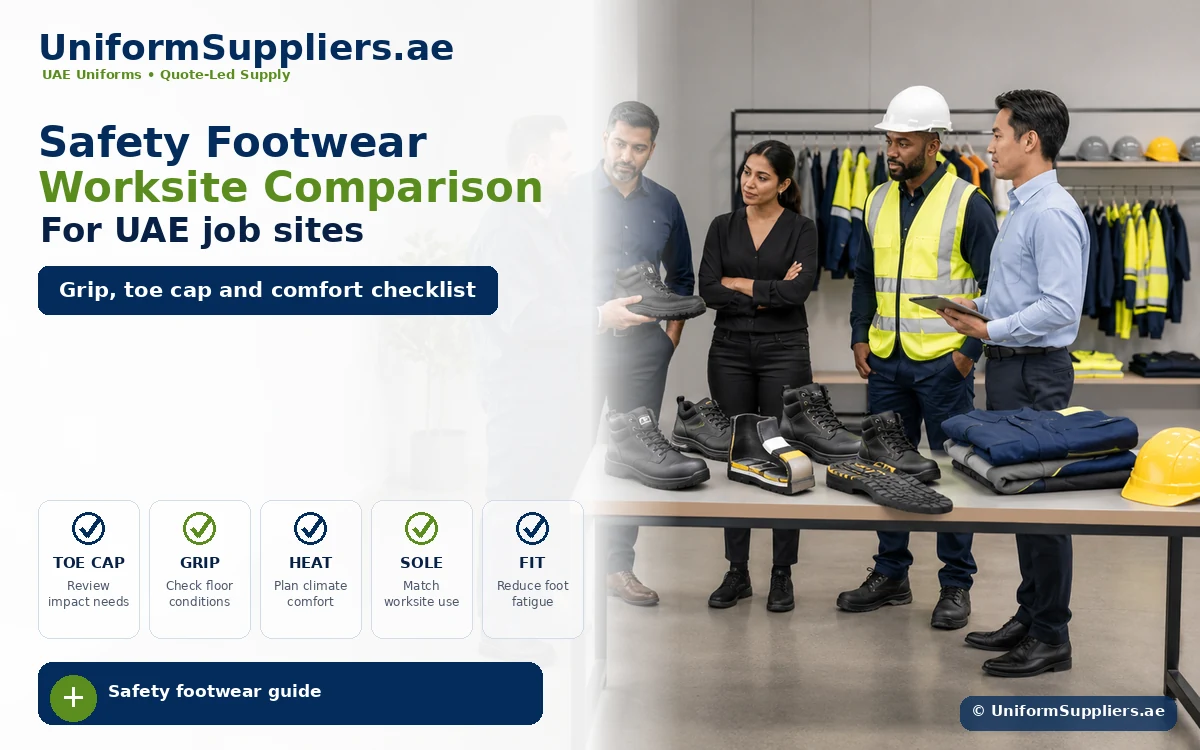
Safety footwear is the item of PPE that workers wear longest each day, and on UAE sites it has to cope with hot ground, dust, long shifts and a wide range of foot shapes. Choosing by appearance or habit usually ends in complaints, early replacement or boots left in lockers.
This safety footwear comparison sets the main footwear types side by side, then matches them to common work environments. If you need the step-by-step selection process first, read choosing safety shoes and boots for UAE worksites.
What this guide covers
- Safety footwear types side by side
- Toe caps, midsoles and soles explained
- Heat considerations on UAE sites
- Reading EN ISO 20345 markings
- Safety footwear comparison by work environment
- Fit, sizing and replacement
- Buyer checklist
- Frequently asked questions
Safety footwear types side by side
Safety shoes are lighter and more flexible, suiting lighter-duty and indoor roles. Safety boots give more support and protection for heavy-duty and outdoor sites. Within those two families, buyers usually compare five styles.
| Type | Strengths | Limits | Often shortlisted for |
|---|---|---|---|
| Low-cut safety shoe | Light, flexible, cooler around the ankle, easy to walk and drive in | No ankle coverage; debris can enter at the collar | Warehousing, light manufacturing, supervisors, indoor maintenance |
| Ankle boot | Ankle coverage and support, secure lacing, widely accepted on sites | Warmer and heavier than a shoe; slower to put on | Construction, civil works, general industrial sites |
| High-leg or rigger-style boot | Covers the lower leg, keeps out sand and splashes; pull-on designs suit frequent removal | Heavier and warmer; pull-on styles fit more loosely at the ankle | Oil and gas, heavy plant, wet or muddy ground |
| Slip-on shoe or boot | No laces to catch or contaminate, quick to change, easy to wipe clean | Less adjustable for narrow or wide feet | Kitchens, back-of-house, cleaning and facilities teams |
| Lightweight composite trainer style | Low weight, sporty feel, non-metallic components, comfortable over long walking distances | Mesh or textile uppers are less suited to liquids, sparks and rough ground | Logistics, order picking, light assembly, inspection roles |
Browse the ranges under safety shoes and safety boots.
Toe caps, midsoles and soles explained
Toe-cap materials
Steel toe caps are the traditional choice: strong, thin and widely available. Aluminium caps reduce weight. Composite caps are non-metallic, so they do not conduct heat the way metal does and do not set off metal detectors, though they are usually bulkier. Whatever the material, the protection level is shown by the marking on the product, not by the material alone.
Midsoles
A penetration-resistant midsole protects against nails and sharp objects underfoot. Steel plates are thin and proven but make the sole stiffer. Non-metallic textile inserts flex more easily and cover more of the footbed.
Outsoles
Polyurethane soles are light and cushioning, which helps on long shifts. Rubber outsoles are heavier but cope better with hot surfaces, oils and abrasion. Tread pattern matters as much as compound: deep cleats suit loose ground, while finer patterns grip better on smooth, wet floors.
Heat considerations on UAE sites
In summer, asphalt, steel decking and concrete become much hotter than the air, so outsole heat resistance deserves a specific question to the supplier. Inside the boot, sweat is the bigger issue. Breathable linings, moisture-managing socks and removable insoles that can be aired all improve comfort over a long shift.
Some employers issue two pairs to outdoor workers so that each pair can dry fully between shifts. Perforated or mesh uppers are cooler, but only suit dry environments without liquid or spark hazards.
Reading EN ISO 20345 markings
EN ISO 20345 is the standard most often referenced for safety footwear with a protective toe cap. Products marked to it carry a category code. In broad terms, SB indicates the basic requirements including toe protection. S1 adds features such as a closed heel, antistatic properties and heel energy absorption. S1P is S1 with a penetration-resistant midsole. S2 adds resistance to water penetration of the upper, and S3 adds a penetration-resistant midsole and a cleated outsole. Additional letters indicate extra properties, for example HRO for an outsole tested against hot contact.
The standard has been revised, so older and newer codes are both in circulation. Treat this summary as buyer education only: check the marking on the actual product, ask the supplier for the supporting documentation, and confirm current site or client requirements with the relevant authority. Final specification will be confirmed during quotation.
Safety footwear comparison by work environment
| Environment | Typical hazards | Types often shortlisted | What to check |
|---|---|---|---|
| Construction | Falling objects, nails and rebar, uneven ground, hot surfaces | Ankle boot; high-leg boot for wet or sandy areas | Penetration-resistant midsole, cleated heat-resistant outsole, ankle support |
| Warehousing and logistics | Pallet and trolley impacts, long walking distances, smooth floors | Low-cut shoe; lightweight composite trainer style | Weight, cushioning, slip resistance on sealed floors |
| Kitchen and hospitality back-of-house | Wet and greasy floors, hot liquids, dropped knives and pans | Slip-on shoe with a closed, wipe-clean upper | Slip resistance, liquid-resistant upper, ease of cleaning |
| Oil and gas | Hydrocarbons, static, heavy equipment, remote hot sites | High-leg or rigger-style boot; ankle boot | Client or operator specification, antistatic properties, oil-resistant outsole |
| Facilities management | Mixed tasks: cleaning, MEP maintenance, landscaping | Low-cut shoe or ankle boot by task; slip-on for cleaning teams | Task-by-task risk assessment, electrical properties for technicians |
For sector context, see our pages for construction and engineering, warehousing and logistics, restaurants and catering, oil, gas and energy and facilities management.
Fit, sizing and replacement
UAE workforces span many nationalities, and foot width and instep height vary as much as length. A boot that is correct on paper but too narrow will not be worn properly. Ask for a try-on size set before confirming sizes, include women’s sizes where relevant, and record each employee’s size for repeat orders.
Replace footwear when the toe cap is exposed or dented, the sole is worn smooth or separating, or the upper is split.
Mustang recommendation: do not issue one model to the whole workforce. Group roles by hazard and ground conditions, shortlist one footwear type per group from the tables above, then trial two or three models with the people who will wear them for a full shift. Footwear can be combined with coveralls, hi-vis clothing and badges in one employee uniform programme, so the complete workforce identity package comes from one supplier.
Buyer checklist
- Take the hazards for each role from the site risk assessment.
- Note any client, main-contractor or operator footwear specification.
- Choose the footwear type per role group, not per company.
- State the marking category required and ask for documentation for the actual product.
- Ask about outsole heat resistance for outdoor summer work.
- Request a try-on size set and collect sizes by employee.
- Agree how worn or damaged pairs are reported and replaced.
Compare options for your site
Tell us the roles, environments and any marking category your site requires, and we will propose suitable footwear alongside your industrial uniforms and safety workwear. Request a quote or contact us to discuss a site requirement. Delivery timelines are confirmed during quotation.
Frequently asked questions
What is the difference between a safety shoe and a safety boot?
A safety shoe is cut below the ankle, so it is lighter and cooler. A safety boot covers the ankle or lower leg, adding support and keeping out debris. Both can carry the same toe protection; the difference is coverage, weight and warmth.
Are composite toe caps as protective as steel?
Protection is defined by the standard the product is tested and marked to, not by the cap material. A composite cap and a steel cap carrying the same marking are intended to meet the same toe-protection requirement. Always check the marking on the actual product.
Which safety footwear is coolest for outdoor summer work?
Low-cut shoes and lighter boots with breathable linings are generally cooler, but the footwear must still match the hazards identified in the risk assessment.
Do kitchen staff need safety footwear?
That depends on the employer’s risk assessment. Many kitchens specify closed, slip-resistant footwear because of wet floors and hot liquids. Employers should confirm current requirements with the relevant authority.
Can footwear be supplied together with our uniforms?
Yes. Safety shoes and boots can be supplied alongside uniforms, safetywear, badges, ID cards and lanyards as one workforce identity package. For wider guidance, read safety workwear and PPE in the UAE.