


Blog
Industrial Workwear in the UAE: A Complete Safety Guide

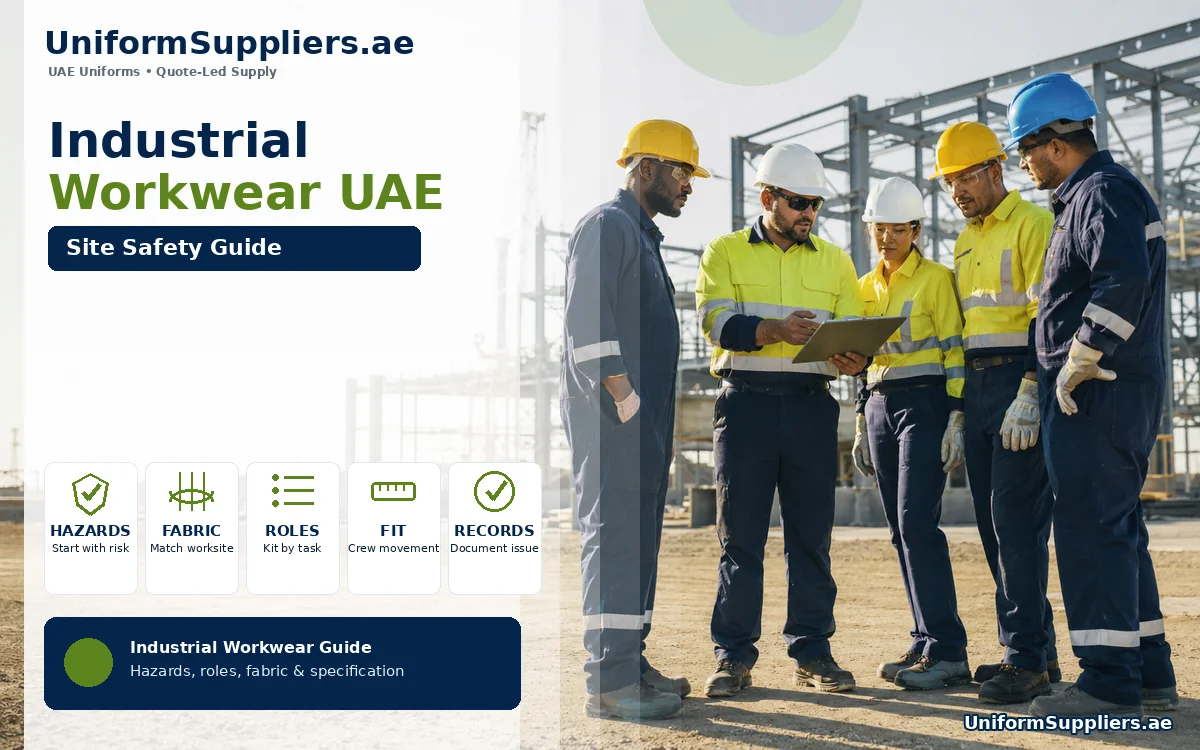
Industrial workwear in the UAE is bought under conditions that most international product catalogues were not written for. Ambient heat runs high for months, dust is constant, shifts are long and outdoors, and a single site can hold several contractors whose crews all need to be told apart at a glance.
That makes hazard-led specification the only reliable way to buy. Choosing a garment because it looks like site clothing produces kit that fails at the point it was needed, or that workers quietly stop wearing because it is unbearable by mid-morning.
This guide maps common UAE site hazards to the garment and fabric response, and sets out what to write on a datasheet and demand from whoever supplies it.
What this guide covers
- What UAE site conditions actually demand
- Hazard-to-garment specification table
- Role-based kit list for a typical UAE site
- What the standards cover, and what to ask for
- Heat, dust and the laundering cycle
- Writing the specification into your tender
- Mustang recommendation
- Getting a specification-led quote
- Frequently asked questions
What UAE site conditions actually demand
Four local realities drive most workwear decisions here. The first is thermal load: from May to September, solar radiation and humidity turn a heavy garment into a genuine hazard rather than an inconvenience, so heat strain has to be weighed against every other protective property.
The second is dust. Fine airborne particulate works into seams, closures and reflective tape, dulling retroreflective performance and shortening fastener life far faster than in temperate climates.
The third is workforce mix. Crews are multinational, so sizing conventions, language and prior training all vary. Kit that relies on the wearer interpreting a label correctly will be worn incorrectly.
The fourth is site complexity. Where main contractors, subcontractors and inspectors share one footprint, garment colour and marking become an identification system rather than decoration. Agreeing that scheme early avoids remarking an entire fleet later.
Hazard-to-garment specification table
Work through this table hazard by hazard for each area of your site, then carry the wording in column four straight into your enquiry or tender. Every protective property listed is something to specify and verify against supplier documentation, not something to assume.
| Site hazard | Garment response | Fabric direction | What to specify on the datasheet | Common specification mistake |
|---|---|---|---|---|
| General mechanical wear and abrasion | Robust coverall, work trouser or two-piece with reinforced knees, seat and elbows | Mid to heavier weight polyester-cotton or cotton-rich twill; triple-stitched stress seams | Fabric weight in GSM, weave, seam construction, stitch density, closure type | Buying on colour and cut alone, with no stated fabric weight or seam specification |
| Low visibility and vehicle movement | High-visibility vest, shirt, coverall or trouser with retroreflective banding | Fluorescent background material plus certified retroreflective tape; breathable base for outdoor wear | The high-visibility class required for the task, background colour, tape width and layout, and test evidence to EN ISO 20471 | Specifying “hi-vis” with no class, so a class 1 vest is supplied for a class 3 roadside task |
| Heat and solar exposure | Long-sleeve lightweight shirt or coverall, brimmed or neck-shaded headwear, breathable layering | Lighter-weight breathable weave with moisture management; light colours where no other requirement conflicts | Fabric weight, air permeability or breathability data, colourfastness to light and washing | Ordering short sleeves to fight the heat, then losing sun coverage and cut protection |
| Sparks and hot work | Flame-resistant coverall or jacket and trouser, plus appropriate gloves and face protection | Inherently flame-resistant or treated fabric; no exposed meltable synthetic in the outer layer | Test evidence to EN ISO 11612 with the exact performance codes, whether protection is inherent or treated, and the wash cycles it survives | Assuming any cotton coverall is safe near hot work, or ignoring the wash-durability limit of a treated finish |
| Chemical splash | Chemical-protective coverall of the correct type, worn over or instead of standard workwear | Barrier fabric matched to the specific substance; taped seams where the type demands it | The chemical protective type required, seam construction, and permeation or penetration data for your actual substances | Selecting a disposable coverall by appearance without checking it against the substance list |
| Dust and particulate | Close-fitting coverall with covered closures, cuff and ankle control, plus separate respiratory protection | Tight weave that resists dust ingress while keeping breathability; smooth outer surface | Closure design, cuff and collar detail, ease of laundering, colourfastness after repeated washing | Treating dust as a comfort issue and specifying only respiratory kit, leaving garments to carry dust into vehicles and rest areas |
Role-based kit list for a typical UAE site
Once hazards are mapped, translate them into per-role kits so procurement can quantify the order and stores can issue against a list rather than a conversation.
| Role | Typical garment kit | Specification notes |
|---|---|---|
| General labourer | Long-sleeve hi-vis shirt or coverall, work trouser, safety helmet, gloves, safety footwear | Highest turnover role; prioritise breathability, wash durability and a wide standing size range |
| Skilled trade | Two-piece workwear with reinforced knees, task-specific protective layer, tool-friendly pockets | Specify the protective layer against the actual task, not the trade title |
| Plant operator | Hi-vis coverall or two-piece, seat-friendly cut, no loose hanging elements | Check reflective layout is visible while seated, not only while standing |
| Supervisor | Hi-vis shirt or polo, work trouser, distinct colour or marking | Colour coding should be agreed with the main contractor before production |
| HSE officer | Hi-vis top in a reserved colour, clear role marking front and back, weather layer | Must be identifiable at distance and in low light from any direction |
| Visiting engineer or client | Hi-vis vest, helmet, eye protection, safety footwear, held as clean visitor stock | Hold a buffer in common sizes and a simple return and cleaning routine |
What the standards cover, and what to ask for
Two standards come up constantly in UAE tenders. EN ISO 20471 covers high-visibility clothing for professional use, setting minimum areas of fluorescent background and retroreflective material and grouping garments into classes; higher classes mean more visible material for higher-risk situations such as road and heavy plant environments.
EN ISO 11612 covers protective clothing against heat and flame, using letter codes for different exposures such as limited flame spread, convective heat, radiant heat and molten metal splash. A garment referenced against it should carry the specific codes, not simply the standard number.
The buyer’s job is to require documentation rather than accept description. Ask any supplier, for any garment, to provide the test report or certificate reference for the specific fabric and construction being offered, confirm whether protective performance is inherent or a treatment, and state how many wash cycles the claimed performance survives.
Standards, classes and codes must appear in your enquiry. Uniform Suppliers UAE supplies PPE and safetywear as part of wider industrial uniform programmes; where a certified protective property is required, state the standard and class in your tender so it can be addressed at quotation stage. Final specification will be confirmed during quotation.
Heat, dust and the laundering cycle
Thermal comfort is a compliance issue, not a luxury. Workwear that is too heavy for the season is removed, unfastened or left open, and the protection specified on paper stops existing. Where a hazard requires a heavier or treated fabric, plan the work around it — rotation, shade, hydration and scheduling — rather than downgrading the garment.
Fabric weight is the lever most buyers reach for first. Lighter weights improve airflow and drying but wear out sooner under abrasion, so the choice is a trade-off to be made per role. Our explainer on fabric GSM for UAE workwear covers how weight interacts with durability.
Laundering is the other half of the calculation. Gulf sites wash workwear frequently, and dust, sweat and soiling shorten garment life. Specify colourfastness and dimensional stability after repeated industrial washing, and set a replacement cycle per role rather than replacing garments only when a supervisor complains. High-visibility items lose performance as tape degrades and fluorescent colour fades.
Writing the specification into your tender
- List hazards by work area, not by job title, then attach garments to hazards.
- State fabric weight, composition, weave and seam construction for every line item.
- Where protection is required, name the standard, the class or code, and the documentation you expect with the offer.
- Give the colour scheme and marking layout, including subcontractor differentiation.
- Specify the size range and how sizes will be captured, including onsite measurement.
- Include the replacement cycle and how single-garment reorders will be handled.
- Ask for a sample of each protective line before bulk supply.
Employer duties, the summer working-hours rules and general site PPE obligations sit outside this guide; see our note on safety workwear and PPE in the UAE and, for footwear, choosing safety shoes and boots.
Mustang recommendation
Build one specification sheet per role and keep it as a controlled document. It should carry the hazard, the garment, the fabric detail, the required standard and class, the colour and marking, the size range and the replacement cycle. Every enquiry, LPO and reorder then references the same sheet, which removes the drift that occurs when three buyers order the same item three ways.
Uniform Suppliers UAE, part of Mustang Advertising Trading LLC and operating in Dubai since October 2007, supplies PPE, safetywear and industrial uniforms alongside custom manufacturing, embroidery and printing, and stores specification records so repeat orders match the original. Certified protective performance is always specified by the buyer and confirmed against supplier documentation at quotation.
Getting a specification-led quote
The fastest route to a useful quotation is a hazard list and a role list. With those, garments, fabrics, marking and quantities can be priced against something concrete instead of a generic product description.
Request a quote with your hazard and role list attached. See also our pages for construction and engineering and oil, gas and energy, or set up a standing employee uniform programme for replacement cycles.
Frequently asked questions
What is the most common mistake when buying industrial workwear in the UAE?
Specifying by product name rather than by hazard. A tender that asks for coveralls and hi-vis vests without stating fabric weight, class or test documentation invites offers that are not comparable. Listing the hazard, the required performance and the evidence expected produces quotations you can evaluate side by side.
How do I know which high-visibility class a role needs?
Class relates to the amount of fluorescent and retroreflective material and the risk of the situation, with higher classes intended for higher-speed traffic and heavy plant environments. Assess each work area for vehicle movement, speed and lighting, decide the class, then require documented evidence that the offered garment meets it.
Can lightweight workwear be used in UAE summer conditions?
Often yes, provided no hazard requires otherwise. Lighter, breathable fabrics reduce heat strain and dry faster, which improves the chance that garments are worn correctly all shift. Where a hazard demands a heavier or treated fabric, manage exposure through scheduling, shade and rotation rather than substituting a lighter unprotective garment.
How often should industrial workwear be replaced?
Set a cycle per role based on soiling, abrasion and washing frequency, and inspect regularly rather than waiting for failure. High-visibility garments need closer attention because faded fluorescent fabric and abraded reflective tape lose performance while the garment still looks serviceable. Record replacements against employee and role.
What documentation should a workwear supplier provide?
For any protective claim, ask for the test report or certificate reference covering the exact fabric and construction offered, the performance codes or class achieved, whether protection is inherent or applied, and the wash durability of that performance. Also request care instructions and a written specification sheet for your records.