Special offers: free digital logo mock-up and free samples against a confirmed LPO. View offers
Corporate Workwear Trends for UAE Businesses

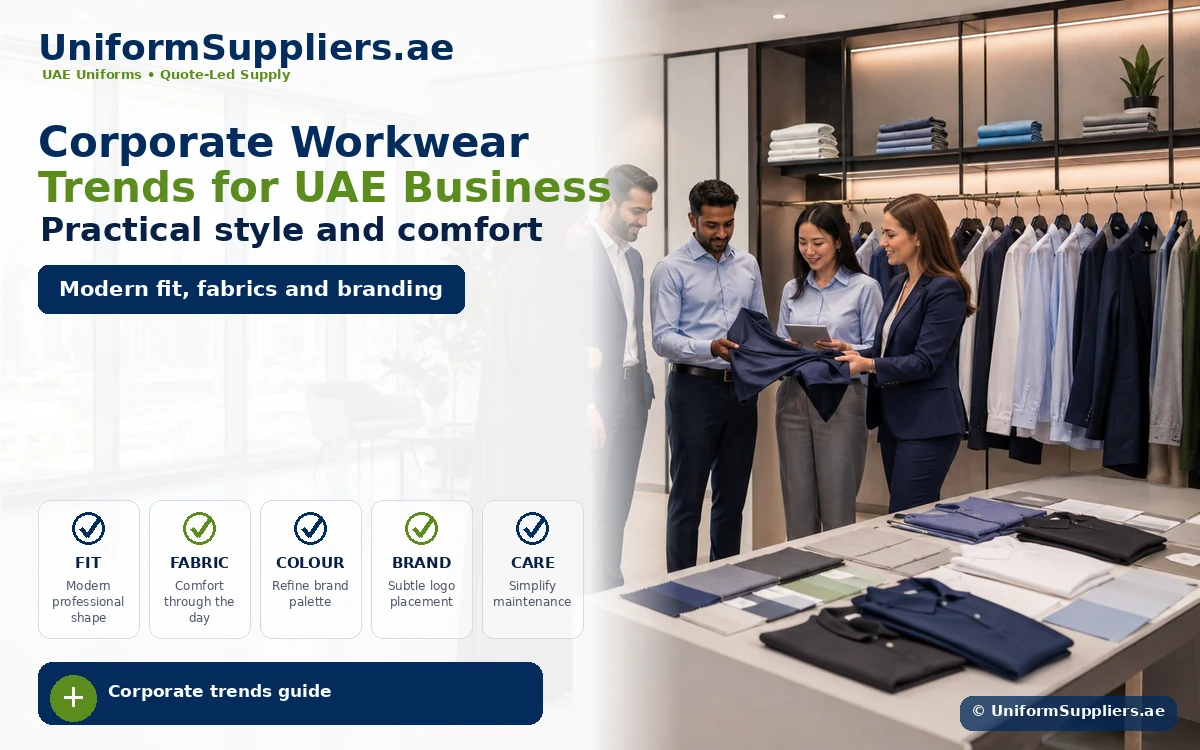
Corporate dressing in the UAE has always had to work harder than in most markets. A single team can move between a chilled Dubai office tower, a client meeting across town in 40°C heat, and a site visit in between — often within the same working day. What counts as “smart” workwear here has quietly shifted over the past few years, and the change is practical rather than fashionable.
None of this is about chasing a look. It is about fabric behaviour, cut, colour and how strictly a uniform policy is actually enforced day to day. For a procurement manager or HR lead planning the next uniform order, the useful question is not “what’s trending” but “which of these shifts will change what we specify.”
This guide walks through the genuine, observable changes in UAE corporate workwear and what each one means for your next order.
What this guide covers
- The move toward smart-casual and performance-blend fabrics
- More gender-inclusive cut options
- Interest in lower-maintenance, easy-care fabrics
- Colour and branding choices for multinational offices
- How hybrid and flexible work is changing uniform enforcement
- Fabric innovation as a market trend, not a certification
- What’s changing and why it matters for your next order
- Frequently asked questions
The move toward smart-casual and performance-blend fabrics
The clearest shift in UAE corporate dressing is away from stiff, fully-lined tailoring toward smart-casual pieces built from performance-blend fabrics: cotton-polyester and cotton-elastane mixes that hold their shape without the rigidity of traditional suiting. Businesses with staff who move between air-conditioned interiors and outdoor heat are the main driver — a blazer or shirt that copes with that swing in temperature is simply more practical than one built for a single climate.
This does not mean formality has disappeared. Corporate offices in Dubai and Abu Dhabi still expect a polished, structured look for client-facing roles. What has changed is the construction underneath — softer interfacing, a touch of stretch in the weave, and lighter-weight linings that reduce the “AC-to-heat shock” staff feel when they step outside. Ask your supplier to confirm fabric weight and composition on the product datasheet before you commit to a bulk order.
The practical test many procurement teams now apply is simple: can a staff member wear the piece comfortably from a chilled lobby, through a car park in August heat, and into an outdoor site visit without needing to change? Fabrics with a small percentage of stretch fibre and a mid-range GSM tend to handle that swing better than heavier, fully-structured traditional suiting. This is one of the more useful questions to raise with a supplier at the sampling stage, before quantities are locked in.
More gender-inclusive cut options
UAE workplaces are increasingly multinational and mixed-gender at every level, and uniform specifications are starting to reflect that. Rather than a single “male” and “female” cut, more organisations are asking for a shared style built in multiple fit blocks — straighter or more tailored through the waist, adjustable rise on trousers, and shirt collars sized independently of sleeve length.
The practical driver is fewer alteration requests and fewer garments returned after the first fitting. When a uniform programme is being planned for a diverse workforce, it is worth asking your supplier to offer more than two fit options at the specification stage, rather than adding them later as a costly correction.
Interest in lower-maintenance, easy-care fabrics
Busy front-of-house and office teams increasingly want uniforms that survive a Gulf laundering routine without daily ironing. Wrinkle-resistant weaves and easy-care finishes are being requested more often for shirts, blouses and trousers, particularly where staff wash and press their own uniforms between shifts rather than sending them to a central laundry.
This is a genuine, sensible ask rather than a marketing add-on. Easy-care fabric reduces the time staff spend maintaining their uniform and helps garments look presentable for longer between washes — a real consideration in a climate where staff may need to launder uniforms two or three times a week. Final specification of any easy-care finish will be confirmed during quotation, as options vary by garment and fabric base.
Colour and branding choices for multinational offices
Colour choices in UAE corporate uniforms are trending toward palettes that read cleanly across a genuinely multinational office — deep neutrals, navy, charcoal and muted brand tones rather than bright, single-market colour statements. The logic is simple: a colour that photographs well in marketing material, reads professionally to visiting clients from different regions, and does not clash with a lobby or branded interior is doing several jobs at once.
Branding placement is also getting more deliberate. Rather than a large chest logo on every garment, many businesses are specifying a smaller, consistent mark — left chest embroidery on shirts and blazers, with heavier branding reserved for outerwear or event pieces. This keeps the everyday look understated while still being identifiably on-brand.
How hybrid and flexible work is changing uniform enforcement
Hybrid and flexible working patterns have changed how strictly some UAE sectors enforce daily uniform wear. In sectors with heavy client contact — banking, real estate, professional services — many businesses still expect uniform or dress-code compliance on any day staff are in the office or meeting clients. In back-office or hybrid-heavy teams, some organisations have moved to a lighter model: a smaller set of core uniform pieces plus an occasional “brand day,” where the full uniform or a branded polo is worn for team events, client visits or company-wide occasions.
This shift has a direct sizing implication. A team ordering a smaller core wardrobe plus occasional branded pieces needs a different quantity plan than one ordering a full five-day uniform set per employee. It is worth deciding which model fits your organisation before finalising quantities, since the two approaches lead to noticeably different order sizes and reorder cycles.
Neither approach is inherently better — the right choice depends on how often your team is genuinely client-facing. A professional services firm with daily client meetings usually still benefits from a full, consistent uniform. A software or back-office team that works mostly from home with occasional office days may get more value from a smaller core set and a well-made branded polo for the days that matter. Reviewing your team’s actual working pattern, rather than assuming last year’s policy still fits, is the useful first step before reordering.
Where uniform policy is being loosened for hybrid staff, it is worth keeping enforcement consistent for any genuinely client-facing or safety-relevant roles — reception, site supervision and similar positions typically still need daily compliance regardless of how the rest of the office dresses.
Fabric innovation as a market trend, not a certification
Fabric innovation — recycled-content blends, lower-impact dyeing processes, more durable easy-care finishes — is a genuine, ongoing trend across the global workwear market, and UAE buyers are increasingly asking suppliers about it. It is worth treating this as a market direction to discuss during quotation rather than a fixed specification, since fabric options and their availability change from supplier to supplier and season to season.
If sustainability credentials matter to your organisation, the practical approach is to ask your supplier to confirm the specific fabric composition, origin and any relevant certification on the product datasheet at quotation stage, rather than assuming a general “sustainable” label covers a specific standard. This keeps procurement records accurate and avoids relying on claims that cannot be verified against a datasheet.
What’s changing and why it matters for your next order
The table below maps each trend to a practical buying implication — useful as a quick reference when you sit down to write your next uniform specification or LPO.
| Trend | What it looks like | Practical implication for your order |
|---|---|---|
| Smart-casual, performance-blend fabrics | Softer tailoring, stretch-woven shirts, lighter linings | Ask for fabric weight and composition on the datasheet; consider a sample before bulk order |
| Gender-inclusive cuts | Multiple fit blocks per style, adjustable details | Specify fit options at the brief stage, not after fittings |
| Easy-care, low-maintenance fabrics | Wrinkle-resistant weaves, easy-press finishes | Useful where staff self-launder; confirm finish during quotation |
| Multinational-friendly colour and branding | Neutral palettes, smaller consistent branding placement | Match colour to lobby/interior branding before ordering |
| Hybrid-influenced enforcement | Core wardrobe plus occasional “brand day” pieces | Decide your uniform model before setting order quantities |
Mustang recommendation: before finalising a corporate uniform order, request a free digital logo mock-up and confirm fabric composition on the datasheet. This lets you sense-check colour, branding placement and fabric choice together before committing to a full run.
For a full walkthrough of how to translate your brand identity into garment choices, see our guide on how to choose corporate uniforms that reflect your brand, and for tailored jackets and suiting specifically, see our UAE sourcing guide to corporate blazers and suits.
If your organisation is planning a wider refresh, our corporate uniforms UAE page covers the full range of options, and our custom uniform manufacturing service can build any of the fabric or fit combinations discussed above to your specification.
Frequently asked questions
Are these trends relevant to smaller UAE businesses, or only large corporates?
They apply to businesses of any size. A ten-person office benefits from easy-care fabrics and a sensible colour choice just as much as a large multinational — the difference is usually order volume, not the underlying fabric or fit decisions. Smaller teams can request the same fabric and fit options as larger programmes.
Do performance-blend fabrics cost more than traditional suiting fabric?
Fabric cost varies by composition, weight and finish, so it depends on the specific blend chosen. Final specification and cost will be confirmed during quotation once you have decided which fabric properties matter most for your team — breathability, stretch, or easy-care finish.
How do we decide between a full daily uniform and a “brand day” approach?
Consider how often staff meet clients or appear in public-facing roles. Client-facing and reception teams generally still benefit from daily uniform consistency, while hybrid back-office teams may only need a smaller core set plus branded pieces for specific occasions. Map your team’s working pattern before setting quantities.
Can we order gender-inclusive cuts without redesigning our whole uniform?
Yes. Additional fit blocks can usually be added to an existing style rather than requiring a full redesign. Discuss the current pattern with your supplier and confirm which additional fits are practical to add during your next reorder.
Is it safe to describe our uniforms as “sustainable” in marketing material?
Only if a specific, verifiable claim backs it up — for example, a confirmed fabric composition or a named certification on the datasheet. A general fabric-innovation trend in the market is not the same as a certified claim about a specific product, so keep any public statement tied to what has actually been confirmed for that garment.
How do we start updating our corporate uniform to reflect these trends?
Begin with a short brief covering your current pain points — fit complaints, ironing time, colour clashes with your branding — and request a quote. A supplier can then recommend fabric and fit adjustments against your existing style rather than starting from a blank page.
Ready to review your team’s uniform against these trends? Request a quote and include your current pain points so the recommendation is specific to your team.