Special offers: free digital logo mock-up and free samples against a confirmed LPO. View offers


Quick Guide: Reading a Uniform Quotation

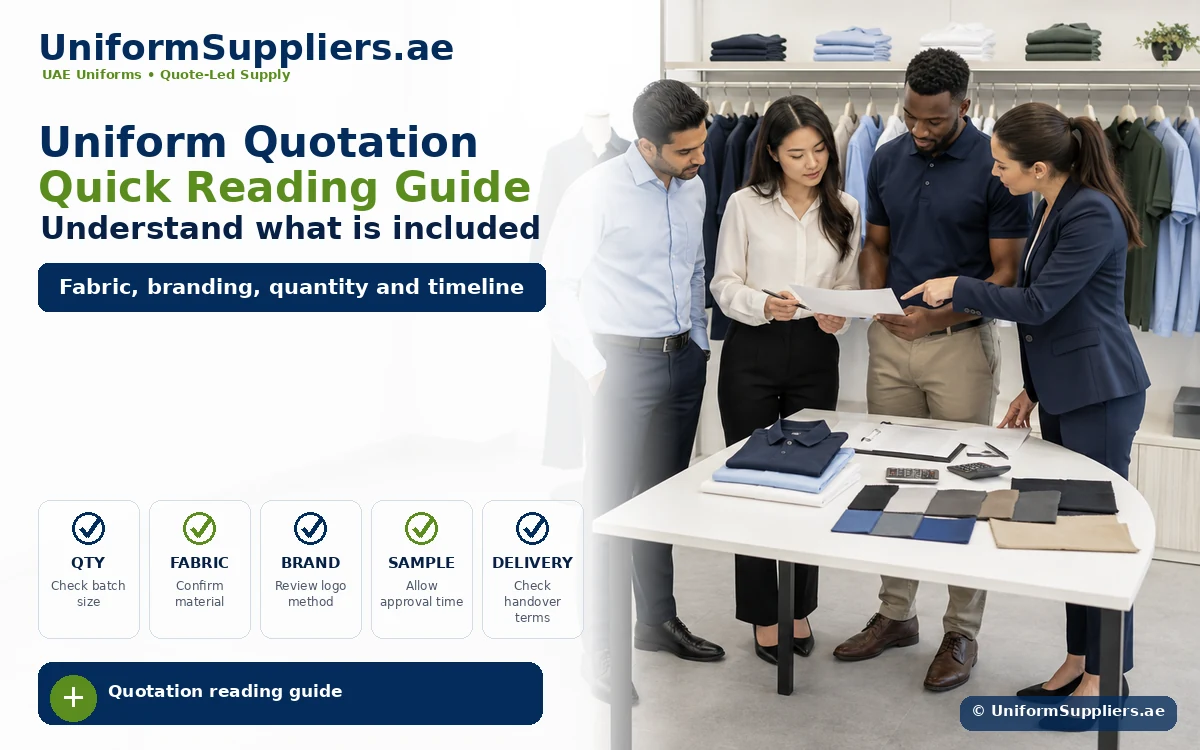
A uniform quotation can look deceptively simple — a single total figure at the bottom of a page — while hiding real differences in what is actually being offered. Two quotations for “50 polo shirts, embroidered” can represent very different fabric weights, embroidery methods, and levels of service, and the only way to tell is to read past the total and into the line items underneath it.
This guide explains what a properly structured uniform quotation should include, how to compare two or more quotations on genuinely equivalent terms, and what to ask if a quotation you receive is too vague to evaluate properly. It does not state specific prices, lead times or minimum order quantities, since these are confirmed for your own order during quotation and vary by garment, fabric and quantity.
What this guide covers
- What a proper quotation should include
- Reading the line items
- Understanding “confirmed during quotation” language
- Comparing quotations on equivalent terms
- If a quotation is too vague to evaluate
- Samples, mock-ups and setup considerations
- Turning a quotation into a purchase order
- What should be on your quotation checklist
- Frequently asked questions
What a proper quotation should include
A well-structured uniform quotation itemises rather than bundles. At minimum, it should identify the garment by name and style reference, the fabric composition and weight, the colour, the sizing range covered, the quantity per size where sizing is already confirmed, and the branding method and placement being quoted. A quotation that simply states “uniforms x50” with a single price gives you nothing to check the eventual delivered garment against.
It should also separate garment cost from branding cost, and separate any one-off setup charge — for example, a digitising charge for a new embroidery file — from the per-unit cost that applies to every future reorder using the same design. Bundling these together makes it harder to understand what a reorder will actually cost once the one-off setup has already been paid.
Reading the line items
Each line item on a proper quotation should be traceable back to a specific decision you made, or a specification your supplier confirmed with you. If a line item does not match anything you discussed — an unfamiliar fabric code, an unexpected quantity, a branding method you did not request — query it before approving, rather than assuming it is a minor administrative detail.
Pay particular attention to quantity breakdowns by size. A quotation that states a total quantity without a size breakdown either assumes a standard size curve that may not match your actual team, or has not yet incorporated your sizing data at all. Confirm which applies before treating the total as final.
Understanding “confirmed during quotation” language
You will often see language such as “final specification will be confirmed during quotation” on a supplier’s website or in early correspondence, rather than a fixed number published upfront. This is normal, not evasive: fabric weight, exact lead time and minimum order quantity genuinely depend on the specific garment, current fabric stock, customisation and the quantity you order, so a single number published for every possible combination would be inaccurate for most actual orders.
What matters is that once you provide your specific requirements — garment, fabric, branding, quantity and sizing — the quotation you receive back should state these details clearly and specifically for your order, not remain vague at the point you are being asked to approve a cost.
Comparing quotations on equivalent terms
Comparing two supplier quotations by total price alone is one of the most common ways buyers end up disappointed with the delivered product. A lower total quotation for what appears to be the same garment often reflects a lighter fabric weight, a cheaper branding method, or a narrower warranty and after-sales support than a higher quotation for the same garment description.
Before comparing totals, line up the fabric composition and weight, the branding method (embroidery versus print, and stitch density or ink type where specified), the sizing range and any included services — free onsite measurement, free samples against a confirmed LPO, a digital logo mock-up — across both quotations. Only once these are genuinely equivalent does comparing the final total become a meaningful exercise rather than a comparison of two different products.
See our companion guide, a procurement manager’s guide to uniform suppliers in the UAE, for the broader supplier evaluation process this quotation comparison sits within.
If a quotation is too vague to evaluate
A quotation that gives you only a total figure, with no fabric, branding or sizing detail behind it, is not ready to approve. Go back to the supplier and ask for the specific line items before making a decision — a supplier confident in their pricing structure should be able to provide this without difficulty.
Our guide on questions to ask a uniform supplier before you buy covers the broader set of questions worth raising at this stage, several of which map directly onto quotation line items — fabric composition, branding method, warranty terms and reorder process among them.
Samples, mock-ups and setup considerations
A quotation should also make clear what happens before bulk production. Free samples are available against a confirmed LPO, and a free digital logo mock-up is normally provided so you can check branding placement before committing to a full run — confirm these are included in the quotation stage rather than assumed. Where a genuinely new custom garment design is involved rather than an existing style, a physical prototype or pattern development step may also be part of the process, and should be reflected in the quotation timeline rather than treated as a hidden extra step.
Any one-off setup charge, such as digitising a new embroidery design, is normally a single charge that does not repeat on future reorders using the same design and specification — worth confirming explicitly if you expect to reorder the same uniform regularly.
Quotations for reorders versus first orders
A reorder quotation should generally be simpler to read than a first-time quotation, since the specification, fabric, branding and sizing curve are already established from the original order. Stored repeat-order specification records exist for exactly this reason — a reorder quotation can reference the original approved specification directly rather than restating every line item from scratch, which also makes it easier to confirm the reorder genuinely matches what was approved previously.
If a reorder quotation looks meaningfully different from the original approved specification — a different fabric code, a changed branding placement — this is worth querying before approval, since it may indicate a supplier-side substitution or simply an administrative error in preparing the new quotation.
Turning a quotation into a purchase order
Once a quotation is approved, it typically becomes the basis for a formal LPO or purchase order, referencing the same line items, quantities and specification agreed in the quotation. Keeping the approved quotation and the resulting LPO aligned — rather than allowing informal changes after approval that are not reflected in either document — avoids disputes later about what was actually agreed.
For organisations with a more structured procurement process, requesting quotations broken down by department, cost centre or project phase from the outset, rather than one consolidated total, makes this LPO stage considerably smoother.
What should be on your quotation checklist
| Item | Why it matters |
|---|---|
| Garment name and style reference | Confirms exactly which product is being quoted |
| Fabric composition and weight | The single biggest driver of quality and comfort differences between quotations |
| Sizing range and quantity breakdown | Confirms the quotation reflects your actual team, not an assumed size curve |
| Branding method and placement | Embroidery and print differ meaningfully in cost, appearance and durability |
| One-off setup charges separated from unit cost | Clarifies what a future reorder will actually cost |
| Included services | Free measurement, free samples against LPO, digital mock-up should be stated, not assumed |
Mustang recommendation: before comparing two quotations by total price, confirm the fabric, branding method, sizing range and included services are genuinely equivalent — a lower total is only meaningful once you know it is describing the same product.
Frequently asked questions
Why don’t uniform suppliers publish fixed prices online?
Fabric weight, branding method, lead time and quantity all affect cost meaningfully, so a single published figure would be inaccurate for most individual orders. A proper quotation reflects your specific requirements instead.
What is the biggest mistake buyers make when comparing quotations?
Comparing total price alone without confirming that fabric, branding method and included services are equivalent between quotations. A lower total quotation often reflects a lighter fabric or a cheaper branding method rather than better value.
Should a quotation include a sizing breakdown?
Yes, once your sizing data is available. A total quantity without a size breakdown either assumes a standard curve or has not yet incorporated your actual team’s sizing.
Are setup charges like embroidery digitising a one-off cost?
Normally yes — a one-off digitising charge does not repeat on future reorders using the same approved design and specification. Confirm this is separated clearly from the per-unit cost on your quotation.
What should we do if a quotation only gives us a total figure?
Ask the supplier for the specific line items — fabric, branding method, sizing breakdown — before approving. A supplier confident in their pricing should be able to provide this without difficulty.
Is a reorder quotation simpler than a first-time quotation?
It should be, since it can reference the original approved specification stored on file rather than restating every detail. A reorder quotation that looks meaningfully different from the original is worth querying.
How does a quotation become a purchase order?
Once approved, the quotation’s line items, quantities and specification typically carry directly into a formal LPO. Keeping both documents aligned avoids disputes about what was actually agreed.
Are samples included in the quotation, or charged separately?
Free samples are available against a confirmed LPO. Confirm this is reflected in the quotation stage, along with a free digital logo mock-up for branding placement, rather than assumed.
Not sure how to read a quotation you have received, or ready to request one? Request a quote from Uniform Suppliers UAE, or see our guide on how uniform samples work for the step that usually follows.