Special offers: free digital logo mock-up and free samples against a confirmed LPO. View offers


Uniform Samples in the UAE: How Sampling Works Before You Order

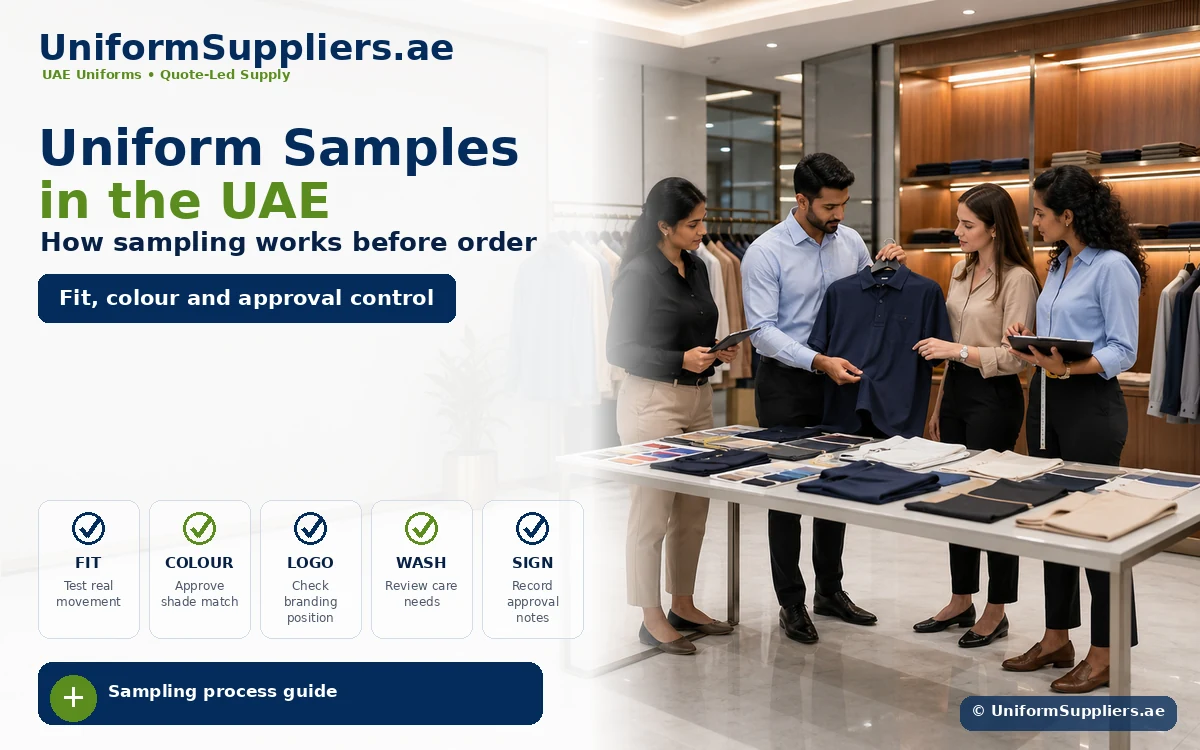
Every uniform order reaches a point where the specification stops being a document and becomes a garment. Sampling is that point, and it is the last stage at which a fabric, a colour, a fit or a logo position can be corrected without the correction costing production time.
Buyers often treat the sample as a formality, approving a photograph or an on-screen mock-up because the schedule is tight. That is usually where wrong-tone brand colours, shrinkage, weak seams and badly placed embroidery are quietly locked into a bulk run.
This guide explains what each type of uniform sample actually proves, how free sampling against a confirmed Local Purchase Order works in the UAE, and exactly what to inspect before signing an approval.
What this guide covers
- Why a physical sample is the only reliable approval
- The six sample types and what each one proves
- How free sampling against an LPO works
- Why colour cannot be approved on a screen
- The sample approval checklist
- The sealed sample and delivery inspection
- Keeping the sample for repeat orders
- Sampling mistakes that cost time
- Request a sample
- Frequently asked questions
Why a physical sample is the only reliable approval
A uniform specification is a list of assumptions until someone holds the garment. A fabric described as 200 GSM pique can feel dense and structured or thin and papery depending on the yarn and the knit, so two suppliers quoting the same specification can deliver noticeably different garments.
The sample converts those assumptions into evidence. It shows how the fabric drapes on a real body, how the collar sits after a wash, whether the sleeve length suits staff who reach and lift all day, and whether the embroidered logo reads clearly from three metres away.
The six sample types and what each one proves
Not every sample answers every question, and asking for the wrong one wastes a round of approvals. The table below sets out the six samples used in most UAE uniform programmes and the limits of each.
| Sample type | What it proves | When to ask for it | What it does not prove |
|---|---|---|---|
| Stock or reference sample | The base garment: cut, fabric quality, build standard and general sizing of an existing ready-stock item | At shortlisting, while you are still comparing suppliers and garment options | Your colour, your branding or any custom change you have requested |
| Fabric swatch card | Hand, weight, weave or knit structure, and the available colour range in the real material | Before the garment is chosen, when fabric is the open question | How the finished garment fits, or how the fabric behaves once cut and stitched |
| Size set or fit sample | How the size chart maps onto your actual team, and whether the grading between sizes works | After the garment is agreed, before onsite measurement or size collection | Final fabric colour or the finished branding quality |
| Pre-production prototype | The full custom garment: pattern, fabric, colour, trims, pockets and construction combined | Once the design and specification are settled and before bulk cutting | Consistency across a full production run, or wash performance over months |
| Branded strike-off | The logo tested on the actual fabric: thread colours, stitch density, print adhesion, hand feel behind the branding | After the digital mock-up is approved and before branding the bulk | Garment fit, since the strike-off may be produced on a fabric panel |
| Sealed production sample | The agreed final standard, signed by both sides and retained as the reference for the run | Immediately before bulk production is released | Nothing further; it is the benchmark everything else is judged against |
Most programmes do not need all six. A ready-stock order with embroidery may need only a reference sample and a strike-off, while a fully custom manufactured uniform moves through swatch, prototype, strike-off and sealed sample in sequence.
How free sampling against an LPO works
UAE procurement runs on the Local Purchase Order, and sampling sits naturally inside that process. Uniform Suppliers UAE provides free uniform samples against a confirmed LPO, which means the sampling stage begins once the order intent is formally recorded rather than while the enquiry is still open-ended.
That sequence protects both sides. The buyer approves physical garments without a separate sampling charge, and the supplier commits pattern-making and branding time to a project that is genuinely proceeding. Before the LPO stage, a free digital logo mock-up lets the branding concept be agreed on paper first.
Practically, the flow is: enquiry and quotation, digital mock-up, confirmed LPO, sample production, physical approval, sealed sample, bulk production, delivery inspection. The uniform ordering checklist sets out the surrounding paperwork in detail, and uniform sampling covers how the stage is run.
Why colour cannot be approved on a screen
Colour is the single most common reason a bulk order is rejected, and screens are the reason. Every monitor and phone renders the same file differently, and no screen reproduces how a dyed polyester knit reflects light compared with a brushed cotton twill. A brand colour that looks correct in a presentation regularly arrives looking flat, warm or grey in fabric.
Fabric also takes dye differently by fibre. The same specified shade lands slightly deeper on cotton than on polyester, which is why a poly-cotton shirt and a polyester cap in one set can look mismatched even when both were produced to the same reference.
Assess colour on the physical sample in two lighting conditions: outdoors in daylight, which is unforgiving in the Gulf, and under the indoor lighting your team actually works in. Showroom, warehouse and hotel lobby lighting are three different environments, and the uniform has to hold up in the one that matters.
The sample approval checklist
Approval is a physical inspection, not a glance. Work through the sample with the checklist below and record the outcome of each point in writing.
- Fabric hand and weight. Handle it, stretch it and hold it to the light. Confirm the GSM stated on the specification and check that the weight suits the role.
- Colour in two lights. Compare the garment with your brand reference outdoors and indoors, and check that every component in the set matches.
- Stitch density and seam finish. Look inside. Seams should be even, with no skipped stitches, puckering or loose thread ends, and stress points such as pocket corners and armholes should be reinforced.
- Shrinkage after one wash. Measure chest, length and sleeve, launder the sample to the intended care instructions, then measure again. Gulf uniforms are washed far more often than office wear elsewhere.
- Branding position measured from a seam. Never approve a logo by eye. Record the distance from the shoulder seam and from the placket or centre line in centimetres, so the same position is repeatable on every size.
- Trim and button quality. Test zips through their full travel, tug buttons, check press studs and confirm that trims are colour-matched rather than merely close.
- Label placement. Confirm size, care and brand labels are where you want them, and that neck labels do not irritate under a collar in summer heat.
- Record and sign. Photograph the sample, note every measurement taken, list any correction required, and have both sides sign and date the approval.
Mustang recommendation: approve the sample with the people who will wear it, not only with the procurement team. A supervisor who spends the shift on their feet finds a restrictive armhole in thirty seconds.
The sealed sample and delivery inspection
Once corrections are agreed, one garment is signed, dated and set aside as the sealed sample. Both parties keep a record of it, and it becomes the reference standard for the entire production run.
Its value shows at delivery. Inspection stops being an argument about whether a shade looks right and becomes a direct comparison: garment against sealed sample, measurement against recorded measurement, logo position against the noted distance from the seam. Anything outside tolerance is identifiable immediately, with evidence. That protects the supplier as much as the buyer.
Keeping the sample for repeat orders
Uniform programmes are rarely one-off. New staff join, garments wear out, and a replenishment order lands twelve months later when nobody involved in the original approval can remember the thread codes. A retained sample solves that. Combined with stored repeat-order specification records — fabric, colour reference, size grading, branding positions and trim details — a repeat order can be matched to the original rather than re-approved from scratch, so new joiners receive garments identical to those their colleagues already wear.
Keep your own copy somewhere findable, ideally with the signed approval sheet and the size records from your measurement exercise in the same file.
Sampling mistakes that cost time
The most expensive mistake is approving a sample that is not the garment you ordered. A reference sample in a different colour, or a strike-off on a different fabric, cannot be treated as a final approval, however similar it looks.
The second is skipping the wash test, because colour bleed, shrinkage and pilling appear after laundering rather than before.
The third is approving verbally. A correction agreed in a meeting and never written onto the approval sheet will not reliably reach the production floor. The ten questions to ask a uniform supplier covers the rest of the vetting conversation, and the custom manufacturing guide explains where sampling sits in the wider production timeline.
Request a sample
If your specification is settled, send the garment type, fabric preference, colours, indicative quantities by size and your logo file for a free digital mock-up.
Request a sample from Uniform Suppliers UAE, part of Mustang Advertising Trading LLC in Dubai, operating since October 2007. To price the programme first, request a quote and sampling can follow the confirmed order.
Frequently asked questions
Are uniform samples free in the UAE?
Uniform Suppliers UAE provides free uniform samples against a confirmed Local Purchase Order, so sampling runs once the order is formally recorded rather than during an open enquiry. Before that point, a free digital logo mock-up lets you approve the branding concept on paper. Sample scope for a specific programme will be confirmed during quotation.
What is the difference between a prototype and a sealed sample?
A pre-production prototype is the first full attempt at your custom garment and is expected to need corrections. A sealed sample is the version everyone has agreed on: signed, dated and retained as the reference standard for the production run and for delivery inspection. A prototype invites comment, while a sealed sample closes the specification.
Should the sample be washed before approval?
Yes. Measure the garment, launder it to the care instructions staff will follow, then measure again and inspect for colour bleed, pilling, seam movement and branding damage. Gulf uniforms are washed far more often than typical office clothing, so first-wash behaviour indicates how the garment will look after a season.
What should be recorded on the approval sheet?
Record the garment and fabric reference, colour reference, all key measurements before and after washing, branding positions measured from a named seam, trim and label details, any corrections required, and the names, signatures and date of both parties. Photographs of the approved sample should be attached to the same record.
How does a sample help a repeat order a year later?
The retained sample and the stored specification record together remove the guesswork. Instead of re-selecting fabric and re-approving branding, the repeat order is matched against the original standard, so new joiners receive garments consistent with what the team already wears. Ask that your specification records are kept on file when the first order is placed.