Special offers: free digital logo mock-up and free samples against a confirmed LPO. View offers
High-Quality Corporate Shirts: What to Look For

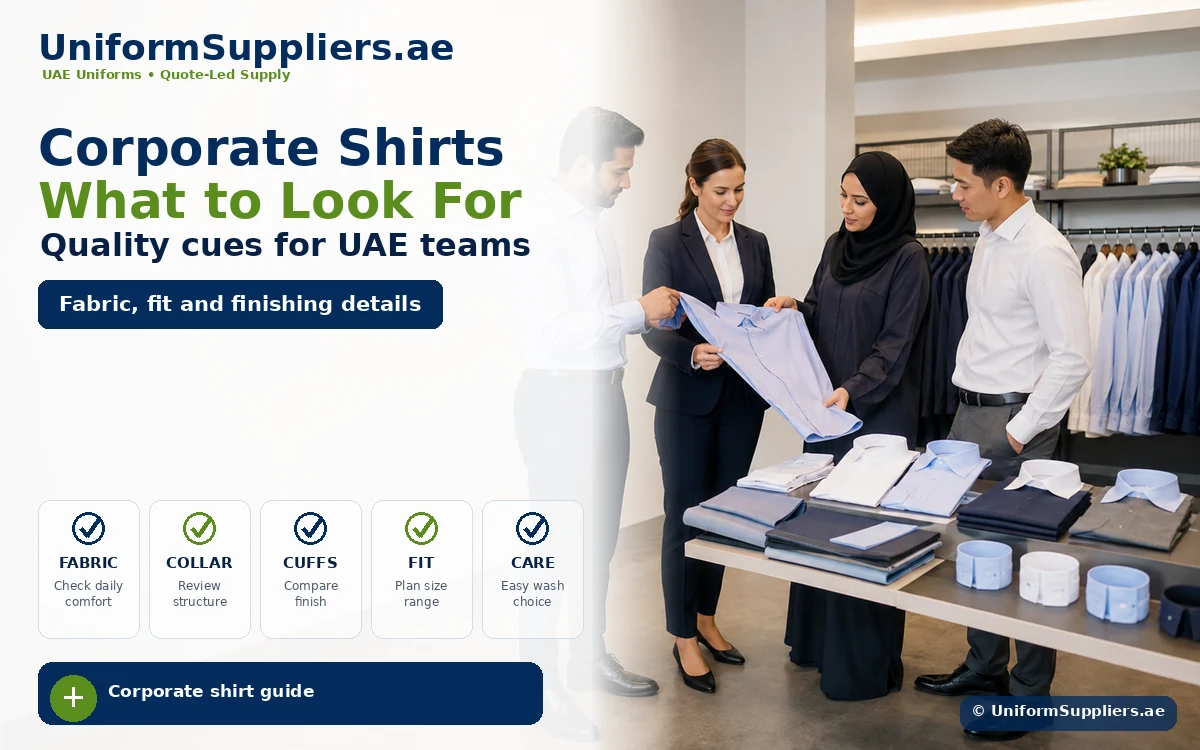
A corporate shirt is worn more often, and scrutinised more closely, than almost any other piece of business uniform. It is the first thing a client sees across a meeting table, it is laundered weekly if not more, and a poorly specified shirt shows its age — collar curl, thinning fabric, dulled colour — long before the rest of a corporate wardrobe does.
This guide focuses specifically on formal, button-front corporate shirts and blouses — not the more casual polo shirt, which we cover separately in polo shirts for business. Here we look at fabric, construction, fit and branding placement specific to a shirt worn all day, every working day, in UAE conditions.
What this guide covers
- Fabric weave and weight for UAE office wear
- Construction quality: collar, cuffs and seams
- Easy-care and wrinkle-resistant finishes
- Fit through the shoulders and body
- Colour-fastness under frequent laundering
- Branding placement on a corporate shirt
- Blouses and gender-inclusive fit options
- Storing sizes for faster reordering
- Quality checklist before you order
- Frequently asked questions
Fabric weave and weight for UAE office wear
A shirt worn indoors in air-conditioned offices, but often carried outside briefly between meetings, a car park or a client site visit, needs a fabric that copes with that swing rather than one built for a single climate. A mid-weight cotton or cotton-blend poplin or twill weave generally strikes the right balance — crisp enough to hold a professional appearance, breathable enough not to feel stifling indoors.
Very lightweight shirting fabric can look slightly sheer or lose its crisp appearance quickly, while a heavier weave associated with cooler-climate business shirting can feel uncomfortably warm across a full UAE working day. Final fabric weight and composition are confirmed during quotation to match your team’s specific working environment.
Construction quality: collar, cuffs and seams
Collar and cuff construction is where a corporate shirt shows quality — or the lack of it — fastest. A properly interfaced collar holds its shape through a full day and repeated laundering, rather than curling or going soft after a few wash cycles. Reinforced button attachment, particularly at stress points like the collar button and cuff, reduces one of the most common and irritating shirt failures: a popped button mid-shift.
Side seams and the yoke (the panel across the upper back and shoulders) should sit flat without puckering, which is as much a sign of good pattern-cutting as fabric quality. A shirt that looks slightly off at the shoulders on the hanger will look worse once worn and moving through a working day.
Easy-care and wrinkle-resistant finishes
An easy-care or wrinkle-resistant finish is worth specifying for any team laundering shirts frequently, particularly where staff wash and press their own shirts rather than sending them to a central laundry. A good easy-care finish reduces visible creasing after a normal wash and short air-dry, without the shirt losing crispness by the end of the working day.
This is a genuinely useful, practical specification rather than a marketing add-on — it reduces the time staff spend ironing and helps shirts look presentable for longer between washes, a real consideration in a climate where a shirt may be worn and laundered several times a week.
Fit through the shoulders and body
Fit matters more on a fitted, formal garment like a corporate shirt than it does on a looser, more forgiving polo or t-shirt. A shirt that is correctly sized through the shoulders and chest but consistently applied across a team looks considerably more professional than a generic size run where fit varies noticeably from person to person.
Free onsite individual measurement is available in the UAE for qualifying company uniform orders, which is particularly valuable for a fitted garment like a corporate shirt, where a size chart alone often does not capture the range of body shapes across a real team as well as individual measurement does.
Colour-fastness under frequent laundering
Corporate shirts, particularly in darker or saturated colours, are laundered often enough that colour-fastness genuinely affects how a uniform looks after a few months in service. A shirt that fades unevenly — often fastest at the collar and cuffs, where friction and sweat concentrate — starts to look mismatched against newer stock even while the fabric itself is still structurally fine.
Requesting a sample and checking it after a hot wash cycle, before committing to a full order, is a straightforward way to check colour stability against your team’s actual laundering method rather than relying on a description alone.
Branding placement on a corporate shirt
Embroidery is the standard branding method for corporate shirts, chosen for its clean, professional appearance rather than the bolder look of printing, which suits more casual garments better. Placement is usually the left chest for a discreet, standard corporate look, though some organisations choose a cuff placement for a more understated mark, particularly on client-facing roles where subtlety is preferred.
A free digital logo mock-up before production lets you check how embroidery placement and stitch density will look on the actual shirt fabric and colour, rather than judging from a flat logo file alone — worth doing before committing to a full run, particularly for a fine or detailed logo.
Thread colour matching is a smaller but genuinely important detail — a logo embroidered in a thread colour that is slightly off from your brand’s exact tone reads as a mismatch on a formal shirt in a way it might not on a more casual, textured garment. Confirm thread colour against a physical brand reference rather than a screen colour alone where the exact shade matters.
Blouses and gender-inclusive fit options
Everything above applies equally to women’s corporate blouses, though the pattern and cut differ meaningfully from a men’s shirt — dart placement, sleeve cut and collar style all need their own fit block rather than a scaled-down version of the men’s pattern. A supplier offering genuine women’s-specific patterns, not a unisex shirt in a smaller size, produces a noticeably better fit through the bust and waist.
Where a team includes staff who prefer a straighter, less fitted cut regardless of gender, it is worth asking your supplier whether a third, more relaxed fit block is available alongside the standard men’s and women’s options, rather than assuming everyone will be comfortable in one of two fixed cuts.
Storing sizes for faster reordering
Corporate shirts are one of the more frequently reordered uniform items, given normal wear, staff turnover and the higher laundering frequency compared with an outer layer like a blazer. Keeping individual sizing on file as a stored repeat-order record means a replacement shirt or a new-hire order can be placed by simply confirming quantity and size, without re-measuring or re-approving fabric and branding each time.
This is particularly useful for corporate shirts specifically, since they tend to need replacing more often than jackets or trousers in the same uniform programme, and a slow reorder process becomes a repeated friction point if sizing has to be reconfirmed from scratch every time.
Quality checklist before you order
| Check | What to look for |
|---|---|
| Fabric weave | Mid-weight poplin or twill suited to AC-to-heat transitions |
| Collar and cuffs | Properly interfaced, holds shape after laundering |
| Button attachment | Reinforced at collar and cuff stress points |
| Seams | Flat, no puckering at the yoke or side seams |
| Finish | Easy-care/wrinkle-resistant if self-laundered frequently |
| Fit | Individually measured or a size chart that reflects your team’s range |
| Colour | Sample checked after a hot wash before bulk order |
Mustang recommendation: request a sample shirt and run it through your team’s actual laundering method — hot wash, tumble dry if used — before committing to a full order, since this is the most reliable way to check fabric, colour and easy-care performance together.
Frequently asked questions
What fabric is best for corporate shirts in the UAE?
A mid-weight cotton or cotton-blend poplin or twill generally balances a crisp professional appearance with breathability for AC-to-heat transitions better than very lightweight or very heavy shirting fabric.
How do we know if collar construction is good quality?
A properly interfaced collar holds its shape through a full day and repeated laundering without curling or going soft. Requesting a sample and checking it after a few wash cycles is the most reliable way to judge this before a bulk order.
Is an easy-care finish worth the extra cost?
For teams laundering shirts frequently, particularly where staff self-launder rather than using a central laundry, an easy-care finish genuinely reduces ironing time and helps shirts look presentable for longer between washes.
Should corporate shirts be individually measured?
It is worth it for a fitted, formal garment like a shirt, where fit variation across a team is more visible than on a looser garment. Free onsite individual measurement is available in the UAE for qualifying company orders.
Where should a logo go on a corporate shirt?
Left chest embroidery is the standard, discreet corporate placement. A cuff placement is a more understated alternative, sometimes preferred for client-facing roles.
How do we compare corporate shirts to the more casual polo shirt option?
See our separate guide on polo shirts for business, which covers the more casual alternative — many corporate uniform programmes use both, formal shirts for client-facing days and polos for a more relaxed daily standard.
Are women’s blouses fitted differently from men’s shirts?
Yes, a genuine women’s-specific pattern accounts for dart placement, sleeve cut and collar style rather than simply scaling down a men’s shirt pattern, and generally produces a noticeably better fit through the bust and waist.
How often do corporate shirts typically need replacing?
More often than heavier outer garments like blazers, given higher laundering frequency and everyday wear at the collar and cuffs. Checking for thinning fabric, collar curl or persistent staining is a more reliable guide than a fixed replacement schedule.
Ready to specify corporate shirts for your team? Request a quote from Uniform Suppliers UAE.